The platform selling the ads also graded whether they worked
A case study says the campaign lifted ad recall by a stated number of points. The source line, in small type, credits the platform’s own brand lift tool. Before that number goes into a comparison sheet, it is worth asking a question the case study will not answer on its own: who ran this test?
The referee also sold the game
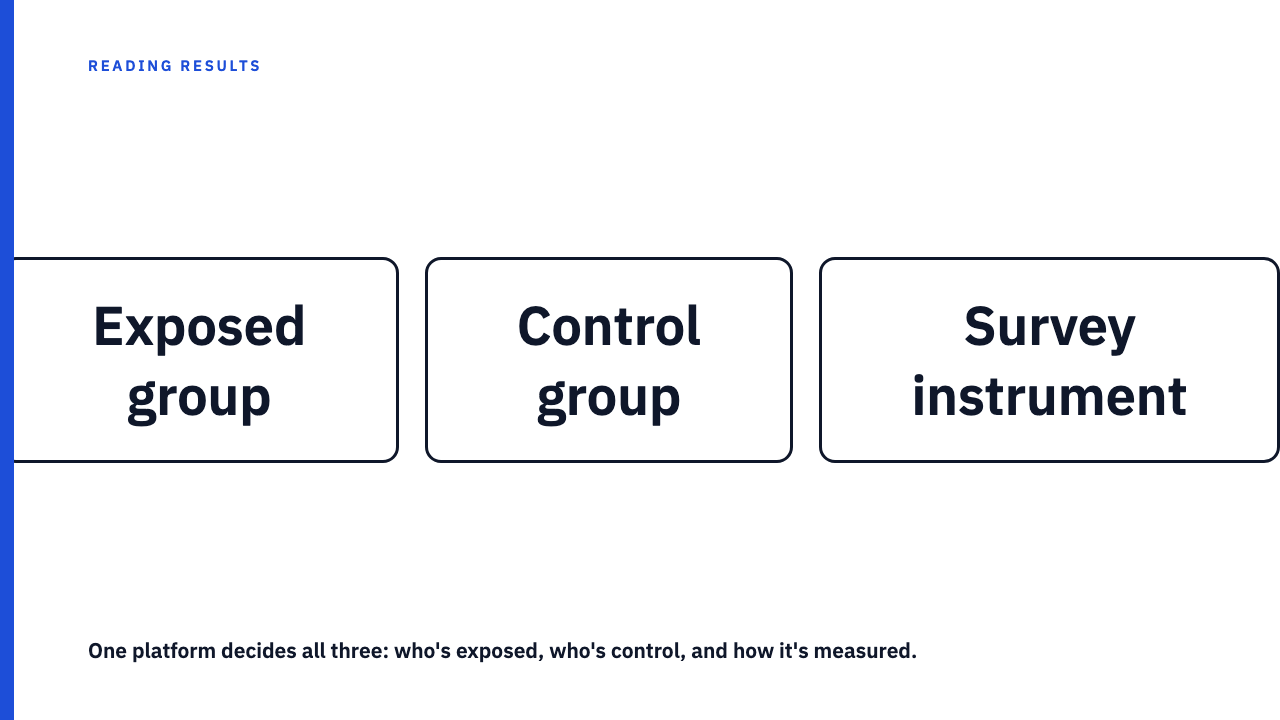
A platform’s in-app brand lift tool controls three things at once: who counts as the exposed group, who counts as the control group, and the survey instrument that measures the outcome. The same commercial party that sold the media also defines the experiment and grades the result.
That is a structural conflict of interest, not an accusation that any specific result was manufactured or falsified. A platform can run its survey in good faith every time and the conflict still exists, the way an exam grader who wrote the questions has a conflict even when grading honestly. The issue is not proof of wrongdoing. It is that the reader has no way to check.
What a platform brand lift survey actually measures
The exposed group is built entirely from the platform’s own ad delivery logs: whoever the system recorded as served the ad becomes the exposed cohort, with no outside source cross-checking that record.
The control, sometimes called a holdout, is drawn from inside the same platform’s user base, often by serving a public service ad to a comparison slice, or by splitting the eligible audience internally. The platform chooses that split’s size and construction; the advertiser rarely inspects it beforehand.
The survey itself, the recall or awareness questions shown as a native poll, is written, hosted, and tabulated by the platform, not commissioned from an outside panel provider on the advertiser’s behalf.
Why the same entity measuring and selling matters
None of this requires bad faith to matter. It matters because of what is at stake on one side and absent on the other:
- The platform has a continuing commercial interest in the advertiser renewing or expanding spend, and a favorable lift number makes that renewal easy to justify.
- The platform can reuse a strong result in its own sales materials, a related but separate failure mode: citing this kind of survey sits one step removed from a platform publishing its own success story.
- There is no outside auditor. Nobody outside the platform can inspect how the groups were assigned or verify the survey sample.
A measurement built this way can be entirely accurate and still be structurally one-sided, because the reader has no independent point of entry into the process that produced it.
A hypothetical brand lift number, read two ways
The following is entirely hypothetical, built to illustrate a mechanism, and must not be mistaken for a real reported result. No real agency, platform, or client is described here.
Picture a hypothetical agency’s case study: “Our client’s campaign drove a 9 point increase in ad recall, measured through the platform’s in-app brand lift survey, against an internally selected control group.” Read alone, that sounds like a clean, quantified win.
Now change one fact. Suppose the same hypothetical 9 point figure instead came from a third-party research firm that recruited its own panel, disclosed its sample size, and published how it assigned people to exposed and control conditions before the campaign ran. The number has not changed. What changed is who could have shaped the split and who defined “exposed” in the first place.
The hypothetical lift number is identical in both versions. The evidentiary weight is not, and that gap is what a reader needs to price in before treating either figure as settled.
What independent measurement looks like instead
An independent test has a checkable shape. The control group’s assignment is not controlled by the party selling the media, the methodology (sample size, assignment rule, timing) is published somewhere a third party can read, and because it is disclosed, an outside party could in principle audit it.
It is also worth separating two things often talked about as one. A brand lift survey asks what people remember or believe, a self-reported measure. An incrementality or holdout test measures what people actually did, such as purchases, against a real control group that never saw the ad. These answer different questions.
Questions to ask before you accept the lift number
Before weighing a brand lift figure in any case study, ask:
- Who administered the survey: the platform that sold the media, or a third-party research firm with no stake in renewal?
- Who defined the exposed and control groups, and is that definition disclosed anywhere in the case study?
- Is the sample size for the survey disclosed at all?
- Is the lift compared against an independently measured baseline, or against the platform’s own historical benchmark?
So is a platform-administered number worthless?
No. A platform-run brand lift survey is not proof the ad failed, and dismissing it outright is its own kind of sloppy reading, aimed the opposite direction from the case study’s overconfidence. It is evidence of a lower-independence kind, one you weight rather than discard, much like a reference letter written by the applicant’s own manager: informative, not disqualifying.
It is worth restating the boundary, since it is easy to drift past it. This piece is about weighing one measurement instrument inside somebody else’s case study, not a verdict on whether to advertise on any platform or how to vet it as a vendor. The question is what a self-reported recall number is entitled to claim, and what to ask before letting it claim more.
Before you go
This conflict is one entry in a longer pattern worth checking before trusting a headline figure. See two measurement tools disagreeing on the same case study, the broader framework for a number that can’t be independently checked, and the foundational guide to reading a case study without being misled. You can also browse the case study library or submit your own.
FAQ
Does a platform-administered brand lift survey mean the ad didn’t actually work?
No. A conflicted measurer is not proof of a false result. It is a reason to treat the number as self-reported rather than independently audited, and to look for corroborating evidence before treating the figure as settled.
What’s the difference between a brand lift survey and an incrementality test?
A brand lift survey asks exposed and unexposed people awareness or recall questions, a self-reported signal. An incrementality test measures actual behavior, such as purchases, between a real holdout group and an exposed group, and is generally the stronger evidentiary standard because it does not depend on what people say they remember.
—LEDGER—
{“verified”: [
{“claim”: “Internal link target exists and resolves: platform-published-success-story-incentive”, “url”: “https://socialcasestudies.com/blog/platform-published-success-story-incentive/”, “status”: 200, “checked”: “2026-09-26”},
{“claim”: “Internal link target exists and resolves: platform-vs-third-party-number-mismatch”, “url”: “https://socialcasestudies.com/blog/platform-vs-third-party-number-mismatch/”, “status”: 200, “checked”: “2026-09-26”},
{“claim”: “Internal link target exists and resolves: self-reported-vs-verifiable-numbers”, “url”: “https://socialcasestudies.com/blog/self-reported-vs-verifiable-numbers/”, “status”: 200, “checked”: “2026-09-26”},
{“claim”: “Internal link target exists and resolves: how-to-read-a-case-study”, “url”: “https://socialcasestudies.com/blog/how-to-read-a-case-study/”, “status”: 200, “checked”: “2026-09-26”},
{“claim”: “CTA link resolves: case study library index”, “url”: “https://socialcasestudies.com/blog/case-studies/”, “status”: 200, “checked”: “2026-09-26”},
{“claim”: “CTA link resolves: submit your own case study page”, “url”: “https://socialcasestudies.com/submit-your-case-study/”, “status”: 200, “checked”: “2026-09-26”}
],
“evidence_gaps”: [“Could not locate a live, readable, platform-published documentation page (Google Ads/YouTube Brand Lift help, Meta Business Help Center, TikTok for Business help) confirming in writing that the platform itself defines the exposed and control/holdout groups for its in-app brand lift product. Multiple candidate URLs were tried by curl and returned 404 or redirected to unrelated generic landing pages; Meta and TikTok help-center URLs are documented elsewhere as returning an unreadable error page or a client-rendered empty shell. The mechanics described in the post are therefore framed as a structural description of how a platform-administered, in-house survey tool must be built (the seller necessarily controls its own ad-delivery logs and its own in-app survey instrument), not as a quote or paraphrase attributed to any specific platform’s documentation.”, “Could not verify a specific, readable, independent source (a named research firm’s or standards body’s published methodology) describing how a third-party incrementality test is structured, beyond the general, unattributed description given in the post. The Media Rating Council’s homepage (mediaratingcouncil.org) was confirmed readable and describes MRC’s general role auditing media measurement, but contained no specific language about brand lift or holdout-group methodology, so it was not cited.”],
“word_count”: 1111}