The Same Client Win Can Appear as Three Separate Case Studies
You have three case studies open and they all point the same way. Then you notice that two cover the same quarter, and the number in the third is the first one’s number in a different shape. Three proofs may be one. Count the engagements, not the write-ups.
The same win, wearing three name tags
One client engagement can legitimately appear in three places: the agency’s own case study page, an awards entry, and a directory or aggregator profile. Each has its own reason to restate the result, and none has any obligation to point at the other two. So the recurrence goes undisclosed, which is not the same as concealed.
Start with how to read a marketing case study without being misled if the general method is new. This is a narrower problem inside it.
Why it doesn’t look like a repeat
The first disguise is the shape of the number. One underlying change can be a percentage lift in one version, a multiplier in another, a raw count in a third. All three can be arithmetically correct, and none looks like the others.
The second is naming. The campaign might carry its internal project name on the agency site, a category-friendly title in the awards entry, and a plain description in the directory listing. Add a phase label, “phase two” or “the relaunch,” and it reads as a separate chapter of work.
The third is client identity. The client is named on the agency’s site because the client approved that, and becomes “a mid-market homeware retailer” in the directory profile because a different approval was never sought. None of this requires altering a fact. These are editorial choices about one set of true things.
A hypothetical worked example
The following is invented for illustration. No real agency, client or number appears here, and none of it is a reported result.
Imagine an engagement between Agency B and Client A, running March to June on one video-first platform, built around a creator-led series filmed in the client’s warehouse. Newsletter signups move from 4,000 to 10,000. Written up three times:
- Agency site: “Client A: a 150% lift in signups from a creator-led series.”
- Awards entry: “The Warehouse Sessions, phase two. Signups 2.5x over a single spring campaign window.”
- Directory listing: “Drove 6,000 additional newsletter signups for a mid-market homeware retailer through short-form video.”
Three framings, one movement from 4,000 to 10,000. What gives it away is what nobody thought to vary: the same March to June window, the same platform, the same warehouse series.
Checklist: one engagement or three?
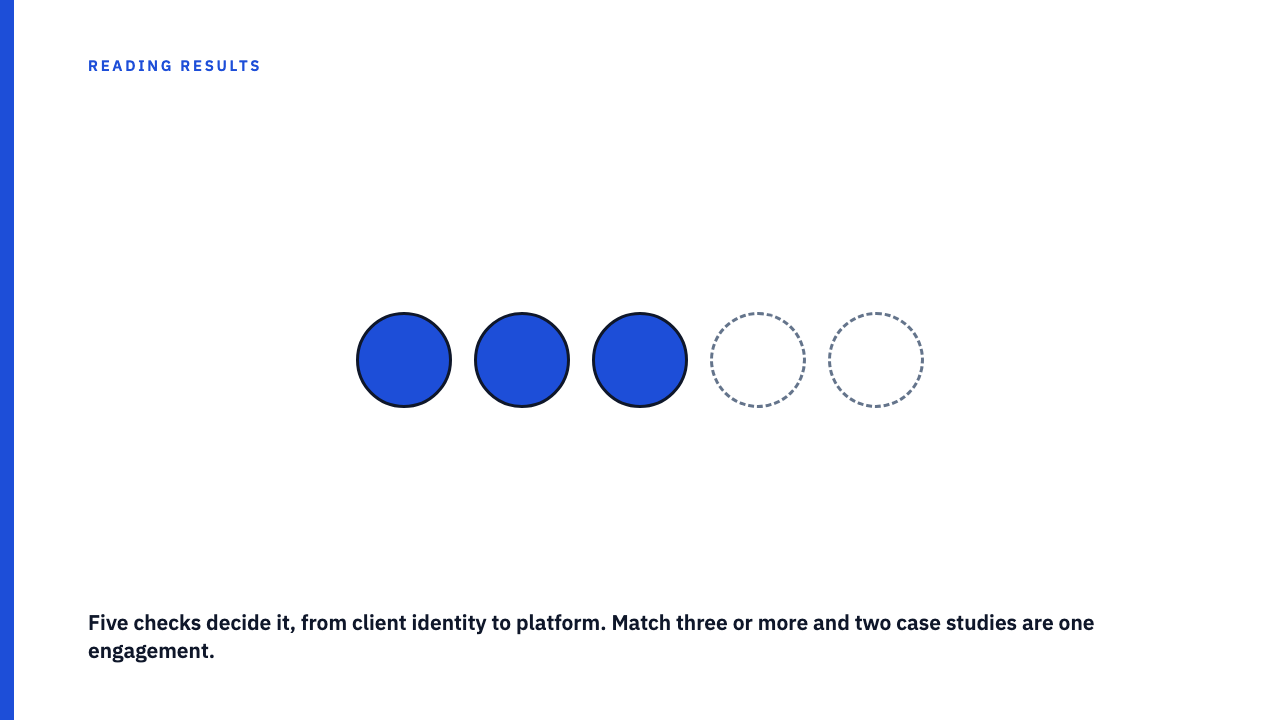
Run two similar-looking case studies against these five. Three matches or more and it is almost certainly one engagement.
- Client identity. The same client, or an anonymized description that fits the named one on industry, size and region.
- Date range. The same window, or two that overlap enough for the same weeks to do the work in both.
- Base metric. The same quantity under a different label. Convert the percentage, the multiplier and the raw total into each other and see if they land on one figure.
- Distinctive detail. A reused creative asset, a project name, an unusual format.
- Platform and channel. The same platform, and the same channel within it, paid or organic.
Why agencies repost their best result
A standout result is scarce, and different formats reward different placements. Restating a true result truthfully in three places is normal publishing. Treating each restatement as independent proof is a reading error, and that error is yours.
Directory profiles deserve caution, because they can be built from what the listed party supplied. Awwwards, for one, sells submissions per website and lists a directory listing and a self-created professional profile among its paid plan benefits. A profile the subject wrote and paid to place is not a second party checking the first party’s number. Awards entries work the same way on the input side: the Shorty Impact Awards rules require a written case study covering objective, strategy and implementation, and results, and allow one project into multiple categories. Check whose words you are reading before counting a listing as corroboration. It is the venue-level version of a case study number is only as good as what backs it up.
Not the same problem as a thin library
| Selection bias | Double counting | |
|---|---|---|
| What goes wrong | Only wins get published | One published engagement gets tallied twice |
| When | Before publication | After publication, in your counting |
| Visibility | Invisible, the unpublished leaves no trace | Visible on the page |
| The fix | Discount the sample, ask what is missing | Merge duplicates, then count |
You can have both at once. A case study library is a selected sample to begin with, and some entries in it are one engagement under different name tags. Fixing one does nothing for the other.
Before you count, collapse
When listings match, merge them into one entry in whatever tally you are building, and note the merge rather than quietly dropping two of the three.
A single strong engagement, presented honestly, is still evidence. The problem was never the result, nor that it got published three times. It is the arithmetic afterwards, when three listings quietly become three wins.
Read more with this in hand
Browse the case study library, each entry credited to the agency behind it, or submit your own.
FAQ
Is it dishonest for an agency to reuse the same result across its own site, an awards entry, and a directory listing?
On its own, no. Publishing one true result in three formats is standard practice. The error appears at your end, if you count three appearances as three proofs rather than one engagement described three ways.
What if the client is anonymized in one version of the case study but named in another?
Anonymization does not break the match, it moves the work. An anonymized “regional healthcare provider” sharing a quarter, a channel and an unusual creative format with a named client on the agency’s site is almost certainly that client. Treat the pair as one engagement until something contradicts that.
Does this mean case study libraries overstate what an agency has actually done?
Only if you tally recurring engagements as separate wins. Collapse matching listings into one entry before judging how broad a track record is, rather than assuming every library is padded.
Sources
- Shorty Impact Awards, official rules, fetched 7 September 2026.
- Awwwards, submit your website, fetched 7 September 2026.