‘150 Percent of Goal’ Tells You Nothing About the Goal
A case study leads with “exceeded goal by 150 percent,” and the number sounds decisive. It is not. A percent of goal figure only tells you the relationship between a result and a target, and before you can trust what it implies about performance, you need to know what the target was and who chose it.
The percentage is doing a job the absolute number can’t
Strip the framing down and a percent of goal claim is a ratio: the result divided by the target, multiplied by a hundred. The result is a fact. The target is not. Someone picked that number, before the campaign ran, using a method the case study almost never describes. A ratio built on a fact and a choice is not a fact itself, even when reported with a fact’s confidence.
That structure is convenient two ways. A modest absolute result can sound dramatic simply by pairing it with a small enough target. And a percentage never has to disclose the number underneath it. “150 percent of goal” can be true of a campaign that brought in twelve sign ups or twelve thousand. The reader who does not ask has no way to tell which one they are looking at.
Who sets the goal, and what they are trying to do when they set it
The plain incentive is not complicated. Whoever sets their own bar for success has a reason to set it somewhere they can clear, the same reason grading your own homework tends to produce different results than someone else grading it. Nobody has to be acting in bad faith for this to matter. A target is easier to hit when the person setting it also benefits from hitting it, and a case study that reports the outcome against that target without saying who chose it is asking you to trust a number whose origin you cannot see.
That is not the same as saying targets are routinely set low on purpose. A conservative goal has legitimate reasons behind it too: a new channel with no track record, an unfamiliar platform, an audience never tested before. In each case a cautious target is sound planning, not a setup for an easy win. A low goal is not proof of anything by itself. It is a reason to ask how it was arrived at, not to assume the answer.
A hypothetical worked example: same result, two goals
Here is a fictional illustration, with round numbers chosen only to make the mechanism visible. No campaign, agency, or client behind these figures exists.
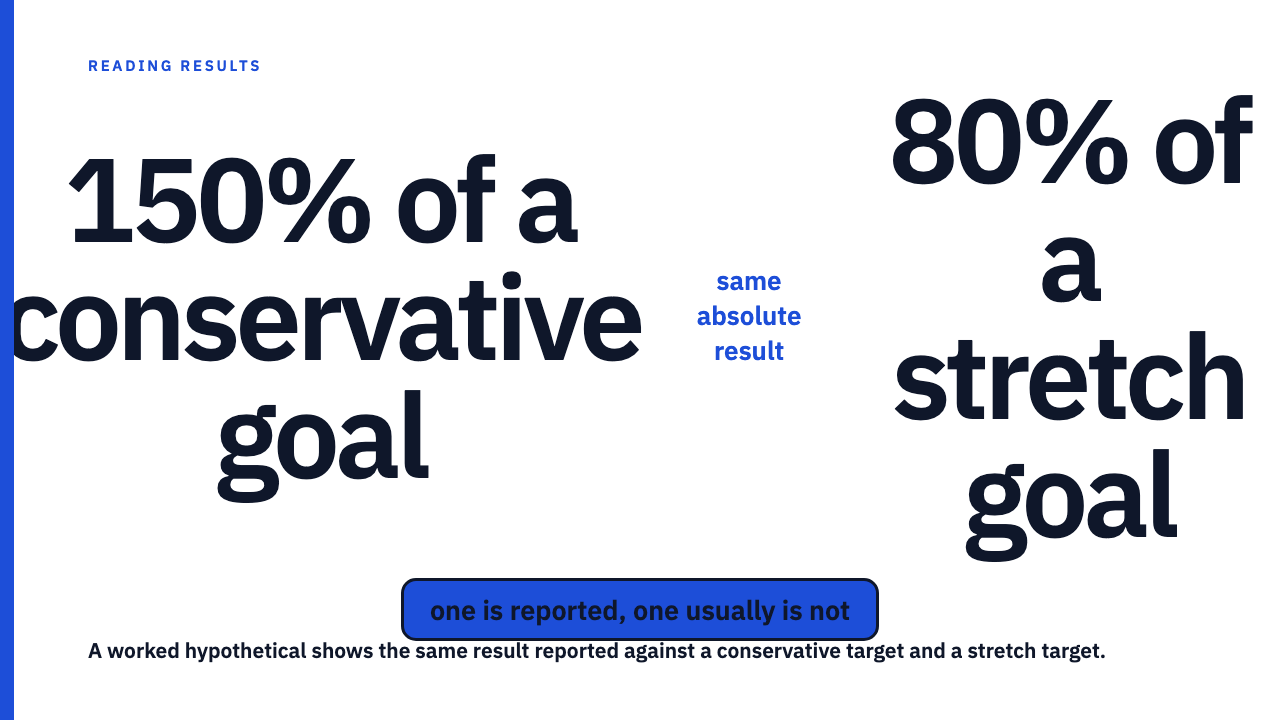
Picture a campaign that produces exactly 4,200 sign ups, a hypothetical figure, reported two ways depending only on the target set beforehand.
| Goal set before the campaign (hypothetical) | Actual result (hypothetical) | Reported as |
|---|---|---|
| 2,800 sign ups (conservative) | 4,200 sign ups | 150 percent of goal |
| 5,200 sign ups (stretch) | 4,200 sign ups | roughly 80 percent of goal |
The campaign did exactly one thing: it produced 4,200 sign ups, once. Nothing about the work changed between the two rows. What changed is the number written down before the campaign started, and that earlier choice decides whether the headline reads as a triumph or a shortfall. A reader who sees only “150 percent of goal,” and a reader who sees only “roughly 80 percent of goal,” would form opposite impressions of the same 4,200, and neither would be entitled to any conclusion without seeing the number the goal was measured against.
What a case study would have to show for the goal to mean anything
A percent of goal figure becomes checkable, rather than a number you either trust or don’t, once the case study discloses:
- The absolute result the goal represents, not the multiple, so the percentage can be recalculated rather than taken on faith.
- When the goal was set relative to the campaign’s start. A target set before planning began carries different weight than one written after early results were already visible.
- Who set the goal, and whether that party also benefits from the campaign being seen as a success.
- Whether a comparable campaign’s historical performance informed the target, or the number was picked with no prior data behind it.
This is distinct from goal metric mismatch, a separate failure mode already covered on this site: whether the reported metric is even the one the campaign was hired to move. That is about which number got measured. This is about whether the target set for that number was set at a level that made beating it meaningful.
The version of this claim worth trusting
None of this makes a percent of goal figure inherently dishonest. The reassuring version states the absolute result plainly, states what the goal was and roughly when it was set, and only then adds the percentage, usually as a footnote rather than the headline.
The tell is not the size of the multiple. It is whether the case study lets you see the goal and the number underneath it, or asks you to accept the ratio on faith while the two figures that produced it stay out of view. A percentage offered alongside its inputs is a summary. A percentage offered instead of its inputs is a request to stop asking questions right where they get interesting.
Read the next claim the same way
The habit here applies beyond percent of goal claims. 100 percent better and one point better can be the same result covers a related case where the percentage itself is ambiguous. When a favorable number is chosen over others on the same dashboard, see why the best metric on a dashboard is rarely the real story. And a figure that impresses mainly because of what kind of metric it is falls under when the headline number is a vanity metric. For the broader discipline, start with how to read a marketing case study without being misled. Browse the case study library, or submit your own.
FAQ
Does a low goal always mean the case study is being dishonest?
No. A conservative goal can be legitimate, for example on a new channel with no track record. The tell is not the size of the goal but whether the case study discloses the absolute result and how the goal was set, so you can judge it yourself instead of taking the percentage on faith.
What should I look for instead of the percent of goal number?
Look for the absolute result, when the goal was set relative to the campaign, and who set it. If those details are missing, treat the percentage as unverifiable rather than as evidence of a strong result either way.