100 Percent Better and One Point Better Can Be the Same Result
A case study says engagement improved by 100 percent, and you cannot tell whether that is a transformation or a rounding error. The number is probably accurate. What is missing is what it is a percentage of, and without that the claim has a size you cannot see.
The same movement, described two ways, both true
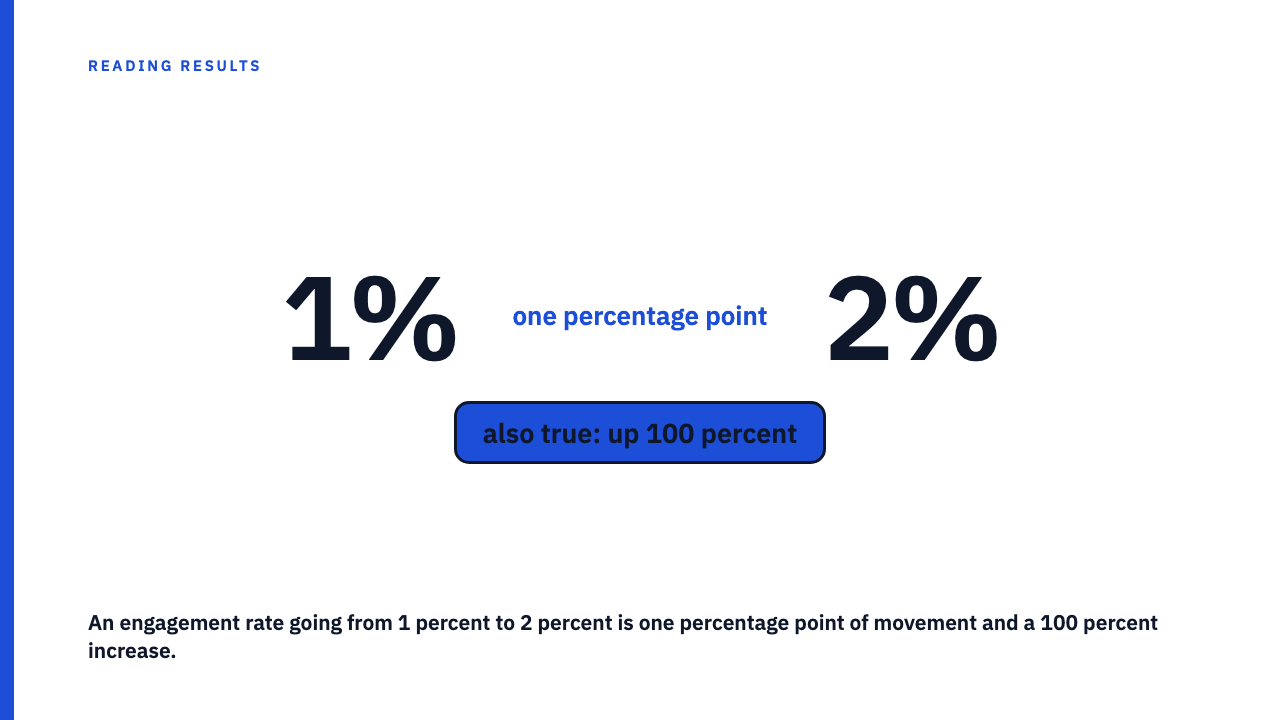
Take a hypothetical engagement rate moving from 1 percent to 2 percent. That is a 100 percent increase, since the ending value is twice the starting value. It is also a one percentage point increase, since the difference between the two percentages is one point. Both are correct.
What separates them is the unit, not the honesty. Relative change is a percentage of the old value. Absolute change is in percentage points, the unit for comparing percentages directly. The relative version is the bigger number, so it reaches the title and you react before any arithmetic.
The arithmetic, once, so you can do it in your head
Relative change is the point movement divided by the starting value, read as a percentage. Point movement is that same change times the starting value.
Hypothetically: a rate moves from 4 percent to 5 percent, so 1 point, and 1 divided by 4 is 0.25, a 25 percent increase. Backwards: a claimed 40 percent improvement on a 2.5 percent conversion rate is 0.40 times 2.5, or 1.0 point, so 2.5 percent became 3.5 percent. Both directions need the starting value, so a relative claim with no base cannot be converted.
Why a small base makes any improvement look enormous
Two hypothetical one point movements show it. A rate from 1 percent to 2 percent reads as a 100 percent increase. From 10 percent to 11 percent, the same point reads as 10 percent. Smaller base, sharper effect: a hypothetical click rate from 0.2 percent to 0.4 percent is still 100 percent, and the movement is two tenths of a point.
So the lower the starting rate, the more the relative framing exaggerates a fixed point movement. Nobody has to lie for it to work, which makes it the cheapest inflation there is: no cherry-picked window, no changed definition, just the flattering unit.
Three claims, converted
Every figure below is invented for illustration, not a result reported by anyone.
| Hypothetical metric | Start | End | How it gets phrased | Movement |
|---|---|---|---|---|
| Engagement rate | 0.8% | 1.2% | “lifted engagement by 50 percent” | 0.4 points |
| Conversion rate | 1.5% | 1.8% | “a 20 percent uplift in conversion” | 0.3 points |
| Click-through rate | 2.0% | 6.0% | “tripled click-through, up 200 percent” | 4.0 points |
Note the third row: four points from a 2 percent base is a large change, and the 200 percent headline is fair. Nor are the smaller rows condemned by their size, since whether four tenths of a point matters depends on the volume underneath it.
When the relative number is the only sensible unit
Points exist only for a rate or a share, something measured against a denominator. Engagement, conversion and click-through rates have one. Revenue, sessions, leads and cost per result are not percentages of anything, so asking for points on revenue is a category error. The check for a count is the absolute starting number, because a hypothetical 300 percent increase in leads behaves the same way when the base was four a month. So: rate or count first, then ask for the base in the unit that fits.
The questions that convert a percentage into a fact
- What was the value before, in the same unit as the value after?
- Is this metric a rate, a share, or a count?
- Which denominator does the rate use, since two rates with the same name can be computed differently?
- Over what period was each value measured, and were both windows the same length?
- Is the movement stated in points anywhere, or only in relative terms?
The first question does most of the work.
What to do when the base is withheld
Often the starting value is not there. A relative claim with no base is not a small result and not a large one. It is uninterpretable, and belongs in the unknown file rather than the bad one. The one inference available is that the framing was chosen by someone holding both numbers.
So ask: “Could you tell me the starting and ending rates behind that percentage improvement, so I can see the movement in percentage points?” That check sits inside the wider method for how to read a case study without being misled, and every published library is a selected sample. A claim that survives conversion into points is stronger for it, not weaker.
Try it on a real document
The library holds 10 published case studies, and every number in them belongs to the agency that reported it. Browse the case study library and convert the first percentage you meet, or submit your own.
FAQ
Is a 100 percent increase the same as a one percentage point increase?
Only when the starting rate was 1 percent. The point movement equals the relative change times the starting value, so the same 100 percent claim means a different movement at every base: hypothetically, two tenths of a point from 0.2 percent and ten points from 10 percent.
How do I convert a percentage improvement into percentage points?
Multiply the claimed relative improvement by the starting rate. Hypothetically, 30 percent on a starting conversion rate of 2 percent is 0.30 times 2, a movement of 0.6 percentage points. It cannot be done without the starting rate, which is why to ask for that first.
Does using the percent framing instead of points mean the agency is lying?
No. Both units are correct arithmetic and relative framing is the commercial standard, so using it says nothing about intent. The problem is the impression, not the accuracy. A result given in both units is a report that expects to be checked.
Do percentage points apply to revenue or lead volume?
No. Points apply to rates and shares. For a count or an amount, the equivalent check is the absolute starting number, since a large relative gain on a tiny base behaves the same way.
What is a basis point?
One hundredth of a percentage point, used where movements are too small for points to describe usefully. Like the percentage point, it is an absolute unit, not a relative one.
Sources
- Eurostat glossary: Percentage point, fetched 2026-08-26
- Percentage point, fetched 2026-08-26
- Basis point, fetched 2026-08-26