Followers gained is not followers kept: gross vs net
A case study says the account “gained 10,000 new followers.” You want to know whether the audience is 10,000 larger, and the page does not say. The number sounds like growth, but it may describe only one direction of travel.
The headline that gives you one number out of three
Picture a bold figure, a green arrow, the word “gained,” and no before and after screenshot. A follower count moves in both directions at once. People follow, and people leave. One headline figure describes only part of that.
There are three different claims hiding behind the word “growth”:
- Gross gain is the number of people who followed during the window.
- Net gain is follows minus unfollows and removals during the window.
- Ending count is the total number of followers at the end.
These can only be reconciled if you also know the starting count and the exact window.
One hypothetical account, three different stories
Everything in this section is hypothetical. The numbers are invented round figures to show the arithmetic. They are not from any case study in the library, and they are not typical, average or a benchmark for anything.
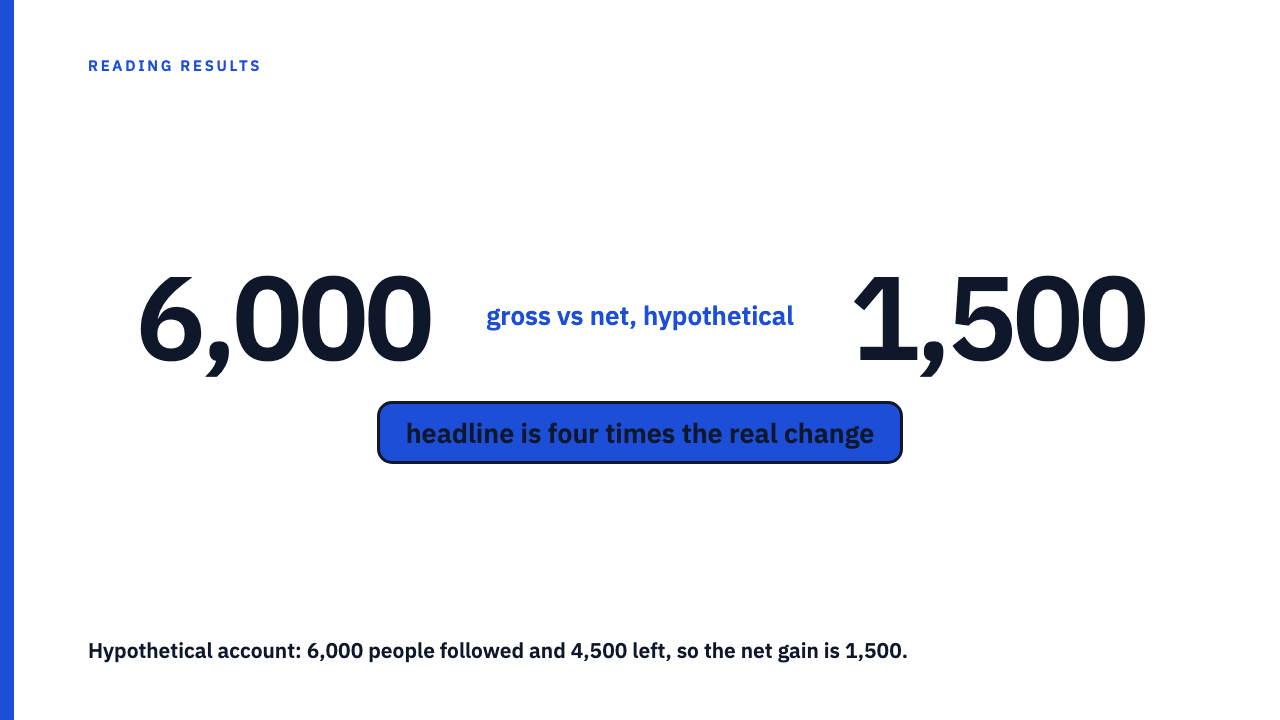
Take a hypothetical account that starts a month at 20,000 followers. It gets 6,000 new followers and 4,500 people leave in the same window. A second hypothetical account has the same start and the same 6,000 new followers, but only 200 people leave.
| Hypothetical figure | Account A | Account B |
|---|---|---|
| Starting count | 20,000 | 20,000 |
| Gross gain (follows) | 6,000 | 6,000 |
| Departures | 4,500 | 200 |
| Net gain | 1,500 | 5,800 |
| Ending count | 21,500 | 25,800 |
| Net as a share of gross | 25 percent | about 97 percent |
Check Account A by hand: 20,000 plus 6,000 minus 4,500 is 21,500, so the net gain is 1,500, a quarter of the 6,000 headline. The headline is four times the real change. Yet “gained 6,000 followers” is what both accounts could print. The headline cannot tell them apart, and one ended the month 4,300 followers ahead of the other.
Why the unfollows go missing
Gross gain is the larger number, and it is often the easier one to find.
Dashboards also differ in how they present follower change. Some views may show only net change over a period, others may split follows from unfollows. This post makes no claim about what any particular platform reports, so check what the specific dashboard being quoted actually exposes before deciding what a number means.
That matters because you cannot see the distinction from the headline. An agency reading from a net view and reporting “gained 1,500” is making a net claim. One reading from a gross view and reporting “gained 6,000” is making a gross claim. A gross figure is a legitimate number when it is labelled as gross and given with its window. The problem is only when it is read as growth.
Where churn is worst, and where it matters most
Two situations push gross and net far apart. The first is a giveaway or contest, where people follow to enter and have little reason to stay. As a matter of reasoning, not a statistic, followers who arrived for a prize have a weaker tie to the account than those who arrived for the content. The same logic applies to a growth push that attracted low-intent followers: people who followed on impulse are easier to lose.
The library already covers both angles. For a contest’s follower spike, see the post on reversion. For who the followers are, see a follower count going up does not say who is following. This post is only about the arithmetic.
The pattern to be most careful with is a high gross number over a short window with no ending count.
The check you can run in two minutes
Work through four steps.
- Identify which claim is on the page. The wording is the clue. “Gained” or “added” usually points to gross. “Grew by” suggests net but does not guarantee it. “Now has” is an ending count.
- Look for a start and an end count. Check screenshots, captions and the body text. If you find both, subtract the start from the end to get the net change over the stated window.
- Compare net with gross. If the net change is far below the gross figure, the difference is departures, not an arithmetic error.
- If neither count is given, stop. The claim cannot be converted to a growth rate, and a guess does not help. If only a starting count turns up and it is small, remember that when the base is small, the percentage is just noise, and that the “before” picture is also a choice.
What to ask for when only one number is given
A short request is easiest to answer:
For the dates covered, could you share the starting follower count, the ending count, and the number of follows and unfollows, ideally from the platform’s own export or a screenshot?
A good answer has all four numbers, for the same window, from the platform’s own analytics export or screenshot. A weak answer is a new, larger gross figure, a different window, or an ending count with no start.
If the net is declined, that is itself information about what can be checked. It is not proof of anything. It leaves the claim where it was: unverified.
What this does and does not tell you
Netting out departures gets you to honest arithmetic and no further. It does not say whether the campaign caused the growth, since followers might have arrived anyway. It does not say who the followers are, which is the question in the audience quality post linked above.
Every number in the library belongs to the agency that reported it, and none is a benchmark. If you want to practise on real published work, browse the case study library, or submit your own.
FAQ
Does “gained 10,000 followers” mean the account is 10,000 bigger?
Not necessarily. It most likely describes follows in the window. You need start and end counts for the same dates before calling it growth.
How do I work out net follower growth from a case study?
Subtract the starting count from the ending count for the stated window. If either is missing you cannot compute it, and the gross figure alone does not substitute.