When the Base Is Small, the Percentage Is Just Noise
A case study says enquiries rose 200 percent, and from that sentence you cannot tell whether the business changed or barely moved. A percentage is a ratio, and a ratio has discarded the thing you need: how many there were to start with.
The percentage tells you the shape of the change, not the size of it
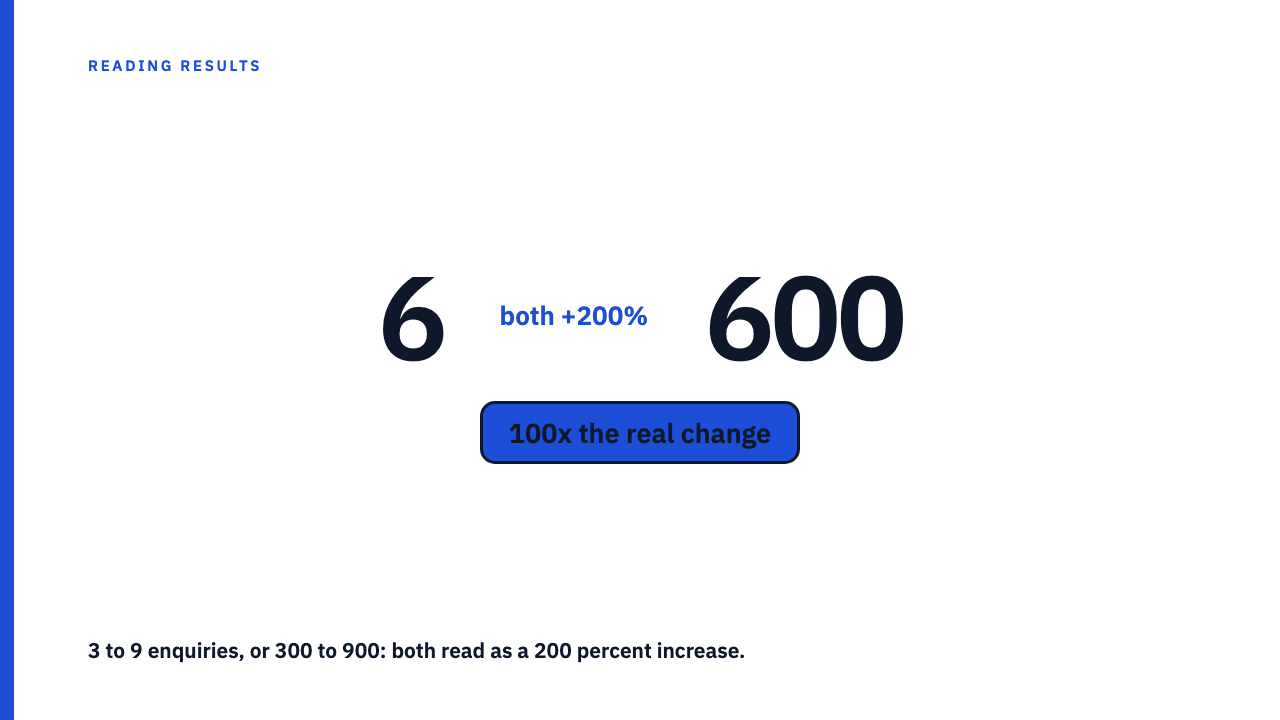
Percent change is simple arithmetic: new number minus old, divided by the old. A hypothetical example: enquiries at a business move from 3 one month to 9 the next. The difference is 6 over a base of 3, which is 200 percent. “Enquiries up 200 percent” is arithmetically perfect, and in this hypothetical it describes six enquiries.
Now hold that same 200 percent against a second hypothetical business whose enquiries went from 300 to 900. That is 600 more on a base of 300, also 200 percent. Nothing in the phrase tells you which of the two you are holding. The percentage carries the shape of the change and says nothing about its scale. Percentage increase against percentage points is a different confusion, covered in 100 percent better and one point better can be the same result.
Why small counts swing more
A number built from a handful of events is naturally jumpier week to week than one built from thousands, and the jumpiness has nothing to do with performance.
Three or four enquiries a week come from three or four individual people acting for reasons mostly unconnected to any campaign. One reminded by a friend, one who finally got round to it, and the week has doubled. Nothing changed. At high volume those quirks cancel out. At low volume, that wobble alone can produce a swing that reads as a result.
This is intuition, not a formula you are expected to apply. The formal treatment of why a measured rate’s reliability depends on how many observations sit behind it is the standard overview of sample size determination. You need none of its machinery, only the habit of asking how many events built the number. The same idea from another angle: why the bad quarter flatters the next.
A rule of thumb, not a threshold
The heuristic, offered plainly as a heuristic:
- Treat a base under roughly 20 to 30 with real caution. The figure has no formal authority behind it. No study or standard produced it and nobody should cite it as one. It is just low enough that two ordinary events move the percentage a long way.
- A base above the line is not automatically fine. The rule triggers scepticism, it certifies nothing.
- Below the line, ask for the raw before and after counts. Not the percentage restated. The two whole numbers, and the period they cover.
- Then re-read the claim in whole units. Hypothetically, “bookings went from 7 to 16 over eight weeks” is assessable. “Bookings up 129 percent” is not.
Reading the same percentage two ways
A hypothetical claim from a hypothetical unnamed business, with no real reported result behind it: engagement up 150 percent.
In the first hypothetical telling, posts were getting 4 comments and now get 10. Six extra comments. The 150 percent is correct, and one person sharing a post in a group chat could explain it.
In the second hypothetical telling, posts were getting 400 comments and now get 1,000. Six hundred extra comments. The 150 percent is identically correct, and this time describes something hard to produce by accident.
Both are hypothetical and neither is a real reported result. The sentence is identical either way, and a reader who stops at the percentage cannot tell six comments from six hundred. “Engagement” also hides which denominator built the rate, covered in engagement rate is three different metrics wearing one name.
Where this shows up most
Small base percentages turn up most often in results from small or local businesses and new product launches, because the underlying activity there is genuinely low volume. That is not a comment on how honestly those results are reported. The reporting is fine, the reading needs care.
This library has published 2 case studies from local businesses. That is a fact about this collection, not a claim about how common small base reporting is anywhere else.
What to ask for before you accept the percentage
| The claim as stated | What to ask for | Why it matters |
|---|---|---|
| “X percent increase” | The raw before count | The denominator. Whether the ratio means anything depends on it, and it is most often left out. |
| “X percent increase” | The raw after count | With the before count it gives the absolute movement, which is what actually happened. |
| “X percent increase” | The time window covered | A small count over a short window is the noisiest possible measurement. |
| “X percent increase” | Whether the base was disclosed at all | In a footnote, the reporting is complete. Nowhere, and the absence is the finding. |
Read a few of these with the counts in front of you
Browse the case study library and convert each headline percentage into whole units before you read the body. If you have published work with the counts disclosed, you can submit your own, credited to the agency behind it.
FAQ
Is a 200 percent increase always meaningless?
No. It becomes uninformative only when the base is small enough that ordinary variation between periods could have produced the same swing. A 200 percent rise off a base in the thousands is a completely different claim from one off a base of three. The percentage alone cannot tell you which you are holding, so the response is always the same: ask for the raw counts.
Is there an official minimum sample size for a marketing metric to be trustworthy?
No single number is authoritative for marketing metrics. Treat any threshold you are offered, including the one in this piece, as a trigger for scepticism rather than a pass or fail line. The principle behind why sample size matters is set out in the sample size determination overview.
Does a small base mean the case study is dishonest?
No. A small business or a new product line often has a genuinely small base, and the percentage is still arithmetically correct. It is just not informative on its own. The honest response is to ask for the raw counts, not to assume bad faith.
Sources
- Sample size determination, Wikipedia, fetched 4 September 2026. A general pointer to the principle that small samples carry wider uncertainty. No figure is taken from it.