When the headline number is a vanity metric, ask what it hides
You have just read a case study leading with a very large percentage attached to followers, impressions, reach or engagement. It looks like a result and you are about to cite it. Ask something smaller than “is this true?”, because it probably is. Ask what the person who chose that number decided not to lead with.
The headline number is chosen, not discovered
Whoever assembled the case study saw everything: platform analytics, the ad account, the client’s own reporting, every month of before and after data. One number went at the top. That is a selection, made by someone who could see the full set. The same reasoning applies when the best metric on a dashboard is rarely the real story, narrowed to a single decision.
Sort the headline into one of two boxes before reading further. The first holds activity and exposure metrics: followers gained, impressions, reach, video views, engagement. They count what happened on a platform. The second holds business outcomes: revenue, leads, bookings, retained customers, cost per acquisition. They count what happened to the business. Both are real, but only one is what the client was paying for, and size in the first box implies nothing about the second.
Why a vanity metric ends up in the headline
The reflex is to assume something was hidden. Usually something simpler is happening.
- The client would not release the numbers. Permission to publish reach is far easier to get than permission to publish turnover.
- The business outcome had not landed yet. If the sales cycle runs six months and the write-up happened at month three, the conversion data did not yet exist.
- Awareness was the actual brief. If the client wanted recognition in a market where the brand was unknown, reach is the correct headline, not a stand-in for a missing one.
- The business number moved, but not dramatically. A real lift in leads can look unimpressive beside a triple digit growth figure on followers, so the bigger number wins.
None of these make the headline false. They make it incomplete, a different problem. Notice the absence rather than inferring bad faith. The reader who repeats a reach figure as evidence the campaign made money is the one in error.
The same campaign, two headlines
What follows is a hypothetical example with invented numbers. No agency reported this and no client exists. Picture a regional chain of garden centres running a six week spring campaign on short form video. The facts are fixed: 41,000 followers added, 2.1 million views, 260 attributed online orders.
Written one way, the headline is 2.1 million views and 41,000 new followers in six weeks. That reads as a breakout, and the reader believes the brand reached a large new audience fast, which is accurate. Written the other way, it is 260 online orders in six weeks. That reads as modest, and it makes the reader ask what the campaign cost. Same facts, neither version a lie.
What to check before you cite the headline number
- Does a business metric appear anywhere in the body copy? It often does, two thirds of the way down, in a sentence with no bolding. A case study that mentions a lift in bookings in paragraph nine has told you the truth, quietly.
- Is the client’s stated goal written down? If the goal is never stated, you cannot tell whether the headline metric was the target or the consolation.
- Do the time windows match? A headline covering thirty days beside a business number covering twelve months is two measurements, not one story.
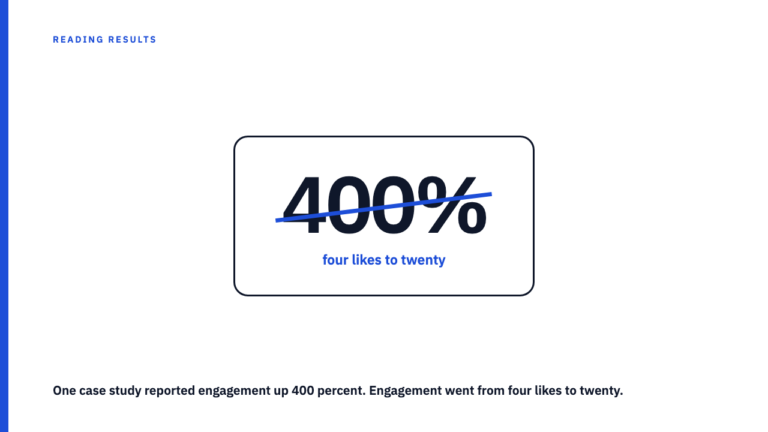
- Does the percentage have a stated starting point? A growth figure with no statement of growth from what is a ratio with an undisclosed denominator.
A case study stating its goal, its window, and even one supporting business number deserves more trust than one with none of the three, whichever carries the bigger percentage. The fuller process is how to read a marketing case study without being misled.
What this library actually shows
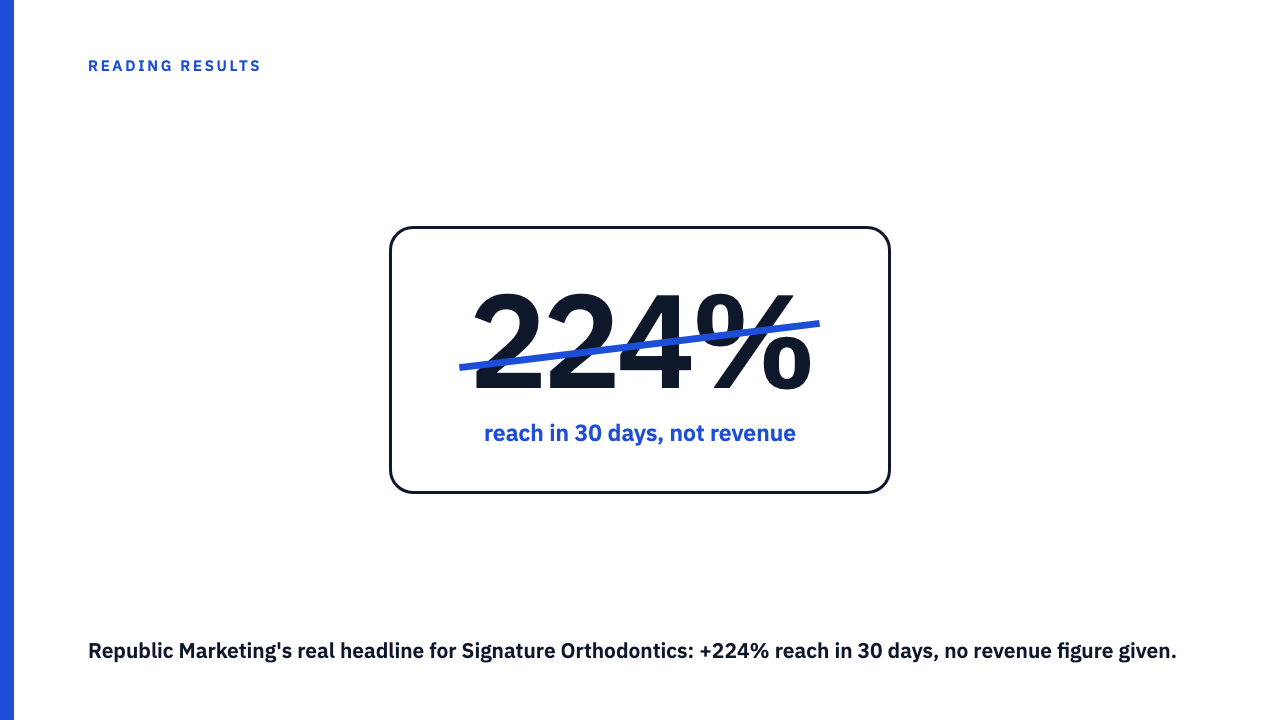
This site currently holds ten published case studies, and the split is visible on the library page. The Signature Orthodontics entry, credited to Republic Marketing, is headlined “+224% reach in 30 days”. Others lead with the business: the Vulcan Strength entry, credited to LYFE Marketing, is headlined “$77,941 revenue at 5.38x ROAS”, and the 2nd Vault entry, credited to Intelus, is headlined “350+ leads in 12 months”.
This library republishes agencies’ own reported case studies with full credit and a link to the original, so those figures belong to the agencies that reported them. Noting that a headline is an exposure metric is a diagnostic observation about how the document was built. It is not an accusation, and not a claim the result is untrue. None of these numbers is a benchmark either.
A vanity metric is a flag, not a verdict
A headline built on followers or impressions tells you one thing reliably: the business outcome is not being led with. That is a prompt to keep reading. It is not proof the campaign failed, since the reasons a business number goes unpublished are mostly mundane, and not proof it succeeded, since a large exposure figure can coexist with no commercial movement at all. Find the goal, the window, and any business number, then cite what the document supports. Extend that to the number no case study can show you. A reader who checks gets harder to mislead without assuming every case study is a trick.
Try it on a shelf of headlines
Browse the case study library and sort each headline into activity or outcome before reading the body. Published one of your own? You can submit your own, with full credit and a link back.
FAQ
Does a vanity metric headline mean the campaign failed?
No. A business metric can be missing for ordinary reasons: the client would not permit revenue figures published, the result had not materialised when the write-up went out, the campaign was commissioned as awareness, or the business number moved too modestly to headline. Absence makes the claim incomplete rather than false.
What is the difference between a vanity metric and a business metric?
A vanity or exposure metric counts activity and reach with no inherent link to money: followers gained, impressions, reach, video views, engagement. A business metric ties to revenue, cost, conversion or retention: sales, leads, bookings, cost per acquisition, retained customers. Exposure metrics are not worthless, and for an awareness brief they are the right measurement. They simply tell you nothing about the business number.
Sources
- Social Case Studies, case study library, fetched 5 September 2026. The headline metrics and agency credits above are quoted from that listing.