‘3x’ and ’10x’ can describe any size of result
A case study opens with “we tripled engagement” or “a 10x return”, and you have to decide how much attention the rest of it deserves. The claim is very likely true. It is also close to uninformative, because its format has already discarded the two numbers you would need to judge it.
The word doesn’t carry a number
An “Nx” claim encodes exactly one quantity: the ratio between an after figure and a before figure. When someone divides 120 by 40 and writes “3x”, the 120 and the 40 are gone, not tucked away inside the phrasing for a careful reader to recover. Computing a ratio is lossy by design: unlimited pairs produce the same quotient, and the quotient carries no trace of which pair it came from.
That erasure happens no matter how the ratio was calculated or how scrupulous the reporter is. An analyst who measured cleanly over a long window and someone who picked two convenient weeks both write “3x”. So a multiplier tells you nothing about the work behind it, only that you have a relationship between two results you cannot see.
Two examples, one claim
Both examples below are hypothetical. Neither is taken from a real case study, and no agency has published these figures.
Hypothetical example one. Picture a small local account averaging 10 interactions a week. Over a quarter it climbs to an average of 30. New divided by old is 3, and the write up says engagement tripled.
Hypothetical example two. Picture a much larger account, averaging 40,000 interactions a week and reaching 120,000 over the same quarter. New divided by old is 3, and the write up says engagement tripled.
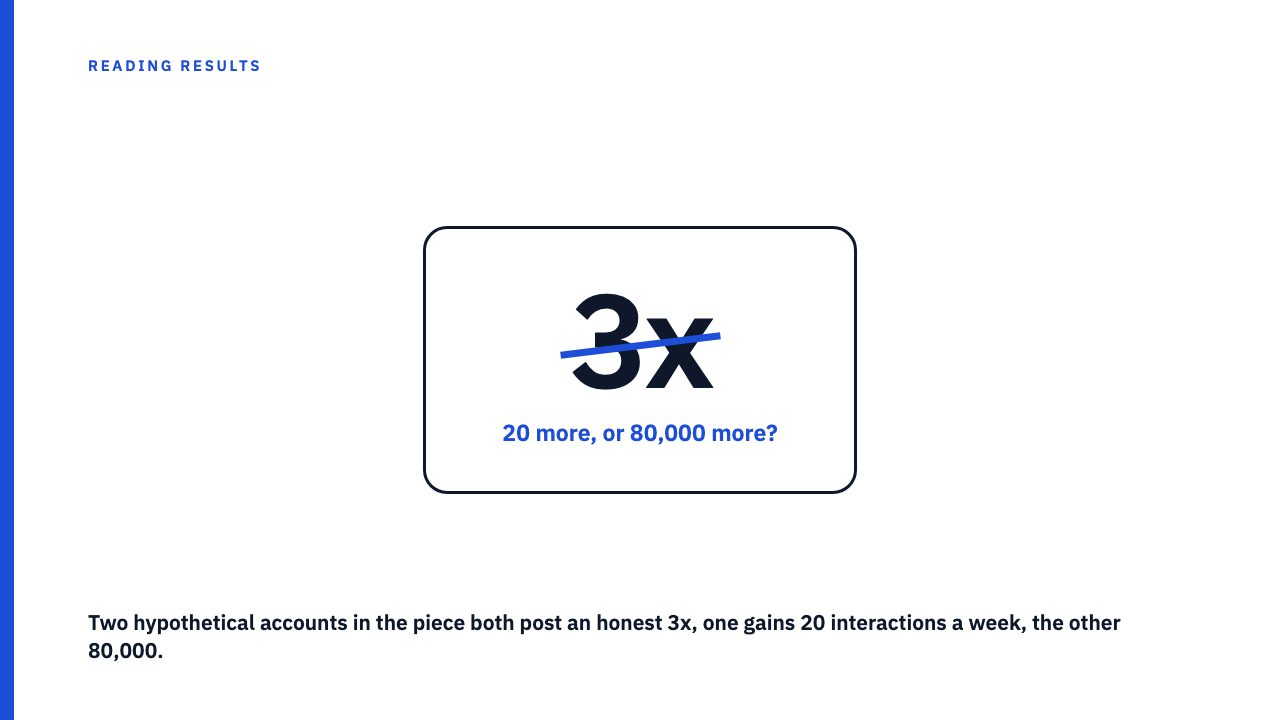
Both are honestly stated 3x claims. But the first account added 20 interactions a week, a change one unusually good post could produce by accident, while the second added 80,000, a real shift in how a large audience behaves. The sentence “engagement tripled” is identical in both and gives you no way to tell which you are reading.
A percentage at least implies a scale
Percentages are incomplete in the same way, but they leak slightly more, and the reason is habit rather than mathematics. Everyday use borrows an implicit 0 to 100 frame from exam marks, battery levels and shares of a total. So a metric that rose 30 percent gives most readers a rough feel for the size of the move before they have seen any underlying figure. Multiplier phrasing has no equivalent anchor. Nothing fixes the scale of “5x”, so it can describe a move from 1 to 5 or from a million to five million with equal honesty. It reads as large either way because “times” sounds like magnitude, when all it reports is proportion.
None of that makes percentages safe alone. A percentage built on a tiny starting figure has the same problem in milder form, which is why when the base is small, the percentage is just noise belongs next to this. The difference is one of degree: a percentage gives you a bad intuition, a multiplier gives you none.
Where multiplier language tends to show up
- A narrow before and after comparison on one metric, where a figure is measured twice and the ratio becomes the finding.
- A headline pull quote lifted out of a longer report, where the surrounding paragraphs may hold the absolute numbers but the quoted line travels without them.
- A follower or engagement growth summary across several months, where the multiplier stands in for a curve nobody has shown you.
It recurs partly because a multiplier is the cheapest honest claim available: it needs only a division and some rounding, and discloses neither underlying number. An absolute figure commits you to something a reader can check. A ratio commits you to nothing, which is why its presence alone says nothing about how good the result was.
The questions that recover the missing base
- What were the two absolute numbers? Not the ratio, the before and after counts.
- Over what window? A tripling across three years and one across three weeks are different findings, and one may be a seasonal peak.
- Was the starting number close to zero? A very small base produces a large multiplier, which is the most common way a modest change gets an impressive label.
- Would it still sound notable stated another way? If “we added 20 interactions a week” would never have made the headline, the multiplier is doing work the result cannot.
These are the instincts to apply to any prominent figure, so learn to ask what the headline number hides, and to notice how percent increase and percentage points can describe the same result.
When a multiplier claim earns more trust
A multiplier stops being a discount signal the moment the absolute before and after numbers appear next to it. If a report says an account went from 40,000 weekly interactions to 120,000, then adds “a 3x increase”, it conceals nothing. It restates figures you can already interrogate, and does what shorthand should do, saving the reader a division.
The pattern worth remaining sceptical about is narrower: the multiplier is the only number in the room, a substitute for the result rather than a summary of it. Checking takes seconds. If the absolute figures sit nearby, read on. If the multiplier stands alone, ask for them rather than assume the worst.
See how the clear ones read
The fastest way to build the instinct is to read work that states its numbers plainly. Browse the case study library, where every result stays credited to the agency that reported it, or submit your own if it carries its before and after figures.
FAQ
Is a multiplier claim ever dishonest just by using “Nx” phrasing?
No. If the ratio is computed correctly then “3x” is true, and treating the phrasing as evidence of spin will lead you to dismiss good work. The format omits both underlying numbers by construction, so a substantial multiplier and a meaningless one look identical on the page. That is a reason to ask for the base, not to disbelieve the writer.
What should a trustworthy case study show instead of just a multiplier?
The absolute before and after numbers, plainly stated, with the measurement window beside them. A 10x claim is arithmetically the same as a 900 percent increase from the same base, since if new divided by old is 10, the increase is 9 times the old figure. Two very different sounding claims, one underlying change. Keep the multiplier as shorthand beside the real numbers, not in place of them.
Sources
- When the Base Is Small, the Percentage Is Just Noise, fetched 7 September 2026.
- 100 Percent Better and One Point Better Can Be the Same Result, fetched 7 September 2026.
- When the headline number is a vanity metric, ask what it hides, fetched 7 September 2026.