200 Pieces of Content Is an Input, Not a Result
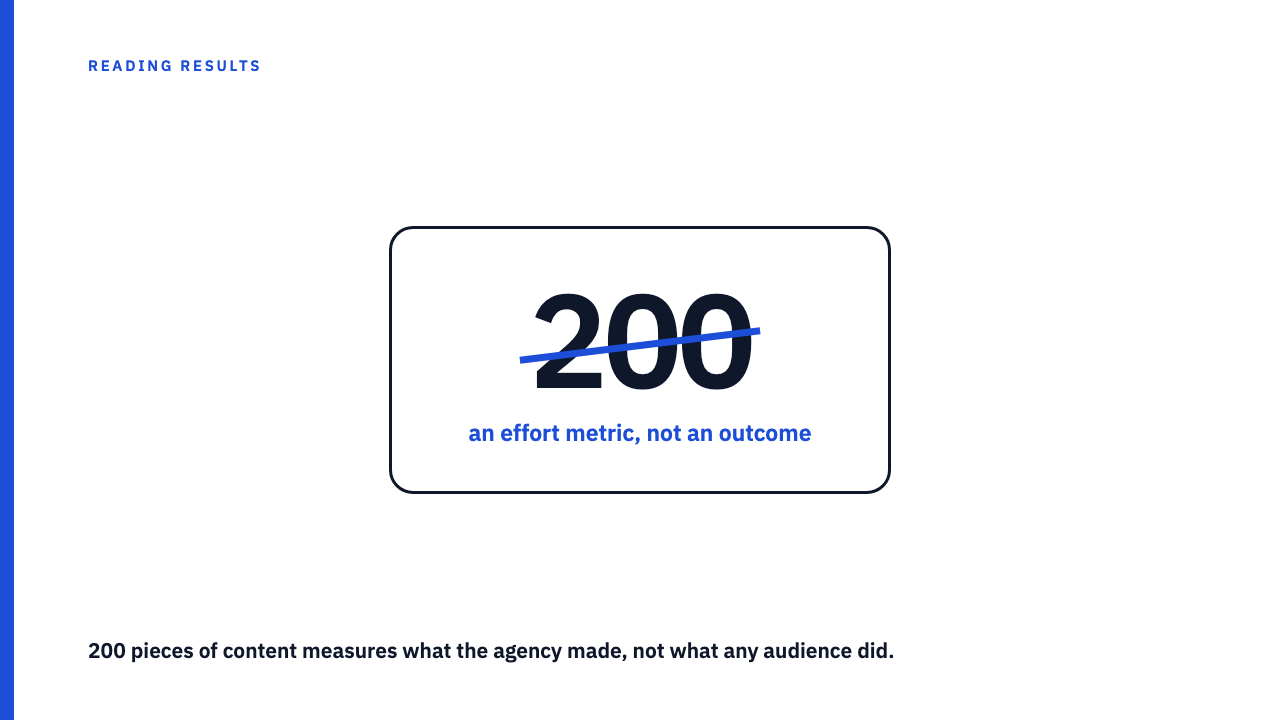
You are three paragraphs into a case study’s results section and the first number you hit is 200. Two hundred pieces of content produced across the quarter, sitting in the same box as engagement rate and follower count, formatted with the same weight, as if it answered the same question. It has not. A production count and an outcome are different claims, and a results box that cannot tell them apart is worth a second look before you credit either one.
The number that answers the wrong question
A results section exists to answer one question: what changed because of the work. A count of posts published, videos produced, or pieces of UGC collected answers a different question entirely, which is what the agency did. That is not a technicality. It is the difference between a number the agency controls directly, by deciding to make more of it, and a number it does not control, because it only exists if an audience responded.
An agency can decide, on any given Tuesday, to produce twenty more pieces of content than planned. Nobody outside the agency needs to do anything for that count to rise. Engagement, followers gained, conversions, revenue attributed to the campaign: none of those move unless someone who owes the agency nothing chose to act. That is the distinction, and it is the test that follows.
Effort metrics and outcome metrics, side by side
Most numbers in a case study sort cleanly into one of two buckets. Here is the working split.
| Effort metrics | Outcome metrics |
|---|---|
| Posts published | Engagement rate |
| Videos produced | Followers gained |
| Hours of production | Conversions |
| Pieces of UGC collected | Revenue attributed to the campaign |
| Campaigns launched | Reach |
The test that sorts any number you have not seen before: could this figure go up even if literally nobody looked at any of it? If the answer is yes, you are holding an effort metric, no matter how large or precisely stated it is. A results section built entirely from the left column has not told you whether the work did anything at all.
Where the number actually belongs
Here is a hypothetical worked example, not a real reported case study, to show the same figure placed correctly and then incorrectly.
Hypothetical case study excerpt, methodology section: “Produced 200 pieces of content across the quarter, spanning short-form video, carousel posts, and creator collaborations.” Results section: “Engagement rate rose from 1.8% to 3.1% over the same period.”
Placed there, the 200 does legitimate work. It tells the reader roughly how much material generated that lift, which matters for judging efficiency, and it sits next to a figure that describes what an audience did. Now move the same number into the results box on its own: “Results: 200 pieces of content produced this quarter.” Nothing in that sentence says the content did anything. No engagement figure, no follower change, no conversion number, no reach total, nothing naming an audience response. The methodology fact has been relabeled as an achievement, and the reader is left to assume a result that was never stated.
Why this substitution happens
It rarely reflects bad faith. Volume is easy to report because the agency generated it directly and knows the exact figure without needing anyone else’s cooperation. An outcome number requires the client’s own analytics and a willingness to publish a figure that might turn out underwhelming. One path is entirely within the agency’s control. The other depends on a client comfortable sharing real numbers, including unflattering ones.
When a case study leads with volume instead of a result, the honest reading is usually that the volume is standing in for a result the write-up does not have or chose not to include, not that volume is deceptive by nature. Read this alongside a vanity metric as the headline number, a related but distinct trap: a vanity metric is at least a real audience response, just a shallow one, where a content count is not an audience response at all. Both point at the same failure named in the goal statement and the result don’t always match, a case study answering a question other than the one its headline implies.
A content count can still be useful, just not as a result
None of this makes a production count worthless. It has a legitimate job, just not the one it is asked to do when it sits alone in a results box. Once you have a real outcome number, the count becomes useful denominator information. A 3.1% engagement rate built from four pieces of content reads very differently than the same rate built from 200 pieces, and a case study that gives you both figures lets you judge efficiency, not just outcome. That pairing role is different from standing alone as the headline. A count next to an outcome number is context. A count instead of one is a substitution.
Three questions to ask when a results box leads with a count
- Does this number describe something the agency made, or something the audience did in response? If the former, it belongs in the methodology, not the results.
- Is there a separate outcome number anywhere else in the case study, or is the count standing in for one? Scan the whole write-up before deciding the result is missing.
- If the count were doubled, would that alone tell you the campaign worked better? If doubling it says nothing about audience response, it was never a result.
Running a case study through those three questions is close to the full method in how to read a case study without being misled, applied to the moment a results box opens with a count.
Read more, or add your own
This library republishes agencies’ own published case studies with full credit, so you can practice sorting effort from outcome on real write-ups rather than hypothetical ones. Browse the case study library, and if your agency has a result worth reading closely, submit your own.
FAQ
Is it ever fair for a case study to mention how much content it produced?
Yes, as context in the methodology or approach section, and as a useful denominator alongside a real outcome number. The problem is only when the count itself sits in the results box with nothing measuring audience response next to it.
How can a reader tell if a number is an outcome or just relabeled effort?
Ask whether the number could rise even if nobody in the audience engaged with any of it. If the answer is yes, it is describing what the agency did, not what happened as a result.