Pledged, Matched, or Collected? What Raised Really Means
You’ve just read a cause marketing case study that opens with a total raised in the hundreds of thousands or millions of dollars, credited to an agency’s campaign. Whether that figure is cash the cause can spend today, a donor’s promise, an employer’s match still awaiting paperwork, or the retail value of donated product, the case study usually doesn’t say.
What ‘raised’ can mean before any money moves
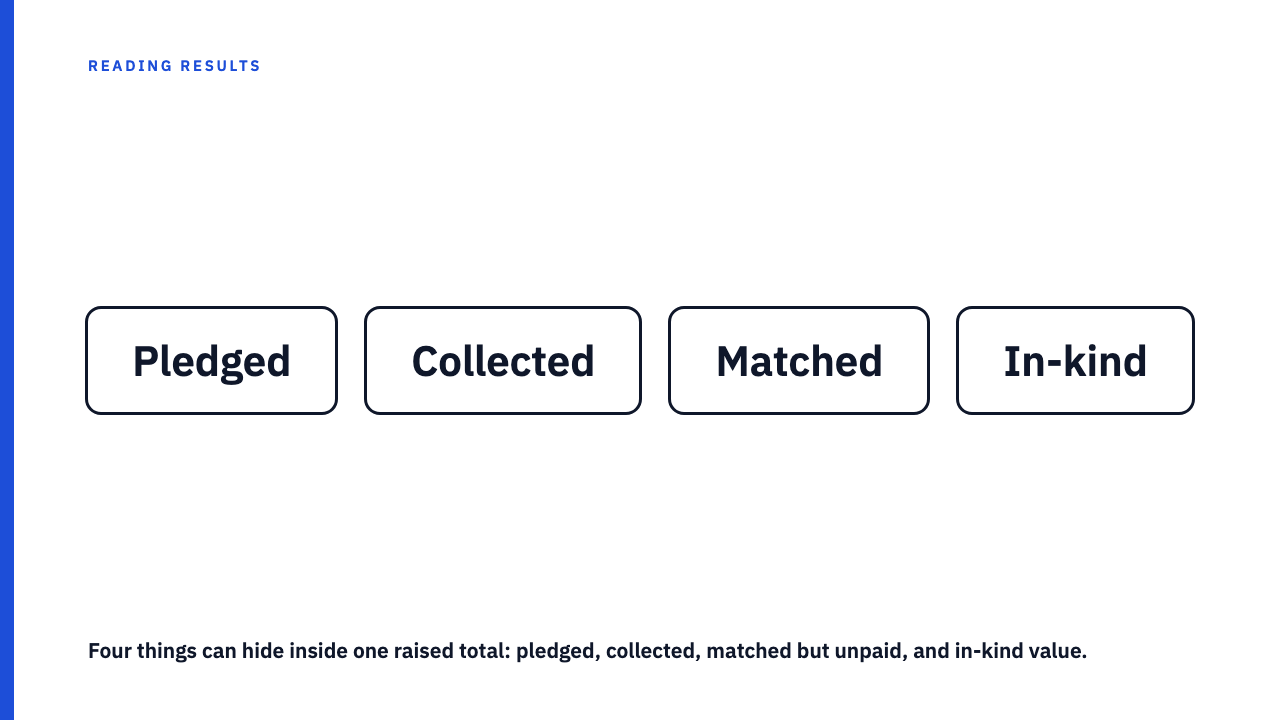
Four things can sit inside a single “raised” figure, and a case study rarely tells you which. Pledged means a donor has stated they will give an amount, but the cause has not received it yet. Collected means cash has landed in the cause’s account and can be spent today. Matched but unpaid means a company has committed to match donations, dollar for dollar or at some ratio, but has not disbursed the funds, often because a donor must file a separate claim first. In-kind means goods or services were donated and assigned a dollar value, never cash at all, just an estimate of what the donation would have cost to buy.
A headline total can be the sum of all four with no breakdown given. That is a different claim from “the cause has this much to spend,” the same way a projected number is not a reported result even when both appear under one “results” heading.
A hypothetical worked example: the same total, four ways
Hypothetical example, not a reported result. No real campaign produced these numbers; they exist only to show how a total can be built. Picture a campaign that closes with a headline of $500,000 raised, broken into components like this.
| Component | Amount |
|---|---|
| Cash collected, spendable now | $180,000 |
| Pledges made, not yet paid | $120,000 |
| Employer match pledged, not yet disbursed | $150,000 |
| In-kind product donations, valued at retail | $50,000 |
| Total | $500,000 |
Of that $500,000 headline, the cause can spend $180,000 today, a minority of the figure every reader saw. The rest is a promise, a match pending unconfirmed paperwork, and a valuation of product rather than money in an account. Again: a hypothetical example, not a reported result.
Why a pledge showing up as ‘raised’ isn’t necessarily wrong
[EVIDENCE NEEDED: the specific accounting standard, such as FASB ASC 958-605, that requires an unconditional pledge to be recorded as revenue when promised rather than when cash arrives] is generally understood to be why nonprofit financial statements can legitimately show a pledge as revenue before the cash shows up. A total including unpaid pledges is not automatically a misrepresentation on the cause’s own books.
What that basis does not cover is a case study’s choice to headline the gross pledged total without disclosing what fraction has been paid. Booking a pledge on a statement that also shows a receivables line is one act; a bare number in an opening paragraph is another. The first is a standard, the second a disclosure choice, and nothing requires the second to be made well. Not every pledge is treated alike, either: a conditional pledge, dependent on something happening first, such as a matching threshold being hit, can be reversed if the condition is never met, and folding it into a total as though it were cash collected makes a claim the donor agreement may not support.
What to check before you credit a matching gift multiplier
- Has the match been disbursed, or only “committed to”? Those are different claims.
- Did donors have to submit a separate matching gift request for it to be paid? [EVIDENCE NEEDED: a verified percentage of matching pledges that go unclaimed] One matching gift administrator reports the problem in dollar terms rather than a rate: a substantial amount of pledged matching funds goes unclaimed industry wide each year, usually because a donor never filed the paperwork.
- Did the matching pool have a cap that could have been reached before every donation was matched?
- What date was the “matched” figure taken from, relative to close? Processing can lag by months, and a lagging figure should not be reported as if it were already measured in full.
In-kind value is a valuation, not a receipt
An in-kind donation, whether product, meals, ad space, or a donated service, gets assigned a dollar figure based on an estimate of fair market or retail value. The IRS’s own guidance on valuing donated property walks through how that estimate is built, using comparable sales, replacement cost, or appraisal, precisely because fair market value is a judgment, not a transaction that occurred. Nobody paid that price or received that cash.
An in-kind gift can be product the cause did not particularly need, or a service donated at a rate the cause would never have paid out of pocket, and the valuation does not capture that, the same way earned media value is an estimate wearing a dollar sign rather than money that changed hands. Cash can be redirected to whatever the cause needs most; in-kind value cannot, since it is fixed to whatever was actually donated.
Four questions worth asking before you credit the number
- What fraction of the stated total is cash the cause has already received and can spend.
- What is the disbursement status of any named matching gift: pledged, or actually paid out.
- Is any part of the total an in-kind valuation, and on what basis was it valued.
- Does the headline period match the window the money arrived in, or does it quietly fold in a lifetime total presented as a campaign result.
Read the underlying numbers, not just the headline
The library republishes cause marketing case studies with credit to the agency behind each one, so you can read what was actually disclosed. Browse the case study library, and if you have reported on a campaign with a clear breakdown of pledged, collected, matched, and in-kind totals, submit your own.
FAQ
Is it dishonest for a case study to include pledges in its total raised figure?
Not inherently. Nonprofit accounting practice can treat an unconditional pledge as revenue from the moment it is promised, not when cash arrives, so a total including it isn’t automatically a misstatement. The problem is a case study stating one combined number with no breakdown, leaving the reader to assume the whole figure is cash in hand.
What should a cause marketing case study disclose to make its raised total trustworthy?
A breakdown of cash collected, pledges outstanding, the disbursement status of any matching gift, and the basis used to value any in-kind contribution, alongside the date that figure was measured against when the campaign closed.
Sources
- IRS Publication 561, Determining the Value of Donated Property, fetched 2026-09-28.
- Double the Donation, Corporate Giving and Matching Gift Statistics, fetched 2026-09-28.