One Winning Test Market Isn’t a Bellwether by Default
A case study lands with one number doing the work: a pilot city that beat its target. The temptation is to read that as proof the campaign works everywhere. But a test market’s result is a fact about that market first, and only becomes a claim about the rest of the business once the pilot is shown to resemble the base it stands in for, which most never show.
The pilot city did well. What does that tell you about the other forty?
Pilots exist to reduce risk and cost: test one market before committing budget everywhere else. If it fails, the damage is contained; if it works, the rollout case writes itself. That logic creates a quiet incentive: whoever picks the market has reason to expect it to go well.
None of that makes the result untrue: a market that outperformed its target did so for real reasons. What it does not tell you is whether those reasons exist anywhere else, a different question from asking how many other units or markets were tested before this result got published. Here there is only one market, and the question is whether it resembles the base it represents.
Why the pilot market was probably not a random draw
A pilot market is rarely chosen by lottery. It is chosen by people with a rollout to justify, and that process favors traits correlated with a favorable result, for reasons unrelated to the campaign’s quality.
- An existing relationship or an unusually strong local team, executing better than an average market would.
- Low media costs relative to the metric being measured, which makes almost any spend look efficient.
- Weak or absent local competitors during the test window.
- A market where the client or agency already had brand presence, a head start a cold market would not have.
- Simple convenience, such as head office proximity, which says nothing about how typical a market is.
Any one of these can inflate a result alone. Several at once, common since they travel together, can produce a number that looks like a campaign win but is really a market-conditions win in disguise.
A hypothetical: the pilot market and the base it’s supposed to represent
Here is a hypothetical, with invented figures, to show the mechanism rather than report anything real. Picture a mid-size test city chosen as the pilot for a campaign meant to eventually run across a national footprint of stores.
In this hypothetical, the test city’s population skews younger than the national base, its competitive set is two smaller retailers rather than the three or four national chains dominating most regions, and its media cost per thousand impressions runs well below the national average. None of these figures describe a real place.
Run the same campaign in both, and the test city wins on nearly every axis before it starts: less competition, cheaper reach for the same spend, a population skewed toward the target demographic. A strong result there needs only an easy market, not a better campaign, yet a case study that omits these dimensions leaves the reader unable to tell them apart.
What a case study would need to disclose for the market to count as a bellwether
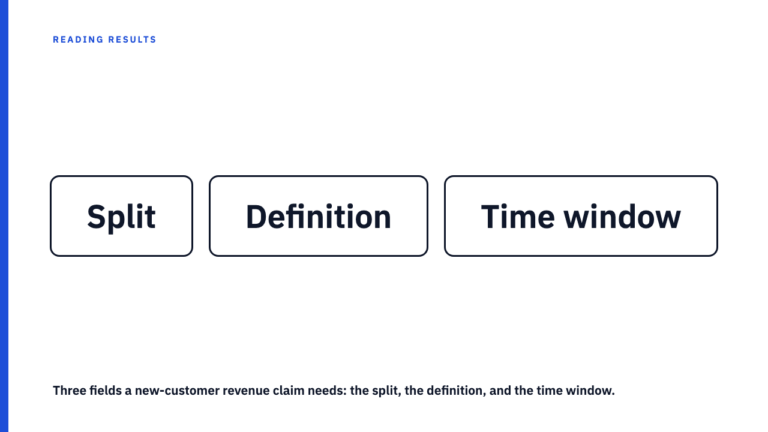
A reader cannot judge representativeness from a headline number alone. Three disclosures matter most: how the market was selected and by whom; how it compares to the base on demographics, competitive intensity, media cost, and brand presence; and whether the campaign has been run again in a second market chosen to differ from the first on those dimensions.
That third disclosure is the strongest evidence a case study can offer. A single winning pilot is one data point; a second, run in a market that differs from the first, producing a comparable result, starts an actual pattern. Short of that, claiming the market is representative asks the reader to take it on faith. And the library itself is a selected sample worth reading with that in mind.
Questions worth asking before you assume the result travels
Most of this reduces to a short list a reader can run against any single test market claim.
- Was this market picked before or after early results were already visible elsewhere, suggesting it was chosen because it looked safe rather than typical.
- Does the case study name any dimension on which the market resembles, or differs from, the base it’s meant to represent, or does it simply assert that the result generalizes.
- Has the same result been reproduced in a second market with a deliberately different profile.
- Is the market unusually small or favorable in ways that would not scale, such as low media costs or minimal local competition.
A case study that answers even two of these openly is doing more than most. One that answers none is not necessarily wrong, but it is asking to be trusted rather than checked.
One market is a data point, not a forecast
A single test market result is real evidence about that market. It is, at best, a hypothesis about the wider base, one that holds only once someone checks whether the two resemble each other. For the fuller checklist, see how to read a case study without being misled.
If you want to see how different agencies handle this kind of disclosure, browse the case study library, and if you have a result worth adding to the record, submit your own.
FAQ
Why would a favorable test market not mean the campaign worked?
A market can outperform for reasons that have nothing to do with the campaign itself, such as low competitive pressure during the test window or unusually cheap media costs. The result is real for that market, but it is not evidence the campaign, rather than the conditions, produced the win, and it says nothing about whether the same performance would repeat elsewhere.
What’s the strongest evidence that a test market result will generalize?
A second pilot run in a market chosen to differ from the first, on the dimensions that plausibly matter, that produces a comparable result. A single winning market, however well documented, cannot show this alone. Absent a second, differently profiled test, representativeness is asserted, not demonstrated.
Is a large test market automatically more representative than a small one?
No. Size affects how stable a number is, not whether the market’s profile, its demographics, competitive intensity, or media costs, matches the base the result is meant to predict. A large market can still be unusual, and a small one can still be broadly typical.