The word ‘conversion’ hides five different funnel stages
A case study says conversions rose 40 percent, and you still do not know what happened. A completed lead form is a conversion. So is an add to cart, and so is a finished order. Before that number can be compared to anything, you need to know which of them was counted.
The word doesn’t specify where in the funnel it happened
“Conversion” names an outcome, not a location. It says someone did the thing, without saying what the thing was or how far down the funnel they went, so a reported lift can sit at very different points of business value under the same word.
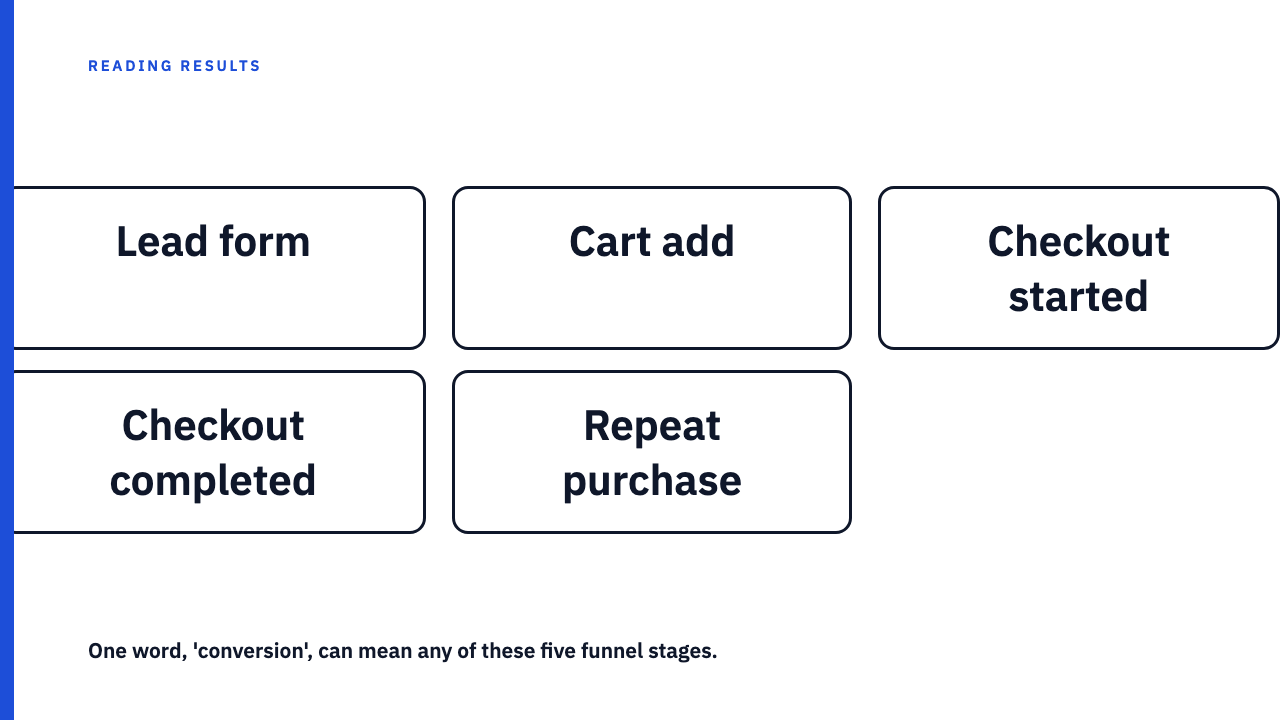
Picture the funnel as a series of gates, each one a point where a person continues or leaves and a tracking event can fire. The word gets applied to at least five of them: a completed lead form, an add to cart, a checkout started, a checkout completed, and a repeat or upsell purchase. All five are real events a campaign can move. Only some of them are money.
A hypothetical case, worked twice
Every number below is hypothetical, invented to make the arithmetic visible. None of it describes any real agency, brand, or published case study.
Imagine an online retailer running a quarter of paid social. In the baseline quarter, 2,000 people start a checkout and 500 finish, one in four. At an average order value of 80 dollars, that is 40,000 dollars of revenue. The next quarter’s write-up reports a 40 percent increase in conversions.
| Reading | What moved | Revenue effect |
|---|---|---|
| Conversion means checkout started | 2,000 to 2,800, so 800 extra starts | Unknown without the completion rate |
| Conversion means checkout completed | 500 to 700, so 200 extra orders | 16,000 dollars |
The second reading is arithmetic you can hold someone to. The first is a question dressed as an answer. If those 800 extra starts finished at the usual one in four rate, they produce 200 orders and the same 16,000 dollars. If they finished at one in ten, they produce 80 orders and 6,400 dollars. Broader targeting tends to push that completion rate down, not up. Identical headline, a revenue outcome two and a half times apart, on a rate the write-up never showed. The first reading is not worse. It is unresolved.
Why the vaguer stage tends to get reported
When an undefined conversion number does turn out to have a definition, it is more often an early stage than a late one, and that is structural rather than sinister. Early gates are cheap to move in raw volume. Broader targeting or a discount hook can add hundreds of extra form submits for spend that would shift only a handful of completed orders, because nothing harder sits in the way, no price objection and no trust problem at the payment step. It is that large achievable numerator, not a wider denominator, that makes a big percentage easy to reach early in the funnel. An agency reporting the metric its objective was built around, under the label the platform prints on the column, is doing something ordinary rather than deceptive. The incentive sits in the funnel’s shape, so the reader supplies the scepticism.
The question that pins the number down
Ask it in these words, or find it in the document:
- “Which step in the funnel does this conversion event fire on, a form submit, a cart add, a checkout start, or an order confirmation?” The case study either answers it or it does not.
- Is the event defined anywhere at all? Check the methodology note, the chart axis label, the screenshot caption, the small print under the headline stat. A defined event appears as a plain noun: leads, bookings, orders, subscriptions.
- Does it show a value or only a count? A count with a currency figure beside it has been reconciled against something. A count with no revenue and no cost per acquisition has not.
- Does it name the same stage on both sides of the comparison? Cart adds in the after and orders in the before is not a comparison, and you only catch it by reading both numbers.
Comparing two case studies that both say “conversions”
Two write-ups are open. One reports conversions up 40 percent, the other 120 percent, and the pull is to call the second campaign three times better. You cannot. If neither post names its funnel stage, you are comparing two quantities that share a name. Approximate would mean the answer sits near the truth; invalid means 120 against 40 is not a ratio at all. Set it aside until both stages are named, rather than hedging with a “roughly”. The same mechanism runs underneath engagement rate has the same problem.
What this doesn’t settle
Naming the funnel stage tells you what the number measures, not whether it was measured fairly. A perfectly defined order confirmation event can still be counted inside the attribution window behind the number, and still be measured against a baseline period the agency selected. Stage, window, and baseline are three separate locks, and this piece picks one. The guide to how to read a case study without being misled runs them in order, and why the best metric on the dashboard is rarely the real story covers the headline choice.
Try it on published work
Browse the case study library and run the question against a few entries. The clearer ones name the gate outright, counting leads or tracked purchases rather than an unlabelled “conversion”. If you have published work of your own, you can submit your own.
FAQ
Does a higher reported conversion percentage always mean more revenue?
No. A lift at an earlier, cheaper to move stage does not translate proportionally into revenue, because every gate below it still applies its own drop off rate to the extra volume. A 40 percent lift in cart adds and one in completed orders describe very different amounts of money, and a smaller percentage at a later gate is often worth more.
Is there a standard definition of “conversion” in social media marketing?
There is no single standard. The term is defined per campaign, per platform, and per analytics tool. The only definition governing a number is the one stated in that case study, so a write-up that never states one has left the question open, not answered it by convention.
Sources
- Social Case Studies, case study library index, with entries checked for whether their reported outcome metrics name a funnel stage. Fetched 6 September 2026.