The attribution window is a choice, and it is rarely disclosed
Two decks land in front of you the same week. Similar budgets, similar platforms, similar campaigns. One reports a return of four to one, the other seven to one. Before deciding the second team is better, ask a duller question: did those numbers count the same things?
A conversion is a rule applied to a click, not a fact found in the world
A reported conversion count sounds like a tally of events that happened. It is closer to the output of a query. A system holds a record of an ad interaction, then a record of a purchase, and a rule decides whether the second belongs to the first. Two settings do most of that deciding. The click-through conversion window sets how long after a click an action can still be credited to that click. The view-through window does the same for an impression, after someone merely sees the ad without clicking. Widen either and more actions fall inside the boundary. Narrow either and fewer do. Nothing about the creative, the audience or the buying behaviour changes, and the reported number moves anyway. This is narrower than how to read a case study: assume the causal story is honest, and ask which outcomes were eligible to be counted.
What the platform documentation actually says about the conversion window and the attribution model
Google Ads publishes both settings. Its conversion windows page defines one as the period of time after an ad interaction, such as an ad click or a video view, during which a conversion is recorded in Google Ads. The click-through conversion window defaults to 30 days if not customised, and the page states it can be set from 1 to 30, 60, or 90 days for Search and Display campaigns depending on the conversion source. The view-through window, which applies after an impression, defaults to 1 day.
The attribution model is a separate lever. Google’s page on attribution models describes them as deciding how much credit each ad interaction gets when a customer interacted with several ads on the path. It lists last click, which gives all credit to the last clicked ad and its keyword, and data-driven, which uses the account’s own past data and is the default for most conversion actions. One lever decides whether a conversion is inside the boundary; the other decides how credit is split.
That is Google Ads specifically. Other major ad platforms run their own equivalent: a boundary in time decides what counts. Names, defaults and permitted lengths differ, and several platforms’ help pages will not serve readable documentation to an automated request, so no figures appear here. Ask for that number in the platform’s own documentation.
A hypothetical: the same clicks, two counting windows, two headline returns
Picture a hypothetical online retailer selling something people research for a fortnight before buying. The figures below are invented and describe no real campaign or company.
Hypothetically, the retailer spends 100,000 in a quarter. The underlying reality, which no report shows directly, is one fixed set of clicks and the purchases that followed. Under a narrow click-through window, only purchases landing within a few days of the click count, so the hypothetical report shows 300,000 in attributed revenue and a return of three to one. Under a wide window on the identical clicks, the slower purchases sit inside the boundary, so it shows 500,000 and five to one.
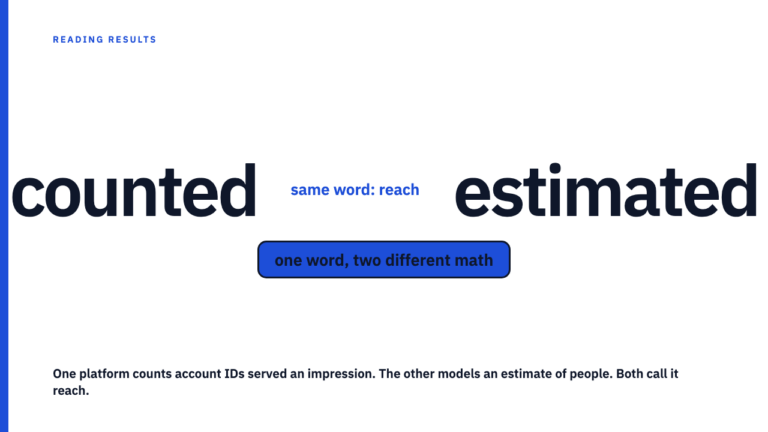
The multiple there is arbitrary. The direction is not: for the same underlying activity, a wider window can only count the same conversions or more, never fewer. A return figure is therefore partly a property of the counting rule, the same failure mode as a metric name can hide more than one definition.
The window is usually picked after the campaign runs, and that is what a case study leaves out
Two practices produce identical looking numbers. In one, the window and the model are fixed before the campaign starts, written into a measurement plan, and the result is read off that rule whatever it says. In the other, they are selected or adjusted once the outcome is visible.
The second is not fraud and usually not even cynical. Someone decides a longer window fits a slow buying cycle better, and may well be right. But the reported number was picked from several available ones by someone who could see them all. What it cannot be is a figure you set against another case study’s. This is a cousin of the number no case study can show you, but sharper: a counterfactual is unobservable, while a window is documented.
Questions to ask before you compare two return figures
- Does it state a conversion window or attribution model at all? If those words appear nowhere, you are comparing two unlabelled outputs of two unknown rules.
- Is the window click-based, view-based, or a blend? A return including view-through credit counts people who never clicked. Defensible, but a different claim, and the source should say which.
- Did the reporting period give the window time to mature? A quarter’s results pulled the day it ends cannot contain conversions still inside an open 60 or 90 day window. That figure undercounts by construction.
See how the disclosure varies in practice
Read published case studies with this in mind and notice how rarely the counting rule appears. Every number in the library belongs to the agency that reported it, credited as their result, not a benchmark. Browse the case study library and see which write-ups state their window. If you have published work of your own, submit your own, and state the window in it.
FAQ
What is an attribution window?
It is the length of time after a click or an impression during which a resulting action can still be credited to it. Google Ads documents this as the conversion window: the period after an ad interaction, such as a click or a video view, during which a conversion is recorded. Actions after it closes are not recorded against that interaction.
Does a longer attribution window always produce a higher reported return?
For the same underlying activity, a longer window can only count the same conversions or more, so the figure rises or stays flat. That is a mechanical property of the counting rule, not evidence that the longer window gives the true answer. Adjusting the setting is an ordinary documented choice. The problem is reporting a number without saying which rule produced it.
Sources
- Google Ads Help: About conversion windows, fetched 2026-09-03.
- Google Ads Help: About attribution models, fetched 2026-09-03.