The ROI Number That Left Out the Cost of Making the Thing
You are looking at a case study reporting a six times return, and the number is probably true. The useful question is not whether the agency made it up, but which costs were allowed onto the bottom of that fraction. That decides whether the ratio means anything for your budget.
What a reported ROI, ROAS, or CPA actually nets against revenue
When a results claim says “6x ROAS” or “$12 CPA”, the cost side is, in almost every case, media spend alone. Attributed revenue over dollars paid to the platform gives the return, platform dollars over conversions gives the cost per acquisition. Nothing else sits on the denominator unless the document says so.
Three cost categories are almost never in there. Production or creative cost, whatever it took to make the asset exist before a dollar of media ran behind it. The agency’s retainer or management fee for the period. And internal hours, the time your own team spends briefing, reviewing, and approving the work.
That describes common reporting practice, not a definition issued by any platform or standards body.
Leaving those costs out is not automatically dishonest
Media-only return is a legitimate metric with a real job. It answers what a media buyer needs to know: is the spend itself working, and should the next dollar go here? A public case study is also a marketing document, not management accounts.
The failure is on the reader’s side. It starts when a media efficiency figure is read as a fully loaded business return, the same category error as treating someone else’s case study result as your benchmark, moved from context to cost basis.
Media-only return versus fully loaded return
| Cost input | Media-only ROAS or CPA | Fully loaded ROI |
|---|---|---|
| Ad spend paid to the platform | Counted | Counted |
| Production and creative cost | Typically excluded | Counted, often amortised |
| Agency retainer or management fee | Typically excluded | Counted for the period covered |
| Client-side internal review hours | Excluded | Counted at an assumed rate |
Neither column is the correct one. The left tells you whether the media buying worked, the right whether the program was worth running. They answer different questions.
A hypothetical worked example: the same campaign, two totals
The numbers below are hypothetical. They describe no real agency and no case study published anywhere, including in this library.
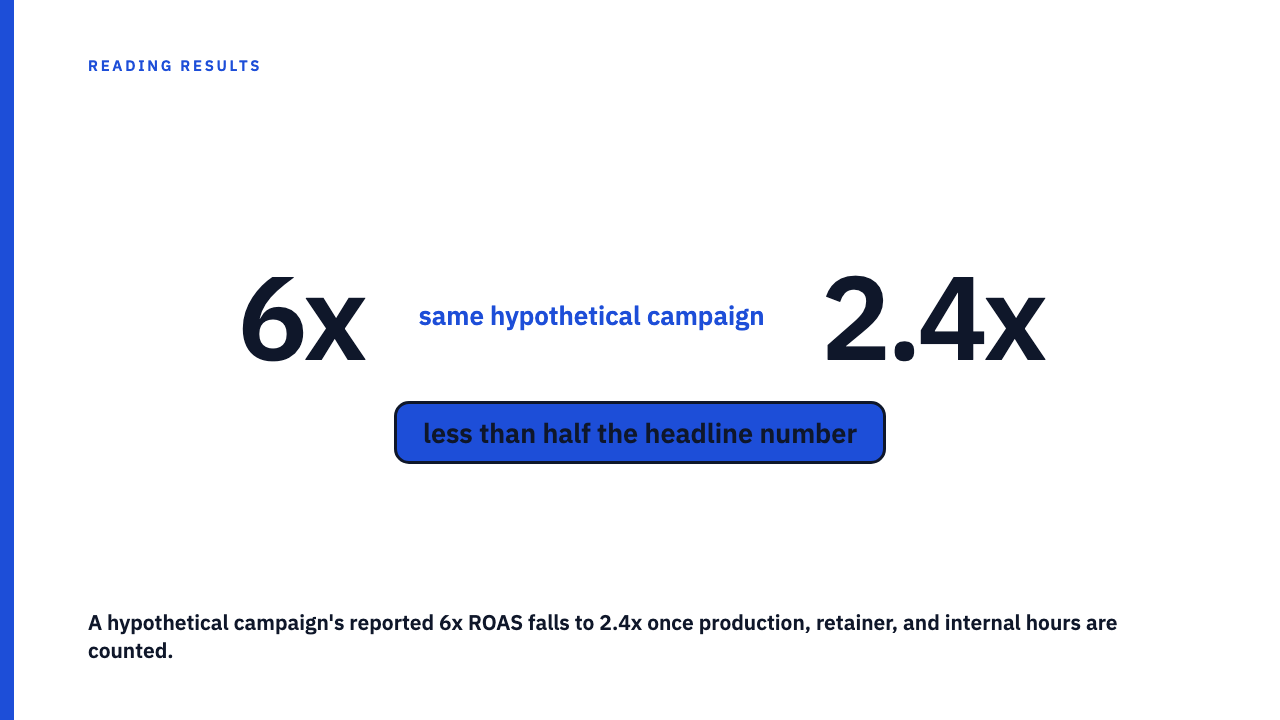
Picture a regional insurance broker that spends $10,000 on paid social over a quarter and attributes $60,000 in revenue to it. Sixty thousand over ten thousand gets reported as a 6x ROAS.
Now add what the ratio never saw. Say the creative took a hypothetical $8,000 production budget and the agency charged a hypothetical $4,000 retainer for the quarter. Total cost becomes $22,000, and sixty thousand over twenty two thousand is roughly 2.7. Add 40 hours of the client’s own briefing and approval time at $75 an hour, another $3,000, and the total reaches $25,000 with the return at 2.4 times. Less than half the rate the headline implied.
The questions that tell you which costs were allowed to count
- Is this figure media-only or fully loaded? Ask it in those words. A report that has thought about the distinction answers immediately.
- Does the cost recognition window match the revenue recognition window? A one-time production cost is sometimes amortised across a twelve month campaign while the reported result covers only the first eight weeks.
- Does internal staff time appear anywhere in the calculation? Not whether it was significant, just whether it is in there at all.
- What would the ratio need to be to still look good once those costs go back in? Set your threshold first, then compare.
Run that alongside how to read a marketing case study and what backs up a case study number, since a figure can be well sourced and narrowly costed at once.
Internal hours are the cost that goes missing most completely
Production cost and retainer fees at least exist in the agency’s records, so a client who asks can usually get them. Internal hours are different. The agency cannot report them, because it has no visibility into who sat in your review meeting or how long approval ran inside your organisation. That cost is unobservable from where the number is calculated rather than withheld, so the reader has to add it.
The library on this site publishes 10 case studies, each credited to the agency that produced it. The large majority lead with reach, engagement, follower or subscriber growth, or lead volume. Cost-based returns are the exception, and where a return on ad spend figure does headline a study, the page sets revenue against media spend without disclosing production cost, retainer, or client-side hours. That is not a criticism of any agency. It is what the genre reports, which is why asking why the best metric on a dashboard is rarely the real story applies to the cost basis too.
Read the ratios yourself
Browse the case study library and try naming the missing cost categories before each write-up tells you. If your agency has published work with a cost-based result, you can submit your own.
FAQ
Does a reported ROAS or ROI include the cost of producing the ad creative?
Usually not. As commonly reported, the figure nets attributed revenue against media spend alone, so creative production sits outside the calculation. Production cost is a separate line item you have to ask about directly.
Should I distrust every case study that reports ROI without a full cost breakdown?
No. Most case studies are not obligated to publish a full cost breakdown, and leaving one out is normal practice rather than concealment. Your job is to ask what the ratio included before you treat it as a benchmark for your own budget, not to assume something is being hidden from you.
How do I estimate the fully loaded cost of a campaign before comparing it to my own budget?
Add back the production cost of the assets, any retainer or fee covering the period the result spans, and a rough estimate of internal hours at a defensible rate. You will not get precision. Treat the output as a range.
Sources
- The case study library, fetched 2026-09-05.
- How to read a marketing case study, fetched 2026-09-05.
- Someone else’s result is not your benchmark, fetched 2026-09-05.
- What backs up a case study number, fetched 2026-09-05.
- Why the best metric on a dashboard is rarely the real story, fetched 2026-09-05.