When the Control Group Saw the Ads Too, the Lift Is Suspect
You are reading a case study that reports a holdout. The treated group converted at some rate, a control group that supposedly never saw the campaign converted lower, and the difference is offered as proof the campaign worked. Before you accept that gap, ask the question the page rarely answers: how do you know the control did not see the campaign? On social platforms, staying unexposed is harder than the design assumes, and a control that quietly saw the ads can bend the reported lift.
What a holdout is actually claiming
A holdout, or control group, rests on a single argument. You take two groups alike in every way that matters, expose one to the campaign and withhold it from the other, then attribute the difference in outcomes to the campaign. The number you are estimating is the lift: the gap between the treated group’s outcome and the control’s. That gap is a clean estimate only when exposure is the sole difference between the groups. Any other difference that moves the outcome is a confounder, and it contaminates the estimate.
So the whole structure leans on one assumption, that the control did not see the campaign. That assumption is the load-bearing wall of an incrementality claim, asserted far more often than defended. A case study will detail the creative, the spend, and the lift, then dispose of the control in a clause, “a matched holdout group that was not shown the ads.” Whether it stayed unexposed is left for you to take on trust.
The three ways a social control group gets exposed anyway
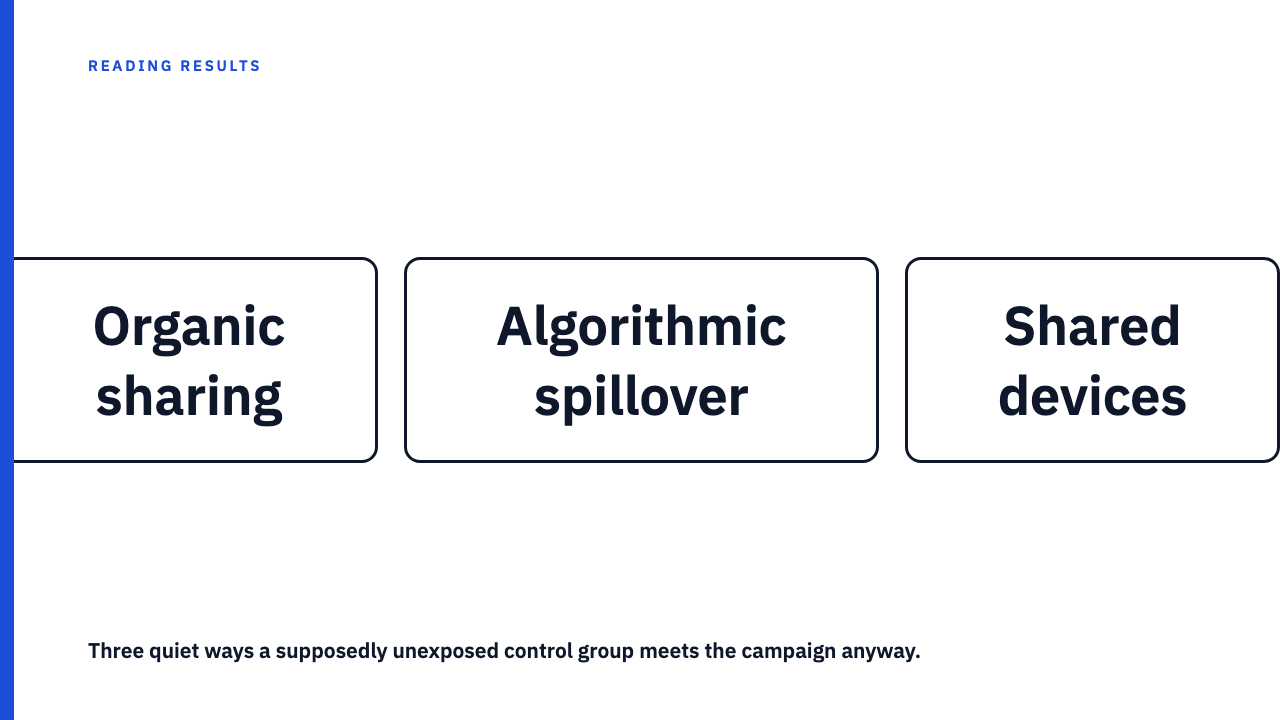
On social platforms, a nominally unexposed control can still meet the campaign through three routes.
- Organic sharing. A treated user reshares the ad, and it lands in a control user’s feed as an ordinary share from a friend, with no ad label. The control has seen the campaign, but the ad delivery logs never recorded them as reached.
- Algorithmic spillover. Engagement from the treated group teaches the platform that the content performs, so it surfaces organically to people who were never targeted, including the control, without ever being billed as an impression.
- Shared devices and households. One household, one smart TV or shared login, one person in treatment and another in control seeing the same screen. Assignment happened per account, but exposure happened per household.
These routes share a property: they all move in one direction. They leak the campaign into the control; none leaks the control’s cleanliness back into the treatment. Contamination here is a one-way door.
Which way contamination bends the number
When the control is partly exposed, its outcome drifts up toward the treated group’s, because some of the control is now getting the same nudge the treatment got. The gap you are measuring shrinks. This surprises people the first time they see it: a leaky control usually understates a real lift rather than inflating it. A contaminated test is not automatically a flattering one.
Work it through with clearly hypothetical numbers. Picture a treated group converting at 6 percent, hypothetically, against a clean control at 5 percent, hypothetically. That is a one point gap, the honest lift. Now let the campaign leak, so shares and algorithmic surfacing lift the control to 5.7 percent, hypothetically. The measured gap collapses from a full point to three tenths of a point. The true effect has not changed, only its visibility, and the reported lift now reads as roughly a third of its real size. Every figure there is hypothetical, illustrating the direction of the distortion.
There is a case where contamination flatters instead, and it is the more dangerous one. If the leakage is correlated with something else that drives conversion, the shrunken gap is not just smaller, it is confounded in an unknown direction. And a shrunken gap tempts the analyst to react: re-slice the data, drop a segment, or pick the window where the gap looks widest, and the surviving figure is overstated or meaningless. The contamination did not have to inflate the number, only to create a reason to hunt for a better one.
The questions that separate a clean holdout from a decorative one
You can interrogate any holdout without special access, just by asking how the control was kept unexposed. How was the control chosen, and could a control user plausibly follow, be followed by, or share a household with someone in treatment? If both groups come from the same social graph, the wall between them is porous by construction. Was the holdout geographic, account level, or device level, and does that unit match how the campaign spreads? A device level holdout does nothing about a share that jumps between devices, and an account level one does nothing about a shared television.
Did the campaign rely on organic sharing or virality? If so, a campaign designed to spread is one designed to reach its own control, and the more it spread, the more contaminated its holdout. And does the study report the contamination it measured, or just assert the control was clean? Carry these as questions to any results page, not a checklist you assume the agency filled in for you.
What a defensible holdout says out loud
A strong version of this claim reads differently, and once you have seen one you spot the difference fast. It names its own contamination: how the control’s exposure was estimated, what share of the control was probably reached anyway, and how the lift was adjusted or bounded as a result. It treats a sealed control as something to demonstrate, not assume.
That leads to a conclusion which feels backwards until you sit with it. A result that admits some leakage and still shows a gap is stronger evidence than one claiming a perfectly sealed control, because the first has reckoned with the thing most likely to be wrong and the second waved it away. You want the lift to be real. Check the control first.
Read more, or add to the library
To see how different agencies handle disclosure of their own controls, you can browse the case study library. If you have published work with a holdout you can defend, you can submit your own.
FAQ
Does a contaminated control always make the result look better?
No, and that catches people out. Leakage usually pushes the control’s outcome up toward the treated group’s, which shrinks the measured gap and understates a real lift, so a contaminated test often looks less impressive than the truth. The exception is when the leakage is correlated with something else that drives conversion, or when the shrunken gap prompts an analyst to re-slice the data until a bigger number appears. Then the figure can end up overstated or meaningless. Read contamination as a warning that the number is unreliable in an unknown direction, not proof it is too high.
What is treatment spillover?
Treatment spillover is when the intervention reaches units assigned to the control, so the groups are no longer cleanly separated by exposure. On social platforms it happens through organic sharing, algorithmic surfacing of content that performed well, or shared devices in a household. It is a recognised source of bias because it violates the assumption that one unit’s treatment does not affect another unit’s outcome, the standard no-interference condition behind causal estimation.
Sources
- Confounding, general definition of confounding and control-versus-treatment logic, fetched 2026-09-11.
- Treatment and control groups, definition and purpose of treatment and control groups, fetched 2026-09-11.
- Spillover (experiment), spillover of treatment into the control and the bias it introduces, fetched 2026-09-11.
- Stable unit treatment value assumption, the no-interference assumption that spillover violates, fetched 2026-09-11.