‘62% Said They Would Buy’ Is Not a Sales Result
You are reading a case study and the headline result is a single survey percentage about wanting to buy. Nothing beside it says anyone bought. Before you decide whether to believe it, it helps to be exact about what the number is a record of.
The headline that has a percentage and no sales figure
Here is a hypothetical. A case study reports that 62% of surveyed people said they would buy after the campaign. To be clear, that figure is invented for illustration. It is not from any library entry and it is not a benchmark.
That one sentence reports three things: a group of people, a question they were asked, and an answer they chose. None of the three is a purchase. The group might be large or small, broad or hand-picked. The question might be blunt or leading. The answer is a statement about the future, made in a moment when nothing was at stake.
This post takes a plain position. Intent is a real measure and often a useful one. It answers a different question from “did sales move”, and trouble starts only when the first is presented as the second. As we have written about the word ‘conversion’ hiding five different funnel stages, stage labels matter, and intent sits well before the till.
Stated and revealed behaviour are two different records
Stated behaviour is what someone tells you: a survey answer. Revealed behaviour is what they did: a recorded purchase, a redemption, a repeat order. Economists have a name for the second idea. Revealed preference is the notion that consumers’ preferences can be read from their purchasing habits, rather than from what they say.
Behavioural research points the same way. In the theory of planned behaviour, intention is treated as the most proximal determinant of behaviour, which makes it a predictor. The same theory holds that perceived control over the action moderates the effect, so a favourable intention produces the behaviour only when a person feels able to carry it out. Intention explains part of what people do, not all of it, and a predictor is not a substitute for the thing predicted.
None of this requires anyone to lie. Most people answering a survey mean it when they answer. The gap opens afterwards, in the world.
Why intent figures run higher than actual conversion
Picture 1,000 hypothetical respondents, of whom 620 say they would buy. Follow them out of the survey. The numbers below are invented to make the arithmetic easy. They are not a typical conversion rate and should not be read as one.
- Answering is free, buying is not. Ticking a box costs nothing. Suppose 150 of the 620 would not have said yes if the answer had required a payment.
- No shelf, no checkout. The respondent has no competitor and no price in view. Suppose another 130 meet a rival offer, or a price, and drift off.
- Wanting to be agreeable. Respondents often answer the way they think will be viewed favourably, which is what social-desirability bias describes. Say 60 said yes to be pleasant to the interviewer.
- A lopsided scale. Someone “somewhat likely” gets counted alongside someone “definitely”. The next section shows how much that alone can move the headline.
- Time passes. The need fades, the budget goes elsewhere. Suppose 100 more fall away.
In this made-up funnel, 620 becomes 180 before any other loss. The size of the drop is an artefact of the invented numbers. What carries over is the direction. The gap is not guaranteed in every case, since people also buy things they said they would not. But the usual caution is overstatement. How large that overstatement typically is, I cannot say from a source I have verified: [EVIDENCE NEEDED: a fetched, readable source giving the typical share of stated intenders who go on to buy].
What the answer scale is hiding
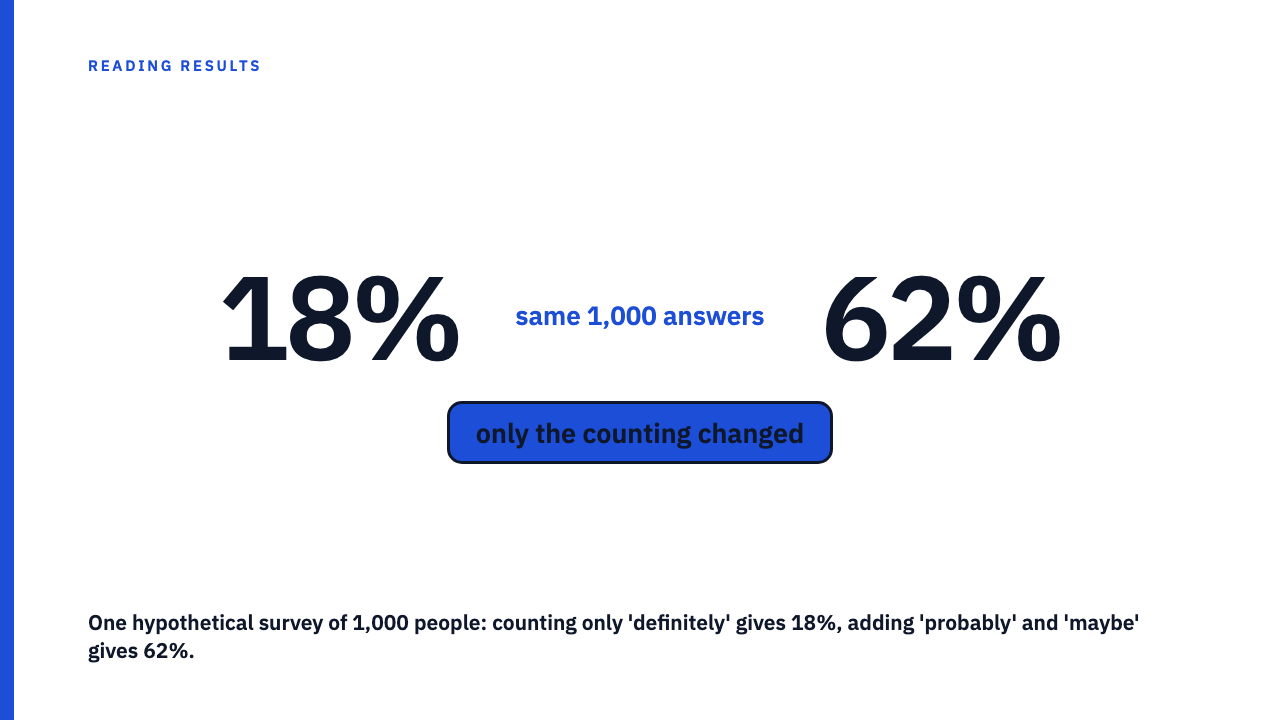
The same set of answers can produce very different headlines, depending on which options are counted as “would buy”. Take one hypothetical survey of 1,000 people.
| Answer (hypothetical) | Respondents (hypothetical) |
|---|---|
| Definitely would buy | 180 |
| Probably would buy | 260 |
| Maybe would buy | 180 |
| Probably would not | 200 |
| Definitely would not | 180 |
| What “would buy” counts (hypothetical) | Headline figure (hypothetical) |
|---|---|
| Definitely only | 18% |
| Definitely or probably | 44% |
| Definitely, probably or maybe | 62% |
Counting only the top answer is often called a top-box approach, and counting the top two is a wider one. Nothing about the respondents changed between rows. Only the counting did. So the questions to put to the case study are the exact question wording, the response options, and which options went into the headline. A bare “would buy” with no wording shown is a claim you cannot yet interpret.
What a case study can honestly claim from an intent measure
Supportable claims stay inside what was measured: that more of those surveyed said they would consider buying than a comparison group did, if there was a comparison group, and the survey was asked the same way. Unsupportable claims jump the gap: “the campaign drove 62% of the audience to buy”, or “sales rose by the intent percentage”. The first describes attitudes. The second asserts behaviour nobody recorded.
Three things turn an intent figure into a stronger claim. A pre-campaign baseline asked the same way shows movement rather than a snapshot. A comparison group not exposed to the campaign shows whether the campaign, and not the calendar, moved the answers. And a later behavioural number from the same period, such as sales, redemptions or repeat orders, shows whether any of it turned into action. Sample matters too, and a disclosed sample size can still hide who was surveyed.
A case study may legitimately report intent when intent was the goal, as with a launch where nothing has shipped yet. There, a stated-interest number is the honest thing to measure. The fault lies in dressing it as an outcome that implies sales. That is the same distinction as a projected number is not a reported result, and it matters because a case study number is only as good as what backs it up.
Five questions to put to any intent percentage
- What exactly was asked, word for word?
- Which answer options were counted as a yes?
- Compared with what: a pre-campaign baseline, an unexposed group, or nothing?
- Does any behavioural figure appear anywhere in the case study?
- Does the agency or the client say what the intent number was meant to predict?
If the sales number is absent, treat the intent result as a claim about attitudes, and ask the agency whether a behavioural figure exists. Absence is not evidence of failure. Plenty of work is judged on intent because that was the brief.
Read more of these, or add one
Browse the case study library and try the five questions on what you find, or submit your own.
FAQ
Does a high purchase-intent score mean sales went up?
Not by itself. Intent is a statement about the future and sales are a record of the past. Intent can be associated with later purchasing, but a case study needs a behavioural figure from the same window to claim a sales effect.
Why do people say they will buy and then not buy?
Answering costs nothing, no real price or alternative is in view, people like to be agreeable, and circumstances change. It is rarely dishonesty. Most people mean it at the moment they answer.
Sources
- Revealed preference, Wikipedia, fetched 2026-10-12
- Theory of planned behavior, Wikipedia, fetched 2026-10-12
- Social-desirability bias, Wikipedia, fetched 2026-10-12