A 90-Day Headline, a 12-Month Campaign: What’s Missing
A case study opens by saying the agency has worked with this client since early last year. Four paragraphs down, the results box is labelled “90 days.” Both are presumably true, and between them sits a hole about nine months wide that the document never mentions again.
The headline window and the engagement are two different numbers
“We have worked with this client for a year” and “in the last 90 days, enquiries rose sharply” are separate claims. The first describes a relationship, the second a measurement taken inside it. A case study leading with the second that never states the first has not lied to you. It has let you supply the missing half, and readers supply the generous version: the quarter is a fair sample of the whole thing.
This is also not the same question as how the result was counted. Which conversions get credited, and over what lookback, is a measurement decision, and the attribution window is a separate choice from this one. The reporting window is just how much calendar time appears in the document.
What a shorter window can be doing that a longer one would show
A narrow window is not one problem. It is at least four:
- The launch spike, then the plateau. New creative or a refreshed account often peaks in its first stretch, then settles. A case study that ends where the settling begins describes a real event, just not a durable one.
- A client-side event the agency did not cause. A quarter can contain a product coming back in stock, a distribution deal landing, or a founder getting written about somewhere large. The social work ran through all of it, and so did everything else.
- The window that stops before the reversion. If the following quarter drifted back toward where things were before, the strongest quarter becomes the only one anyone would publish.
- The window that starts late. Reporting that begins in month four of a twelve month engagement drops the ramp up, when budget was being spent and results were thinner.
Seasonality belongs here too, and a short window can also be hiding a seasonal tailwind that would flatten out over a longer frame.
A hypothetical twelve months, and the ninety days someone would choose to lead with
Here is a hypothetical engagement, invented for illustration. Picture a home goods retailer generating roughly 400 attributed enquiries a quarter before any agency was involved, then running a full year with one:
| Hypothetical quarter | Attributed enquiries |
|---|---|
| Q1 | 400 |
| Q2 | 1,600 |
| Q3 | 500 |
| Q4 | 450 |
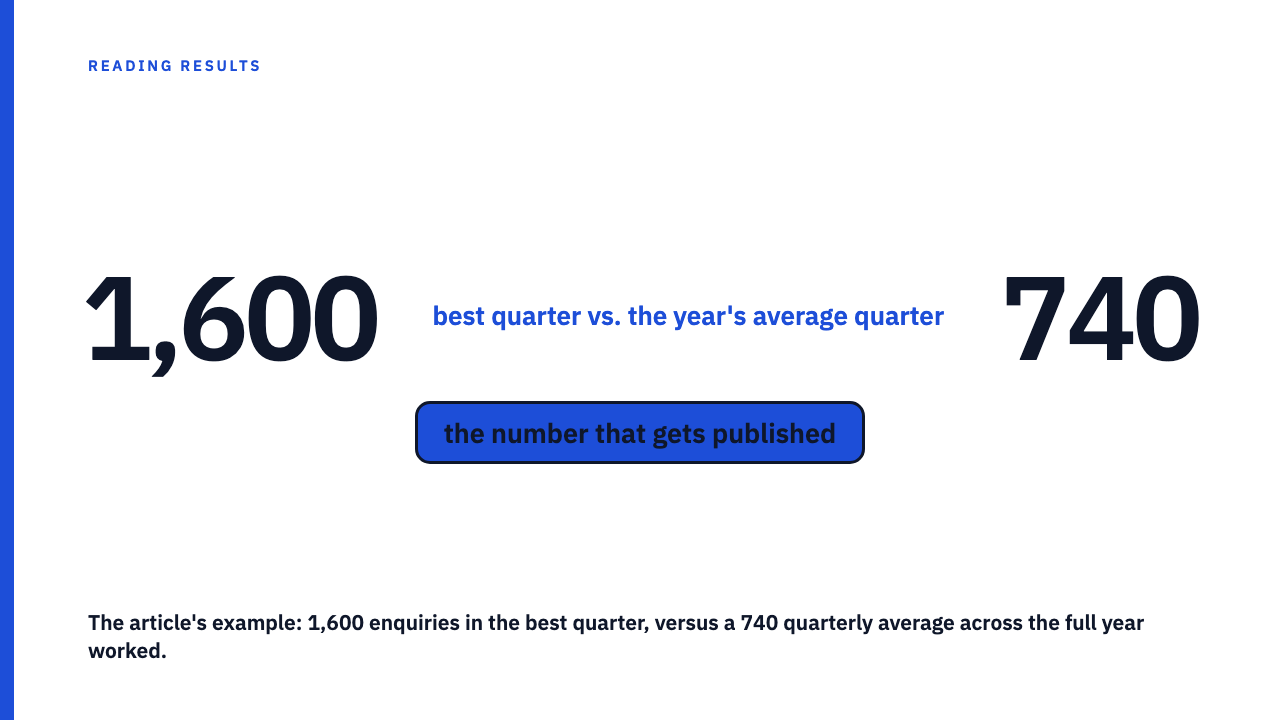
Two headlines come out of that one hypothetical dataset, both arithmetically honest. The first: “1,600 attributed enquiries in a single quarter, four times the pre engagement baseline.” The second: “2,950 enquiries across twelve months, an average of just under 740 a quarter against a baseline of 400.” Only the second represents the period actually worked, and a reader shown the first has no way to know Q3 and Q4 exist.
Where the full timeline actually is, when it is anywhere
The case study often will not volunteer the engagement length, so it helps to know where it leaks out. Agencies date their own relationships in prose that has nothing to do with results: a portfolio page reading “client since 2023,” an about page listing long standing accounts, a services page describing an ongoing retainer. Public mentions of the same client carrying earlier dates do similar work, whether an older case study or a press piece. Where a case study has a methodology note, the window boundaries are usually explained there.
Sometimes none of that exists, and you do not know how long the engagement ran. Record it as an unknown rather than a guess. An unstated engagement length is a gap in the evidence, not proof that something was hidden.
Questions worth asking before accepting the window as representative
- How long does the case study say the engagement has run, and does that number appear anywhere at all?
- Does the reported window start at the beginning of the engagement, or partway through it?
- Is there any indication, in a chart axis or a footnote, of what the unshown months did?
- Would this case study look different if it covered the full engagement instead of its strongest slice?
The last one does the work. If the answer is obviously yes and the full period appears nowhere, you are reading a claim about a quarter, not about a relationship. It is how to read a marketing case study, narrowed to one thing.
A short window is not automatically a cherry-picked one
Plenty of work genuinely is short. A product launch, a six week seasonal push, a single sprint against a defined objective: these have real boundaries, and a case study covering that period reports the whole thing.
The distinguishing test is disclosure, not duration. A short window is fine when the case study says what it is and the stated scope matches the reported period. It becomes a problem specifically when a longer relationship is implied or stated and the result shown covers only part of it without saying so. The FTC’s endorsement guidance sits nearby: it discusses making clear what the “generally expected results” are when a featured experience may not represent them. That is a neighbouring principle, not a rule governing case study date ranges.
Read a few of these side by side
This gets faster once you have seen the same window stated in several different ways. You can browse the case study library and check date ranges against the engagement language, or submit your own with the window stated plainly.
FAQ
What counts as a suspiciously short reporting window?
There is no fixed cutoff, because the number only means something relative to the engagement. A 90 day headline on a case study that also says the relationship has run a year or more is worth checking, particularly if the full period figures appear nowhere. When no engagement length is stated at all, that absence is worth noting rather than treated as permission to assume the window is fine.
Where can I find out how long an agency actually worked with a client?
Usually not in the case study. Look at the agency’s own site language about the relationship, then at other public mentions of the same client carrying earlier dates, then at any methodology the case study includes. If none of those exist, you are left without an answer, and the right move is to say so.
Sources
- FTC, The FTC’s Endorsement Guides: What People Are Asking, fetched 5 September 2026.