Why a Case Study’s Caveat Disappears by the Time It’s a Slide
You have seen the same result three times this week: once on an agency’s site, once as a pitch deck slide, once as a line in a social post promoting the case study. Each version sounded more certain than the last, and you cannot quite say why. Nobody lied between versions. Every format has a hard limit on space or attention, and the caveat is never the part that gets protected when something has to go.
The same result, told four times, four different ways
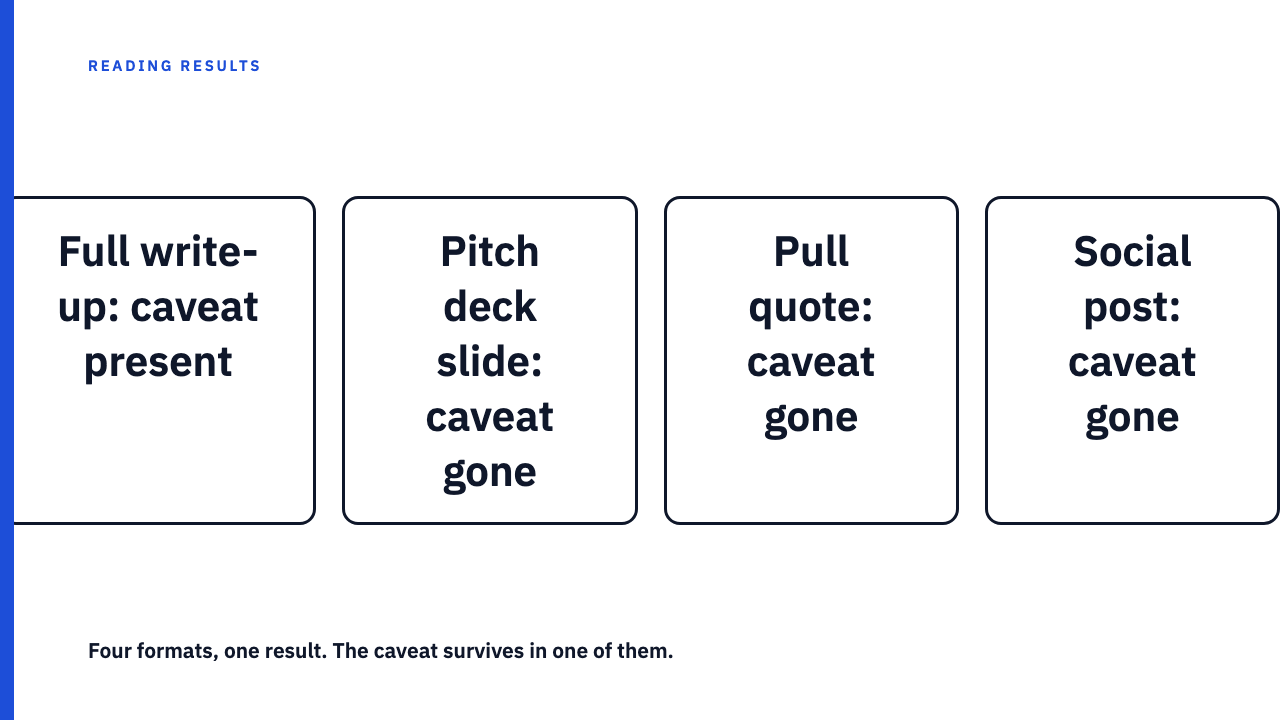
A reported result rarely travels through a marketing ecosystem in only one form. It starts as a detailed write-up with a methods note and a paragraph of qualifications, gets adapted into a pitch deck slide because a prospective client will not read the write-up in a sales meeting, gets pulled into a pull quote for a testimonial page, and gets pushed into a social post because a feed post needs one line, not a sentence. Each step drops length, and a caveat is exactly what does not survive that drop, since it is context that either fits or gets cut, and almost never what gets protected.
This piece traces one result through those four formats, in order of decreasing length: the detailed write-up, the pitch deck slide, the pull quote, the social post. By the fourth version, you are looking at a claim with none of the information that would let you judge it.
A hypothetical case, followed through its own shrinkage
Picture a hypothetical agency case study, illustrative only and not a real reported result: “Across a hypothetical sample of 14 client accounts over a hypothetical eight week reporting window, engagement rate rose by a hypothetical 22 percent compared to the eight weeks prior, with no comparable control group tracked.” That sentence tells you the base is small, the window is short, and there was no comparison group, the small-sample caveat covered in when the base is small, the percentage is just noise.
As a hypothetical pitch deck slide it becomes: “Engagement rate up a hypothetical 22 percent, hypothetical eight week window.” The sample size of 14 accounts is gone. The window survives in shorthand, but the missing control group has vanished without a trace, leaving only the number and a rough timeframe, nothing to weigh how solid it is.
As a hypothetical pull quote it shrinks further, to “a hypothetical 22 percent lift in engagement.” Now the comparison point is gone too, and there is no way to answer lift compared to what, over what window, from the quote alone.
Same hypothetical number, now as a social post
Finally, a hypothetical social post: “Our clients are seeing engagement gains like this.” No hypothetical number survives in checkable form, only a pointer toward the case study. To anyone who has not seen the earlier three versions, this reads as an unqualified success claim, not the tail end of a chain that started with a specific, bounded, small sample result.
Why the caveat goes first, specifically
A caveat is qualifying language, and qualifying language reads as hedging in a format built to persuade, so whoever compresses the text has an incentive to cut it even without deciding to mislead anyone. There is also a plainer, mechanical reason: a number is visually compact, “22 percent” fits in a headline font on one line, while a caveat needs a clause, sometimes a full sentence, and attaches to no single figure the way the percentage does. It loses the space competition before anyone makes an editorial decision about honesty.
This differs from cherry-picking a favorable reporting window or a flattering baseline, choices made when the case study is first written and covered elsewhere on this site. Compression happens afterward, to a study that may have been written honestly and completely. The caveat existed. It simply did not survive being made shorter.
What kind of caveat tends to survive, and what never does
- A caveat that changes the number itself, such as a small sample size that makes a percentage unstable, is more likely to survive into the slide stage, since it is closer to the figure the format is built to carry.
- A caveat about attribution, a missing comparison group, or a short time window is most likely to disappear first. It needs a full sentence and attaches to no single figure, the same reason the attribution window is a choice that rarely survives a retelling.
- Treat this as a pattern to watch for, not a guarantee. No case study is required to follow it.
Which version to trust when you only have the short one
When you find a pull quote or social post with no caveat visible, treat the absence as missing information, not as evidence that nothing was omitted. A short-form restatement was never going to carry the caveat even if the original included one, because the format cannot hold it.
Trace back toward the original detailed write-up before repeating the number further. That is the only format where a caveat had room to survive, so it is the only place a genuine check can happen, and how to read a marketing case study is a reasonable place to start once you find it. If no original write-up can be found, treat the short-form claim as unverified rather than upgraded to a fact for appearing in several places, since repetition across a deck, a quote, and a post is usually the same write-up, or the same missing one, retold. As covered in a case study number is only as good as what backs it up, credibility comes from what supports a number, not how many places you have seen it.
Get the source, not the retelling
Browse the case study library for write-ups that still carry their caveats, or submit your own with the sample size and reporting window included.
FAQ
Is it dishonest for an agency to drop the caveat from a pitch deck slide?
Usually not intentional deception. It is more often what a format with a hard space limit does to any qualifying language, and the same drift happens to results the agency did not choose to omit anything about. That does not make the shorter version safe to repeat without checking the source.
If I can only find the social post version of a result, should I just assume the caveat was minor?
No. Absence of a caveat in the shortest format is missing information, not evidence that nothing was omitted. Look for the original write-up before deciding how much weight the number deserves, since the social post was never built to carry that context.
Sources
- https://socialcasestudies.com/blog/how-to-read-a-case-study/, checked 2026-09-09
- https://socialcasestudies.com/blog/self-reported-vs-verifiable-numbers/, checked 2026-09-09
- https://socialcasestudies.com/blog/attribution-window-changes-the-result/, checked 2026-09-09
- https://socialcasestudies.com/blog/small-numbers-big-percentages/, checked 2026-09-09
- https://socialcasestudies.com/blog/case-studies/, checked 2026-09-09
- https://socialcasestudies.com/submit-your-case-study/, checked 2026-09-09