Two Platforms Define “Impressions” Differently, in Their Own Words
A case study says a campaign generated 2 million impressions. Another case study, for a different agency on a different platform, also says 2 million impressions. It is tempting to read those two numbers as the same kind of thing, just at different scale. They are not always the same kind of thing, and the reason is not a rumor or an inference. It is written down, in each platform’s own words.
The comparison this post is actually making
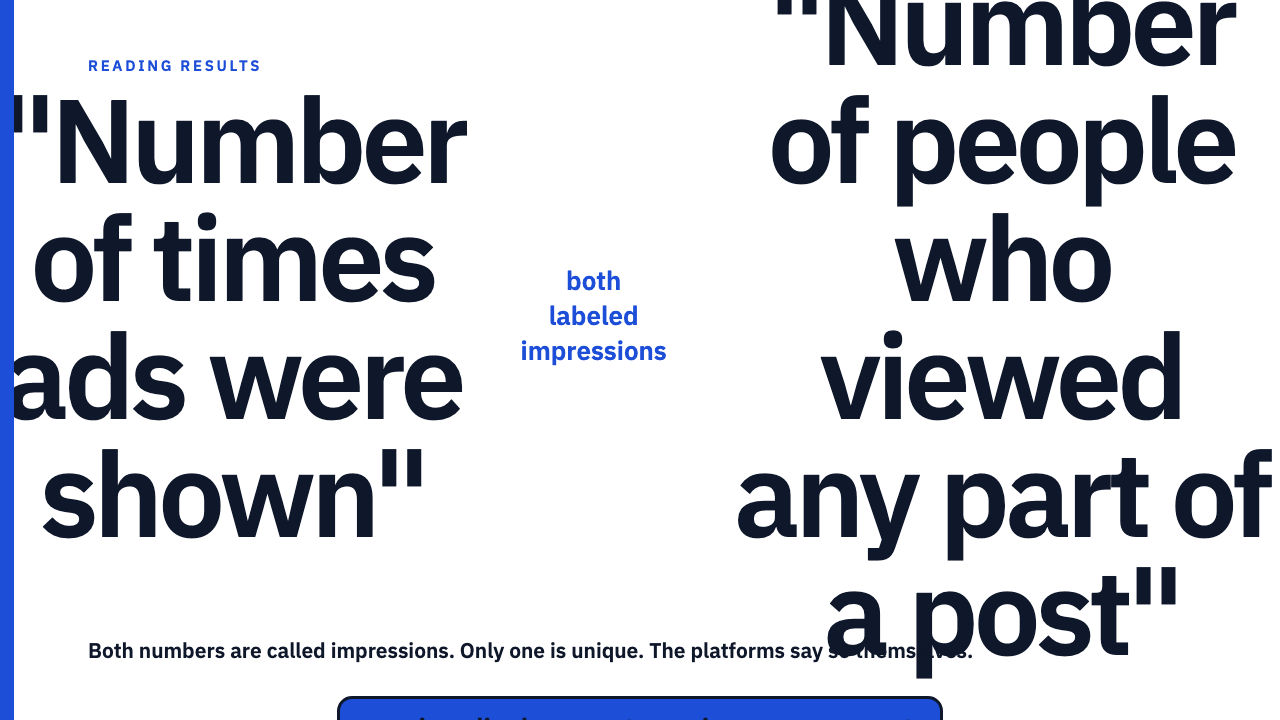
This is not a claim that platforms are inconsistent in some general sense. It is narrower and checkable: TikTok Ads Manager’s help center and X’s help center each publish a definition of the word “impressions,” and the two definitions describe different kinds of counts. TikTok defines it as “Number of times ads were shown.” X defines it as “The number of people who viewed any part of a post.” One counts displays. One counts people.
A per display count and a per person count are not the same kind of number, even labeled with the identical word. If one person is shown an ad five times, TikTok’s definition counts five impressions. X’s definition, applied to a post the same person opens five times, counts one impression, because it counts the person once regardless of repeat views.
This post is not about reach. This site already has a post on how reach is defined differently by platform, and that ground is covered there. What follows is specifically about impressions, and specifically about the fact that the discrepancy is documented by the platforms themselves, not inferred from outside.
What each platform’s own help page actually says
Both definitions below come from live help center articles, fetched and read directly. TikTok’s article, “Basic metrics and definitions,” lists impressions next to reach in the same section. X’s article, “Export CSV definitions,” lists impressions alongside engagement rate, itself calculated by dividing engagements by “total impressions.”
| Platform | Term | Platform’s own definition | What kind of count |
|---|---|---|---|
| TikTok Ads Manager | Impressions | “Number of times ads were shown” | Per display, same person can recur |
| TikTok Ads Manager | Reach | “Number of unique users who saw ads at least once” | Per person, counted once |
| X Ads | Impressions | “The number of people who viewed any part of a post” | Per person, counted once |
TikTok’s own article draws its own line between impressions and reach, one entry apart in the same list, treating one as a display count and the other as a unique person count. That is TikTok’s own distinction, not an outside reading. X’s article uses the word impressions for what TikTok calls reach: a count of unique people. Both describe different measurement concepts under the identical word, and both say so themselves.
Why this is not a semantic technicality
Here is a hypothetical, not drawn from any real platform’s reported figures. Picture Campaign A, running somewhere that counts impressions the way TikTok’s article describes: one person shown an ad five times generates five impressions. Picture Campaign B, running somewhere that counts impressions the way X’s article describes: that same person, shown the post five times, generates one impression. Same person, same five exposures, and the two campaigns report five and one for the identical event. This illustration shows the mechanics only, not a claim about anything either platform has measured.
Scale that up. If a case study’s headline number is “2 million impressions” and the reader assumes two campaigns’ counts measure the same thing, a per display count and a per person count get compared as though interchangeable. They are not, because they answer different questions: one counts how many times something showed up, the other counts how many distinct people saw it. Conflating them means comparing a display tally to a headcount and calling it apples to apples.
The consequence for readers here is specific: two case studies that each print “2 million impressions” can describe structurally different measurements, and nothing about the number itself reveals which is which. The only way to know is which platform each number came from, and how that platform defines the word.
How to check this yourself before trusting either number
- Identify which platform the number came from before evaluating the number itself.
- Go to that platform’s own advertiser or business help center, not a marketing blog’s explainer, and search for the metric by its exact name.
- Read the platform’s definition of the adjacent metric too. For TikTok, read how it defines reach next to impressions, since both definitions side by side show whether the platform treats a term as a unique count or a total count.
- When a case study does not say which platform a metric came from, or blends several platforms’ impressions into one number, treat that total as unverifiable rather than assuming the definitions net out cleanly.
What this means for reading a case study on this site
This library credits every number to the agency or platform that reported it, and never restates a platform’s own number as an industry wide fact. The impressions discrepancy documented here is one instance of a pattern already covered from a different angle: engagement rate is three different metrics wearing one name, because a metric name is not a fixed unit until you know which platform’s definition is attached to it.
This post verifies what two platforms’ own help pages say about one metric. It does not judge whether any agency’s use of that metric was dishonest, and it does not evaluate whether the underlying creative work was good. For the broader habit this post is one instance of, see how to read a marketing case study without being misled.
Before you take the next case study’s numbers at face value
The library organizes case studies by the platform and agency that reported them, so a reader can trace a number back to its source. Browse the case study library, or if you have a case study worth reading this way, submit your own.
FAQ
Does this mean one of the platforms is measuring impressions wrong?
No. Both definitions are documented, internally consistent choices published by the platform itself. Neither claims to match the other’s terminology. The problem shows up only when a reader assumes impressions means one universal thing across every platform, rather than checking each platform’s own definition.
Does every metric have this kind of discrepancy?
This post can only speak to what it verified: TikTok’s and X’s own definitions of impressions. For reach specifically, this site has a separate post on how that term is defined differently by platform. Beyond those two cases, claiming the pattern holds for every metric needs a citation for each one, which this post does not have, so it will not make that claim.
Sources
- TikTok Ads Manager, “Basic metrics and definitions”, checked 2026-09-09
- X, “Export CSV definitions”, checked 2026-09-09