‘Reach’ Does Not Mean the Same Number on Every Platform
A results slide gives you one combined reach figure covering two platforms. Whether that total means anything depends less on the agency’s honesty than on whether both platforms meant the same thing by the word reach.
What ‘reach’ is supposed to measure
Reach, as a concept, is a deduplicated count: each account counted once however many times the content appeared in front of it. Impressions count the other way, every exposure including repeats. Google Ads defines an impression as counted each time your ad is shown, and Pinterest defines impressions as the number of times your Pins or ads were on screen.
That is common ground, not a promise that two platforms arrive at the number the same way. Same failure mode as engagement rate is three different metrics wearing one name: one name over more than one definition.
Two different ways a platform can arrive at that number
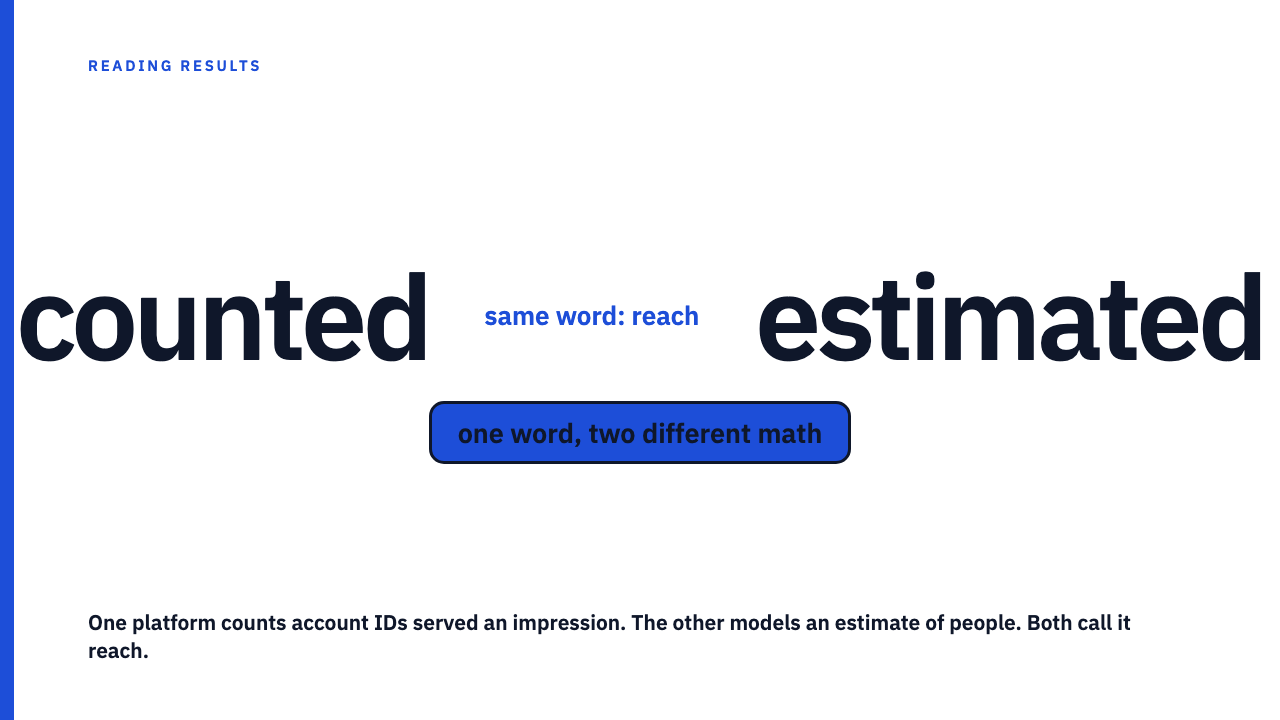
The first mechanism is a count. The platform takes every account ID its logs show was served an impression inside a stated window, removes duplicates, and reports the remainder. Within that window it is exact.
The second is an estimate, and the difference is not cosmetic. Google Ads documents its unique reach as the output of statistical models built on aggregated behaviour across Google products, combined with other signals and local inputs such as census data and probability surveys, to deduplicate an audience across sessions, formats, networks and devices. It describes the result as unique users rather than cookies, calls the outputs best estimates, and notes that geographic modelling can produce a location reach exceeding that location’s total census population. A counted figure cannot do that. An estimate can.
Windows are baked in too. Google Ads reports most reach and frequency metrics only for 92 day ranges or less, Pinterest’s audience figures cover 30 days.
Which platform sits on which side is not something to assume. One major platform’s own help page on how reach is calculated was not readable at the time of writing, so nothing from it is quoted or cited here. [EVIDENCE NEEDED: a current, readable help page from each named platform stating whether its reach figure is a deduplicated count or a modelled estimate.]
A hypothetical case study that adds the two together
What follows is hypothetical. No agency reported these numbers and they describe no real campaign.
Imagine a slide with two lines. Hypothetical Platform A reach: 240,000. Hypothetical Platform B reach: 310,000. Underneath, in the largest type on the page: reached 550,000 people.
Two things are wrong with that sum. First, the units: if the hypothetical 240,000 counts account IDs served an impression and the hypothetical 310,000 models an estimate of people, the addition treats a log entry and a statistical inference as one object. Second, anyone active on both platforms is counted twice, so the sum is an upper bound, not a measure of the unique audience.
The honest version is duller. Report each platform’s reach on its own line, labelled with platform, window, source, and whether it is counted or estimated.
What to check before you accept a cross-platform reach comparison
- Is each figure labelled as a count or an estimate? If the deck does not say, whoever built it either knows and did not tell you, or does not know.
- Is the window stated for each figure? Not the campaign dates, the window used to deduplicate. Reach over 90 days and over 7 days are not comparable, even on one platform.
- Is the source named for each number? Which platform, which report, which metric name inside it. Same standard as a case study number is only as good as what backs it up.
- If the figures are summed, is the mismatch disclosed? A total arriving with no caveat is the thing to push back on.
Why the combined number still makes it onto the slide
Because one large number reads better than two smaller ones, and because reporting templates carry a total reach field with the formula already in it. This does not require bad faith. Convenience produces combined totals as readily as intent to inflate, so reject the number without accusing anybody.
Make the request specific. Ask for reach broken out by platform, each line labelled with the platform, the window used to deduplicate, and whether it is counted or modelled. An agency holding the data can answer that in an afternoon. The wider habit is how to read a marketing case study without being misled.
What a fully disclosed reach figure looks like
A checklist, not a comparison of real platforms. Filling in values unverified would reproduce the error this post describes.
| Disclosure | What it must state | What its absence hides |
|---|---|---|
| Platform named | The platform and report it came from | Shared measurement system or not |
| Counted or modelled | Deduplicated count or statistical estimate | Whether it can be added at all |
| Reporting window | The range used to deduplicate, not campaign dates | Bigger audience or longer window |
| Logged-out traffic | Whether non-account viewers are included | Members or modelled population |
On that last row, inclusion of non-account viewers varies by platform and by surface. [EVIDENCE NEEDED: explicit language in that platform’s own current reach documentation on whether logged-out traffic is included.]
Hold the next one up to the light
The fastest way to get good at this is to read published results and notice which ones label their numbers. Browse the case study library, where every result stays credited to the agency that reported it, or submit your own.
FAQ
Is reach the same thing as impressions?
No. Reach counts each account once, however many times it saw the content. Impressions count every exposure, so one account can generate many impressions while contributing a single unit of reach. Google Ads and Pinterest both define impressions as a per-exposure count, which is why it is the larger figure.
Can a case study add reach from two platforms into one number?
Not honestly, unless it discloses that both figures were measured the same way. If one platform counts the accounts it served and the other models an estimate of people, summing them treats two kinds of measurement as one unit, and anyone present on both is counted twice.
Sources
- Google Ads Help, Measuring reach and frequency, fetched 7 September 2026
- Google Ads Help, Impressions: Definition, fetched 7 September 2026
- Pinterest Business Help, Review Pinterest Analytics, fetched 7 September 2026
- Pinterest Business Help, Review Audience Insights, fetched 7 September 2026