An Agency’s Own Website Is Its Least Independent Case Study Venue
You have found a case study with a number you would like to use. Before you quote it, look at where the page lives. On the agency’s own domain, every editorial decision behind that number was made by the party it flatters.
Who actually decided what’s on this page
Self-publication is not one decision. It is a stack of them, made by the same people, with nobody outside the room.
They decided which client story runs at all, so every account that went sideways never became a page. They decided which metric leads, from a dashboard holding a dozen numbers, several of which moved less impressively. They decided where the before window starts, the most powerful lever on any percentage change, and picked it already knowing the after number. And they keep the right to stop updating the page, or take it down, if the result curdles. None of that is visible in the document.
Now picture the same story passing an outside editor who never worked on the account. They need only ask why this metric. One outside sign-off on one of those four calls changes the provenance of the page, and on the agency’s own site it cannot happen. That is the venue version of a case study number is only as good as what backs it up.
This is a different tier than a platform’s own success story or an award entry
Set the agency’s own site beside a platform’s customer success page and an award submission. A platform page needs partner status. An award entry needs a fee, a deadline and a jury. The agency’s own site is the lowest barrier to entry of the three, the only venue where nobody outside the agency has to agree before it goes up. It costs nothing but the agency’s own credibility, and credibility is only spent if somebody checks.
What they share matters more. In each case a party with something to gain wrote the copy, and the only variable is what that party sells: competence, ad inventory, a trophy. It sits inside the fact that every case study library is a selected sample.
A hypothetical: the same result, told twice
What follows is hypothetical, invented for this article and matching no published case study. Suppose an agency runs six months of social for a regional chain of garden centres, and revenue attributed to social referrals in the second quarter lands 63 percent above the same quarter last year.
On the agency’s own site that becomes a page headlined with the 63 percent, a note on the creative approach and a client quote. It is not dishonest. It is complete on its own terms, and nothing invites a follow-up.
An outside reporter asks what that page has no reason to ask itself. Why the second quarter rather than the six months. What else changed for the business that quarter. Whether the client will confirm the figure on the record. Nobody was going to ask.
Tells that separate a self-published case study from an independently reported one
- The byline. None, or the agency’s own marketing team rather than a named outside reporter.
- The path. The page sits under the agency’s own /work/ or /case-studies/ directory, not a publication’s domain.
- No correction history. No correction notice, no “updated on” line, no visible revision.
- Nobody outside adds friction. Every quote comes from the agency or the client, and each agrees.
- The number is never revisited. No later post asks whether the result held up.
Self-published is not the same claim as fabricated
This is a provenance problem, not a truthfulness verdict. Plenty of self-published case studies are accurate, and treating self-publication as evidence of dishonesty is its own error.
What it removes is a shortcut. When somebody independent has already looked at a claim, you borrow their check. Here that check was never performed, which is why the method for how to read a marketing case study matters more, not less: stated windows, defined metrics, a visible denominator.
Where a self-published result gets a second telling, and where it doesn’t
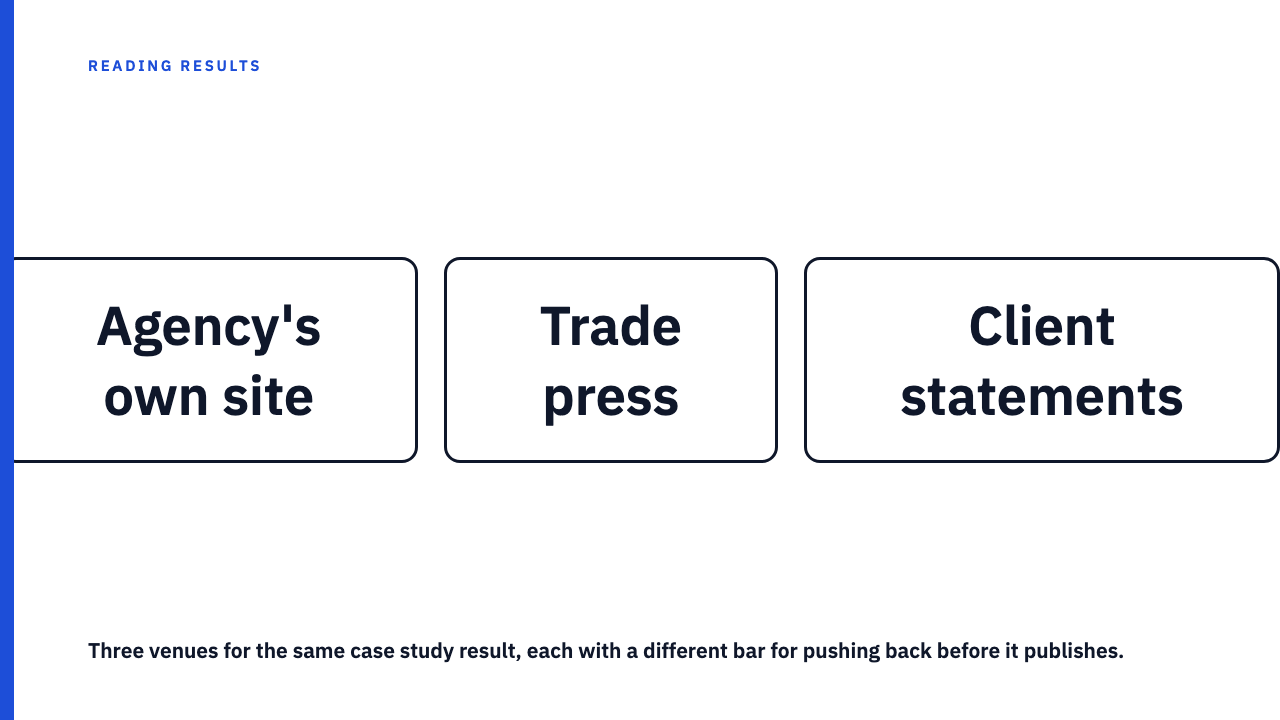
| Venue | Who chose the framing | Who could push back first | If the number is wrong |
|---|---|---|---|
| Agency’s own site | The agency alone | Nobody outside it | Silent edit, or the page disappears, with no record |
| Independent trade press | A reporter and editor, working from a pitch | The editor, sometimes the client | A published correction, and cost to the outlet |
| The client’s own statements | The client, whose incentives differ | Investors, auditors, regulators | Consequences reaching past marketing |
Most self-published case studies never get a second telling, because most campaigns are not newsworthy outside the two companies involved. Absence of outside coverage is not evidence the number is false. It is evidence nobody looked.
What to actually do with a self-published number
Run one search: the client’s name, the agency’s name and the headline result together. If an outside outlet covered the campaign, read that version against the agency’s. A match is corroboration, not proof. A non-match is unverified, not disproven.
Then read the case study on its own internal logic: what the metric measures, when the window starts and ends, how large the base is. That works whether or not a second source turns up.
Read more case studies with this in mind
Every entry here is credited to the agency that reported it. Browse the case study library, or submit your own.
FAQ
Does an agency publishing its own case study mean the result is fake?
No. Provenance asks who published the claim and what they gained. Veracity asks whether the number is true. Self-publication answers only the first: nobody independent checked. The claim has not failed a check. It has not faced one.
What counts as a more independent source for the same result?
Coverage in a trade publication with a named reporter employed by neither the agency nor the platform involved, working under an editor who can correct the piece. A different tier than a portfolio page, not a perfect one.
How can a reader check if a self-published case study has been covered anywhere else?
Search the client’s name, the agency’s name and the headline result together, then again with the client’s name alone. A match is corroboration, not proof. A non-match leaves the result unverified, not disproven.
Sources
- Marketing Dive editorial team, a masthead of named reporters and editors employed by the outlet, not by the agencies it covers. Fetched 2026-09-07.