A Five Times Return Can Still Be a Loss
A case study opens with a return on ad spend figure, five times, in large type. The number is real and correctly calculated, and it still does not tell you whether the client made money. A 5x can lose money on every order.
What the return on ad spend ratio actually measures
Return on ad spend is revenue attributed to the ads divided by the money spent on those ads. Google Ads documents it in that exact shape: five dollars in sales over one dollar in ad spend is a 500 percent target. The numerator is revenue, never profit, so a 5x does not mean five dollars came back to the business.
What the ratio excludes, by definition, is most of what an order costs: cost of goods sold, payment processing, shipping and returns handling, and any marketing cost that is not media. Whether discounts and refunds were stripped from the revenue, the ratio cannot tell you.
Why a healthy multiple is compatible with a loss
The reason is gross margin: revenue minus cost of goods sold, as a percentage of revenue. It is the share of each revenue dollar that survives the cost of the thing sold, and it caps what any return can recover.
Which gives you breakeven return on ad spend: 1 divided by the gross margin rate. Below that line, media consumed more than the margin it generated. Above it, something is left, though not necessarily enough. A thin margin product needs a much higher multiple just to stand still, so the same number means different things by product, and the best metric on a dashboard is rarely the one that tells the whole story.
A hypothetical order, worked in full
What follows is a hypothetical, invented to show the arithmetic, not a reported result from any agency or case study.
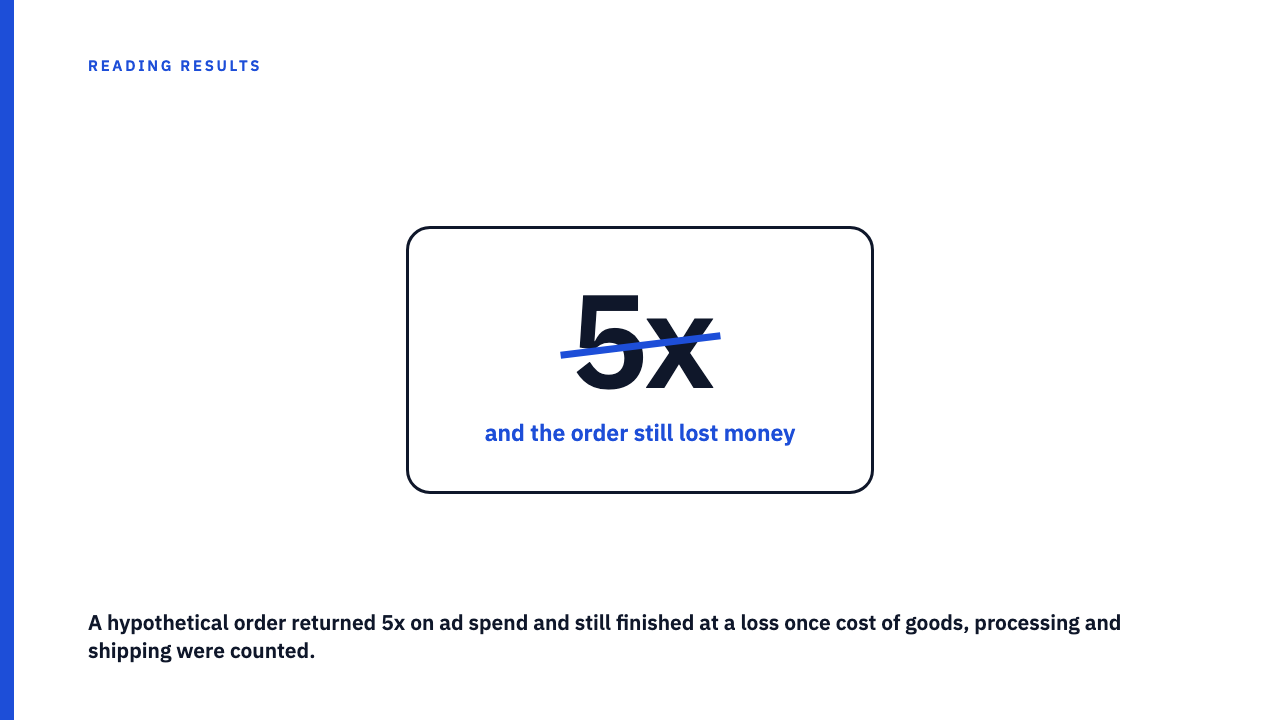
The item sells for 100 and the campaign spent 20 in media, so the reported return is 100 divided by 20, which is 5. Now add what the ratio left out: hypothetical cost of goods 65, payment processing 3.20, picking and shipping 13. That leaves 100 minus 65 minus 3.20 minus 13, or 18.80, against media of 20. The order finished at negative 1.20.
Gross margin here is 35 percent, so breakeven on margin alone is about 2.9, which a 5x clears. But processing and fulfilment are cash costs gross margin does not capture. With them in, only 18.8 percent of revenue is available for media, so the true breakeven is roughly 5.3. The multiple looked strong and the order went backwards. This example was hypothetical.
The breakeven ROAS, and what moves it
The same formula, across a range of margin rates:
| Hypothetical gross margin | Breakeven ROAS (1 divided by margin) |
|---|---|
| 20 percent | 5.0 |
| 35 percent | 2.9 |
| 50 percent | 2.0 |
| 70 percent | 1.4 |
These rates illustrate the formula. They are not benchmarks for any category, product or platform, and they are only a margin-only floor: the real line sits higher once fees and fulfilment are counted. A 5x is breakeven at 20 percent and a comfortable win at 70 percent. Without the margin behind it, a reported return cannot be judged.
What to ask when a case study leads with a ROAS number
None of these questions accuse anyone. They are things a multiple cannot tell you.
- Does it disclose gross margin, or any cost figure? If not, it shows media efficiency and is silent on profit. That silence is often confidentiality, but do not fill it in favourably.
- Is the revenue gross or net? Before or after discount codes, refunds and returned orders. A high return rate category looks strong on orders placed and weak on orders kept.
- Does the spend cover all paid media, or one channel? A return calculated on the highlighted channel’s spend, while other channels ran in the same window, is a channel number read as a business one.
- What attribution window produced the revenue? A longer window pulls more revenue into the numerator without touching the denominator. Unstated, the ratio is not reproducible.
This extends how to read a marketing case study without being misled, and engagement rate has its own version of this problem, at the denominator rather than in the omissions.
The metric is not dishonest, it is just answering a narrower question
Return on ad spend is a legitimate, precisely defined efficiency metric. It answers whether the media spend was efficient at generating revenue. It does not answer whether the business made money, and never claimed to. The substitution happens in the reader’s head, not usually in the reporter’s intent.
Vocabulary helps it along. Return on investment and return on ad spend get used interchangeably and are not the same. Google Ads defines return on investment as revenue minus cost of goods sold, divided by cost of goods sold, with advertising inside that cost. Return on marketing investment also nets cost out. Return on ad spend nets nothing out.
See how results get reported in practice
Every case study here is published work, credited to the agency behind it. Four sit in the e-commerce category, where a return multiple is most likely to be the headline. Browse the case study library, or submit your own.
FAQ
Does a high ROAS mean a campaign was profitable?
No. Return on ad spend compares revenue against media spend only. Profitability depends on gross margin, which the ratio excludes, along with payment fees and fulfilment. A high multiple on a thin margin order can still be a loss.
What is breakeven ROAS?
Breakeven return on ad spend is 1 divided by the gross margin rate, the multiple at which media spend exactly consumes the margin left after cost of goods sold. It is applied to a business’s own margin, not a fixed number.
Why do case studies report ROAS instead of profit?
Because revenue and spend are what exist inside the ad account, which is why Google Ads documents a return target in those terms. Profit needs cost data the platform does not hold.
Is ROAS the same as ROI?
No. Google Ads defines return on investment as revenue minus cost of goods sold, divided by cost of goods sold, so cost is netted out of the return. Return on ad spend nets nothing out.
Sources
- Google Ads, About Target ROAS bidding, fetched 2026-09-05.
- Google Ads, About return on investment (ROI), fetched 2026-09-05.
- Wikipedia, Gross margin, fetched 2026-09-05.
- Wikipedia, Return on marketing investment, fetched 2026-09-05.