The Campaign Ran With 20% Off. Which One Moved Sales?
You are reading a retail case study with a big sales number in the headline. Three paragraphs down there is one clause: the campaign “launched alongside a 20% introductory offer.” The number has not changed, but you can no longer tell what it is a number of.
The sentence in the fine print that changes the headline
A launch offer, free shipping or a price change inside the reporting window is a rival explanation for a sales lift. It is usually a stronger one than the creative. A price promotion changes the purchase decision directly: the same item costs less. Creative mostly changes attention. When both move at once, the offer is the default suspect.
None of this means the agency is misreporting. The sales figure may be exactly right. The problem is credit assignment: a lift that happened while a discount was running belongs to the discount first, and the creative can claim only what remains.
A worked example (hypothetical): twelve weeks of units, with a promotion in the middle
HYPOTHETICAL. Every number in this section is invented for illustration. It is not a reported result and not a benchmark.
Picture a small online shop that sells about 100 units a week. A campaign and a 20% offer start together in week 7 and the offer ends after week 8. Here are twelve weeks of units.
| Week | Period | Units |
|---|---|---|
| 1 | Before | 100 |
| 2 | Before | 100 |
| 3 | Before | 100 |
| 4 | Before | 100 |
| 5 | Before | 100 |
| 6 | Before | 100 |
| 7 | Offer and campaign | 190 |
| 8 | Offer and campaign | 170 |
| 9 | After | 80 |
| 10 | After | 85 |
| 11 | After | 90 |
| 12 | After | 95 |
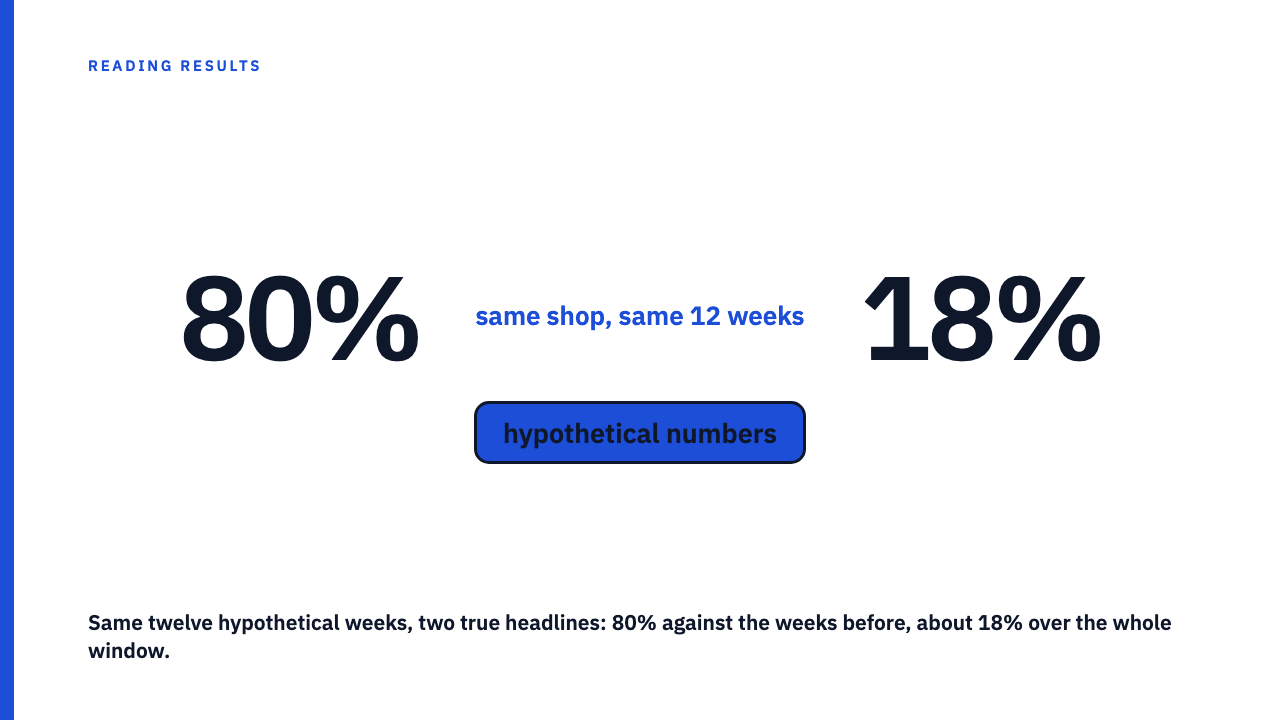
Headline one: the promotion weeks against the weeks before. Weeks 7 and 8 total 360 units, an average of 180 a week. The six weeks before averaged 100. That is a lift of 80%, and every number in that sentence is true.
Headline two: the whole window, including the aftermath, against an equal-length earlier window. Weeks 7 to 12 total 190 + 170 + 80 + 85 + 90 + 95 = 710 units. Weeks 1 to 6 total 600. The difference is 110 units, a lift of about 18%. This is also true, and it is a very different sentence to put in a case study.
The gap between the two is the post-promotion dip. In weeks 9 to 12 the shop sold 350 units against the 400 it would have sold at the old rate, so 50 units went missing. This is pulled-forward demand: buyers who would have purchased later bought at the discount instead. The in-window gain of 160 extra units (360 against 200) shrinks to a net 110 once the dip is counted, still unsplit between offer and campaign.
Why the offer usually outweighs the creative
A promotion changes who responds, not just how many. Bargain-seekers arrive, existing customers waiting for a deal finally buy, and coupon sites send traffic the campaign never touched. When you read “sales rose”, ask who is being counted.
Margin moves too. At 20% off, each extra unit earns less than a unit sold at list price, so a unit lift is not a profit lift.
Creative and offer are usually confounded by design. The ad promotes the offer. Its best-performing message may simply be the one that says “20% off”, in which case the creative was a delivery vehicle for the price. That is a different claim from “our creative drove demand”, and a time series cannot tell them apart.
What to ask for: the offer history
- Did list price, sale price, bundles, free shipping or a minimum-spend threshold change at any point in the window?
- When exactly did each of those start and end?
- Was the offer available to people who never saw the campaign?
- Can you share a sales series that runs well past the end of the offer, so the dip or the hold is visible?
- Did the same offer, or any offer, run during the comparison period? A year-ago window with no promotion is not like for like.
A reasonable answer gives dates, mechanics, and weeks after the offer. An evasive one is vague (“around launch”), supplies only in-window weeks, or treats the question as an attack.
What a fair comparison holds constant
Three cleaner designs would credit the creative separately. The first is the same offer with and without the campaign: a holdout group, or a comparable region that got the discount but not the creative. The second is the same creative without the offer, in an adjacent period. The third is periods with and without the offer, compared on equal footing for seasonality, so a holiday week is not set against an ordinary one.
Most published case studies cannot offer any of these. The lift is real evidence that something worked, and weak evidence about what. See what a trustworthy marketing result requires, why a price cut or launch mid-campaign breaks the attribution, the number no case study can show you, and the mirror image, where a revenue jump might be a price hike, not more customers.
A quick triage for the next case study you read
| What the case study says | What to conclude |
|---|---|
| Offer disclosed and separated (a holdout, or a period with the creative and no offer) | Higher confidence. The creative’s share can be estimated, but check the post-offer weeks. |
| Offer disclosed but not separated | Moderate to low confidence in the credit. Treat the lift as shared between offer and creative, with the split unknown. |
| Offer not mentioned | Unanswered, not a no. Ask directly whether prices, bundles or shipping terms changed. |
The practical stance: until the offer history is supplied, treat the number as a ceiling on what the creative earned, not an estimate of it.
Where to go next
You can browse the case study library and run these questions against what you find. If you are an agency, you can submit your own case study, and the library credits every number to the agency that reported it.
FAQ
Does a discount in the window mean the campaign did nothing?
No. It means the result cannot be credited to the creative alone. The campaign may have spread awareness of the offer, a legitimate contribution, but its size is unknown without a comparison that separates the two.
What is pulled-forward demand?
Purchases that would have happened later but were brought into the promotion period by the discount. It shows up as a dip after the offer ends, so the in-window lift overstates the net gain.