Which Case Study Numbers Can You Actually Check Yourself?
You are reading a case study and a number stops you. It is big, specific, exactly the result you hoped to find. The question worth asking is not how big the number is, but whether anyone besides the agency could confirm it.
The size of a number and the checkability of a number are different questions
The instinct is automatic: a bigger lift reads as a stronger claim, regardless of where the number came from. A 340 percent increase feels like more evidence than a 12 percent increase, before you ask what either number measures or who could check it. Checkability depends on where a number lives, not on how the campaign performed. A modest number can sit in a fully public place, while a spectacular one can exist only in a spreadsheet nobody outside the agency has opened. The same reported lift can land in a different confidence tier depending on the source behind it, and a case study rarely says which.
Tier one: a public source anyone can look up
A number belongs in tier one when it resolves against something outside the agency’s control: a follower count on a live profile, a press mention still online, a ranking on a public app store or list, visible to a reader with no connection to either party. Checkable does not mean citable, though: a follower count can be publicly true and still be a vanity metric that says little about whether the campaign worked.
Tier two: a source that exists, but only a party to the work can see it
Tier two is where most legitimate case study numbers live: a source exists and would confirm or contradict the number, but you cannot see it. A client’s analytics dashboard is real, but you have no login. A shared ad account has real numbers inside it, but only the agency and client can query it. A third party report the agency is quoting may exist, but if unpublished, you cannot check it. A tier two number moves up when someone with access publishes the artifact, or a platform’s newsroom confirms the figure independently. This is not a verdict about honesty: a number can be accurate and still sit here forever, simply because nobody had reason to make the system public.
Tier three: the agency is the only witness
Tier three is defined by the absence of any external system that could confirm or deny the number: a proprietary sentiment score with an undisclosed methodology, an internal CRM revenue figure from a database only the agency or client can query, a custom blended metric invented for one case study. None of this makes the number false, only unconfirmable by anyone outside the agency, permanently, by construction. This is why this site’s standing rule holds: an agency’s own number is credited as theirs, never restated as an industry benchmark or an established fact.
Sort a real-looking case study page into the three tiers
Picture a hypothetical case study page, describing no real agency, client, or campaign. It opens with “48,000 followers” linked to the live profile, then a mention of a feature in a named trade publication, linked to the article. A chart shows “engagement rate: up 22 percent,” sourced to the ad manager but not screenshotted. Below sits “CRM-attributed revenue: up 340 percent,” with no source, and at the bottom “brand sentiment score: 8.7 out of 10,” with no explanation of what produced it.
- The follower count is tier one: the profile is public, with no login.
- The press mention is tier one for the same reason: the article is live and readable by anyone.
- The engagement rate is tier two: the ad manager would confirm it, but the reader has no login and no screenshot was published.
- The CRM revenue figure is tier three: it comes from an internal system with no external counterpart.
- The sentiment score is tier three for the same reason: an undisclosed methodology with nothing outside the agency to check it against.
A single scroll routinely mixes all three tiers, a property of each figure, not of the case study as a whole.
What to actually do with a tier three number
Finding a headline number in tier three is common, not disqualifying: the useful move is to calibrate, not reject. Look for what tier one or tier two figure moved alongside it, ask what methodology produced the number, and treat a vague answer as information. Otherwise, weight it as testimony rather than evidence, since refusing to ever credit an unverifiable number would gut most case studies of their useful detail. The goal is calibration: confidence should track the tier, not the size of the number, the same distinction covered from the other direction in self-reported versus verifiable, the simpler two-way version this piece sharpens into three tiers.
A quick reference for the three tiers
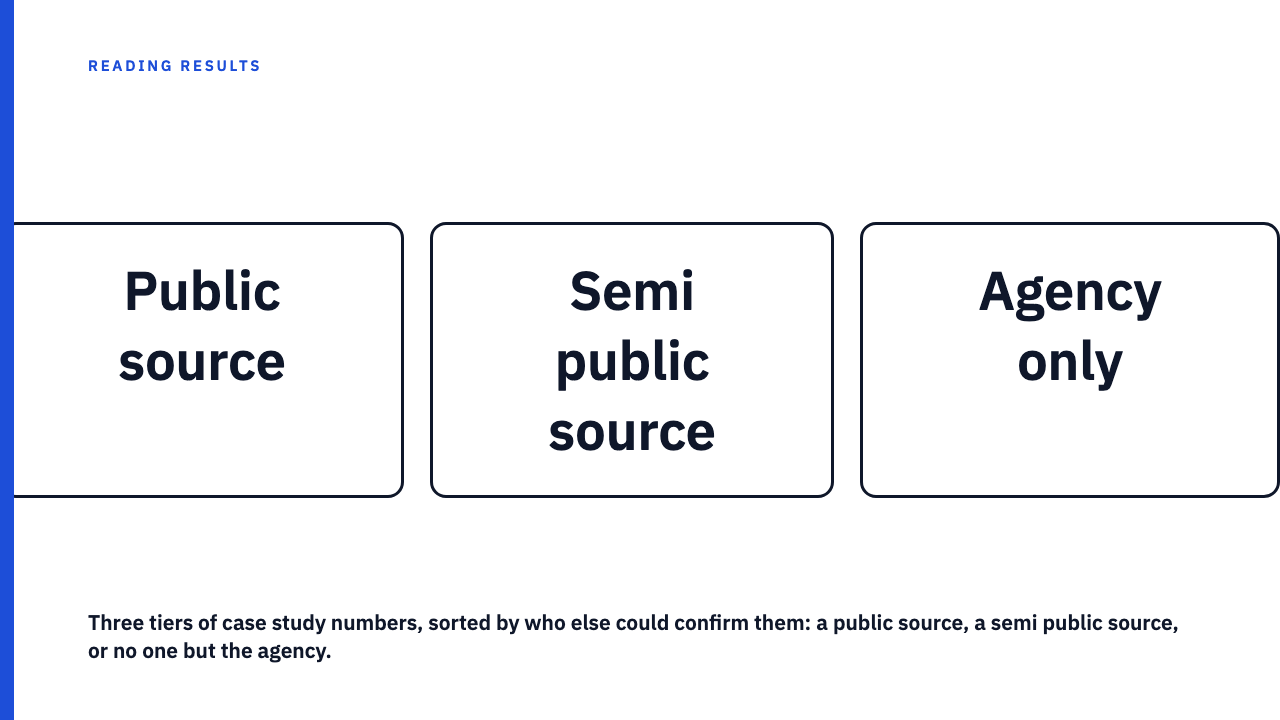
- Tier one, public source. Could a stranger with no login look this up right now? A follower count, a live press mention, a public ranking.
- Tier two, semi public source. Could a party to the work look this up, though a stranger could not? A dashboard figure, a shared ad account number, an unpublished report.
- Tier three, agency only. Can only the agency ever look this up? A sentiment score, an internal CRM figure, a custom metric invented for one case study.
See how to read a case study without being misled and why the best metric on a dashboard is rarely the real story.
Ready to compare this against a real case study?
Browse the case study library and sort a few real pages, or submit your own if you have results worth putting in front of readers who will check them.
FAQ
Does a tier three number mean the case study is lying?
No. Unconfirmable is not the same as false. Tier three describes access, not honesty, and most agencies reporting an internal figure are reporting it in good faith. The tier tells you how much confidence should rest on trust versus on confirmation you could do yourself.
Can a number move from one tier to another?
Yes. A tier three figure becomes tier two once the underlying report is shared with the client or a third party, and reaches tier one only if published somewhere the agency does not control. The CRM example: internal until shared, then tier two.
Sources
- self-reported versus verifiable, checked 2026-09-09
- how to read a case study, checked 2026-09-09
- why the best metric is rarely the story, checked 2026-09-09
- how to read a results chart, checked 2026-09-09