When the Cited Stat Inside a Case Study Is Years Older Than the Campaign
A case study can be published last month and still lean its rationale on a stat that is years out of date. The case study’s own publish date tells you nothing about when what it cites was published.
Two different staleness problems live inside one case study
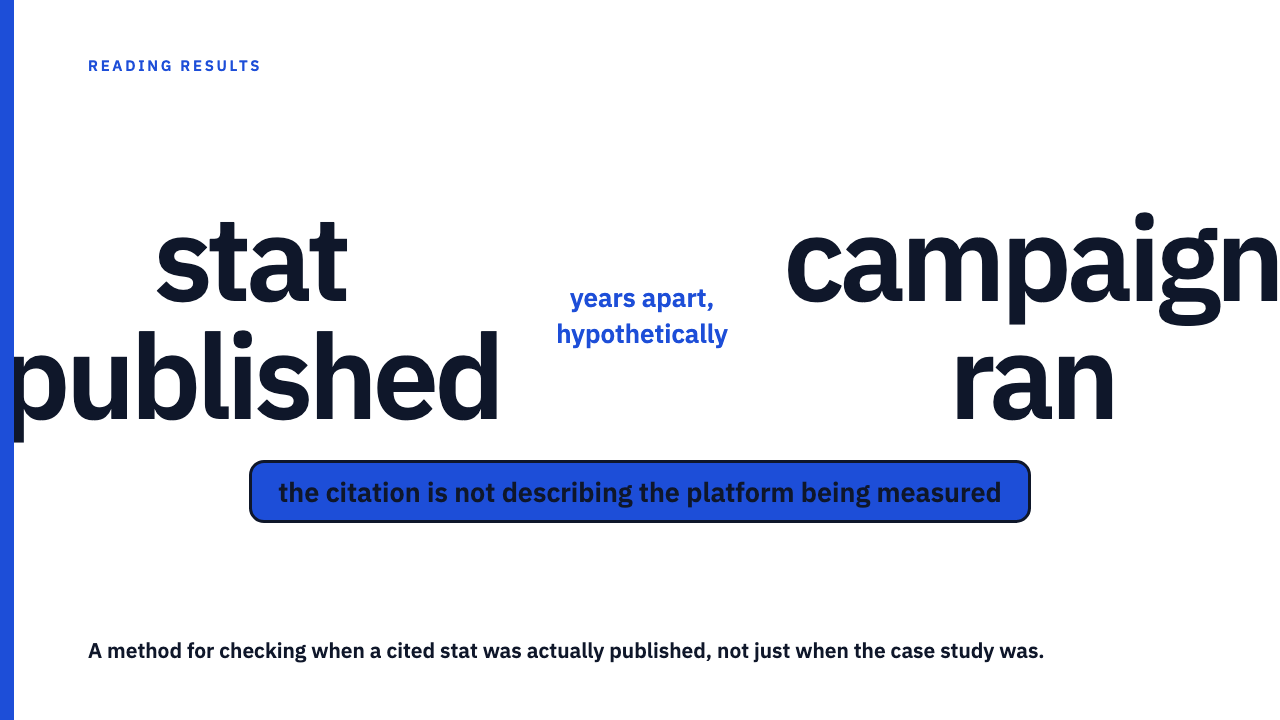
Two clocks run inside any case study: the case study’s own age, how long ago the campaign ran and whether the conditions it describes still hold, and the age of whatever it cites along the way to explain a decision. A case study published this week can rest on a citation from four years ago, and one from three years back can have cited something current when written and unchanged since, because the fact itself moves slowly.
The habit that lets this slide is checking the case study’s publish date, seeing that it is recent, and stopping there, never opening the footnote. That habit is the blind spot covered in how to read a marketing case study without being misled, applied here to one spot: the citation. A citation carries its own date, set when the source it points to was written, and that does not update just because the document quoting it is newer.
Where the borrowed stat usually lives in the writeup
Most case studies follow a familiar shape: setup, strategy, results, close. The outside stat tends to show up early, in the section explaining why a channel, format, or platform was chosen, as a claim about how people behave, offered to justify the approach before a single result of the agency’s own appears.
That stat is not reporting the outcome. It is justifying a decision made before the campaign started, borrowing outside authority to make the strategy look sound. Readers skim past it because it reads as background rather than as a claim to check, which is why it survives unexamined.
A hypothetical walkthrough: the three year old citation
Picture a hypothetical case study, invented for this example and not describing any real agency, client, or platform. Its rationale section cites an outside stat about how users on a platform tend to discover new accounts, offered as the reason for the agency’s strategy, and links to the source rather than just naming it.
Checking the citation means opening the link to find the source’s own publication date, not the date on the case study quoting it, then comparing it to the campaign’s stated dates. In this hypothetical, the source was published roughly three years before the campaign’s start date. A three year gap alone is not disqualifying. What makes it a mismatch here is a second detail: the agency, elsewhere in the writeup, describes that discovery mechanism as having changed materially in that window. That combination, an old date plus the agency’s own acknowledgment of change, is what makes the citation mismatched, not the age alone. Every number and date here is invented for illustration; no real case study, agency, or platform claim is described.
Why a platform’s own age works against an old citation faster than a market’s does
Some things a case study cites change slowly, a finding about social proof, which holds because it describes stable human behavior. Other things describe a platform’s ranking behavior, auction mechanics, or user demographics at a point in time, properties a platform can change unilaterally and without notice.
The rationale assumes the cited condition still held during the campaign. If the platform changed in between, the rationale is no longer verified, even though the results can still be real. What stops being supported is the reason the strategy made sense, not the outcome, a distinct failure from the case study’s own result going stale, covered in an earlier post here: the attribution window is a choice, and it is rarely disclosed.
A three question check for any cited stat inside a case study
- What is the publication date of the source being cited, not the case study citing it? Open the link. If nothing is linked, that absence is itself worth noting.
- Does the campaign’s stated window start after, before, or overlapping the citation’s date, and by how much? A stat cited a month before the campaign differs from one cited years earlier.
- Is the citation about something that changes on its own timeline, a platform feature or algorithm, or something slower moving, and does the agency elsewhere acknowledge the platform changed in the interim? A gap matters more when the subject moves fast and the agency has already said it moved.
A yes to all three does not prove the citation is wrong, only that it needs checking rather than assuming.
What a citation that has aged well looks like, and what one that has not looks like
Consider a second hypothetical: a case study cites a stat about how people respond to seeing a product used by someone they recognize, a finding about social proof rather than platform mechanics. Even several years old, that citation ages well, because the behavior is not tied to a setting a platform could change next quarter.
Now revisit the discovery mechanism cited three years before the campaign, where the agency’s own writeup says that mechanism changed since. That citation has not aged well. The honest response is not to call the case study a fraud, but to drop the citation and restate the claim as unsupported: the strategy might still have been right, but the stated reason no longer has the backing it once appeared to have.
Read the next case study with the footnote open
Browse the case study library and try opening a rationale section’s citation before you read the results that follow it. If you have run a campaign and kept your sourcing straight, submit your own.
FAQ
If the citation is old but the case study’s own results are recent, is the case study still trustworthy?
Separate the two claims. The reported results are a different claim from the rationale that borrowed an old stat to justify the approach. An old citation weakens the stated reasoning, not necessarily the outcome, so check the two independently.
How do I find the original publication date of a stat a case study links to?
Open the linked source directly rather than trusting the case study’s framing of it, and look for the source’s own dateline or byline date, or an archived capture if the live page has since changed. If the case study links to nothing, that absence is itself the finding, covered in a case study number is only as good as what backs it up.
Sources
- The attribution window is a choice, and it is rarely disclosed, fetched 2026-09-09.
- A case study number is only as good as what backs it up, fetched 2026-09-09.
- How to read a marketing case study without being misled, fetched 2026-09-09.
- Browse the case study library, fetched 2026-09-09.
- Submit your own, fetched 2026-09-09.