A Revenue Jump in Dollars Can Be a Currency Move, Not a Campaign
Picture a case study covering six markets that reports one blended number, revenue up by some healthy looking percentage over twelve months. It never says which currency the sales were made in, which currency the percentage was calculated in, or what the exchange rate did in between. Until it does, you cannot tell a result from a translation.
The blended number that hides two different stories
Sales in a multi market campaign happen in local currencies. The headline will be in one reporting currency, usually US dollars. So every market’s number gets converted, at some rate, on some date, and only then does anyone calculate a percentage.
That percentage now moves for two separate reasons. The underlying business changed, which is what the case study claims credit for. And the conversion rate changed, which nobody on the campaign influenced. The published figure sums the two and shows no marker of the split.
This matters under a narrow set of conditions: multiple countries, a year or longer because currency movement accumulates, and a currency that floats rather than being pegged. Where all three hold, it is one of the largest unexplained variables in the claim, and one that how to read a marketing case study without being misled barely touches.
A hypothetical example: the same sales, two different headlines
Here is a fully hypothetical example. The currencies and rates are invented, and nothing below describes any real market, agency, or result. Call the local currency the zed, the reporting currency the ora.
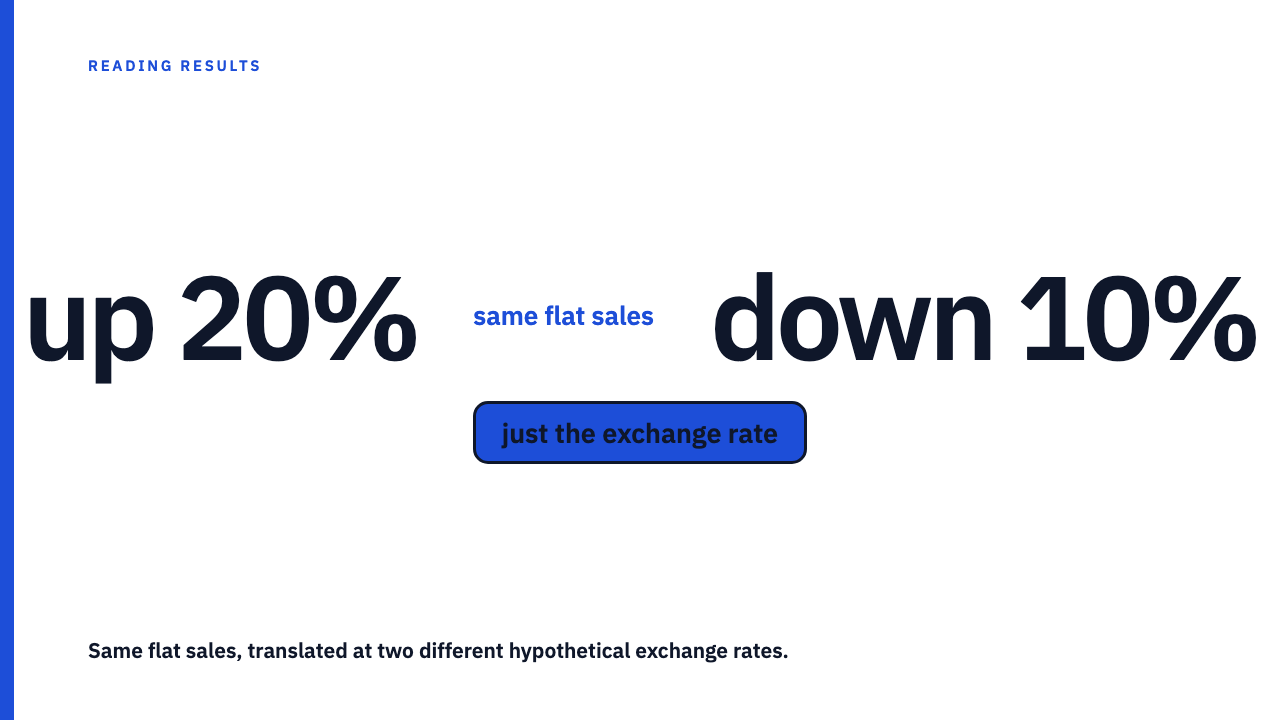
A business in the zed market sells 4,000,000 zeds in the year before the campaign, and 4,000,000 zeds in the campaign year. Flat. Now convert it, using two hypothetical rates:
- At the start, 1 zed converts to 0.50 ora, so the prior year translates to 2,000,000 ora.
- At the end, 1 zed converts to 0.60 ora, so the campaign year translates to 2,400,000 ora.
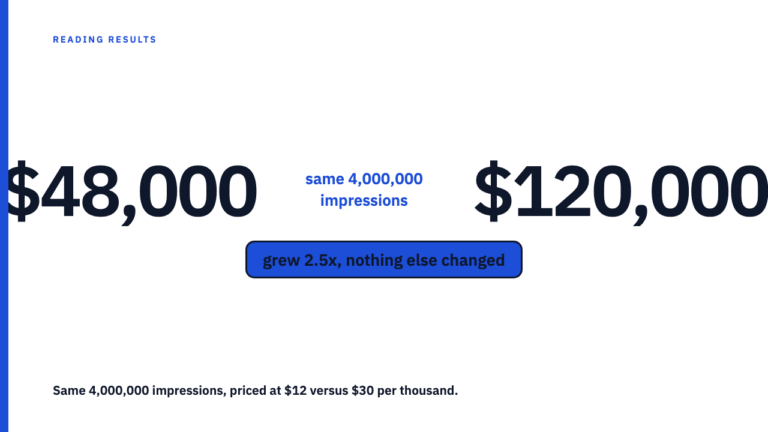
Reported in ora, that is 20 percent growth, and the local business did nothing. Flip the hypothetical end rate to 0.45 ora, and the same flat 4,000,000 zeds reports as 1,800,000 ora, a decline of 10 percent. One unchanged sales figure, three headlines, up 20, down 10, or flat if the rate had held.
Real rate moves are usually smaller than the invented ones above. The point is the mechanism, not the size.
This is a different confound from a price increase
Revenue can also be inflated because the business raised its prices, a separate mechanism worth reading for on its own terms. Ruling out one tells you nothing about the other, and a case study can carry both.
What to ask about the reporting currency
- Which currency are the results stated in? Local currency per market, one blended reporting currency, or both. A blended figure alone means a conversion happened offstage.
- Is there a constant currency figure beside the as reported one? The most useful disclosure here, and close to absent from agency case studies.
- What period, and which markets? A five country, two year claim carries far more currency exposure than a two country, one quarter claim.
- Which rate convention was used? A closing spot rate, a period average, or something else. Rarely stated, and the choice changes the answer.
When this genuinely is not the issue
Do not apply this check to everything. A single market case study reported in that market’s own currency has no conversion step, so there is nothing to correct for. A short window, weeks rather than a year, gives the rate much less room to drift, though not none. And a currency formally pegged to the reporting currency designs most of the effect out.
Currency is one item on a longer list, and the figure inherits how percentage framing can already mislead.
A quick read of the signal, not the number
| What the case study discloses | What you can conclude |
|---|---|
| A blended percentage only, no local currency figure, no mention of currency | You cannot rule out a currency effect. Treat the number as unverified on this point, not as false. |
| An as reported and a constant currency figure, sitting close together | Someone checked, and currency was not doing much work. |
| Both figures given, and they diverge meaningfully | The case study is telling you how much of the headline was the rate. Read the constant currency figure as the claim. |
Bring us the ones that disclose it
Case studies here are credited to the agency that published them. To see how agencies handle multi market results, browse the case study library. If your agency’s published work shows a currency adjusted figure beside the as reported one, submit your own. That is checking a self-reported number against what backs it up.
FAQ
What is constant currency reporting?
It means recalculating one period’s results using the same exchange rate applied to the other, so the percentage change reflects only what the local business did. It is established practice in corporate financial reporting: listed companies routinely publish both figures for the same period, and the two can differ substantially. Its absence from agency case studies is the gap this post points at.
Does a strengthening local currency always inflate the reported number?
No. It depends on which way the local currency moved against the reporting currency. One that strengthened converts into more of the reporting currency, and the figure is flattered. One that weakened converts into less, and can bury good local performance as easily as a strong currency manufactures growth that was never there.
Does this apply to a case study about a single country?
No. A single market case study reported in that market’s own currency involves no conversion step, so there is no currency effect to check for. See above for the other cases where the check does not apply.
How would I actually check this on a real case study?
Find the two dates the claim compares and the markets it names. Then look up a public historical exchange rate series for that currency pair across exactly that window, and see how much of the stated move the rate alone could account for. If the rate moved by anything close to the headline, the case study has not settled the question.
Sources
- First quarter 2026 results media release from a listed multinational healthcare group, which states each headline figure twice, as reported and in constant currencies, with the two differing. Fetched 2026-09-07.