The Industry Average Has No Source? Treat It as Anonymous
When a case study convinces you, ask which number did the convincing. Often it is not the agency’s result but the comparison figure beside it, the one called the industry average, with nothing attached.
The comparison that does the most work in the case study
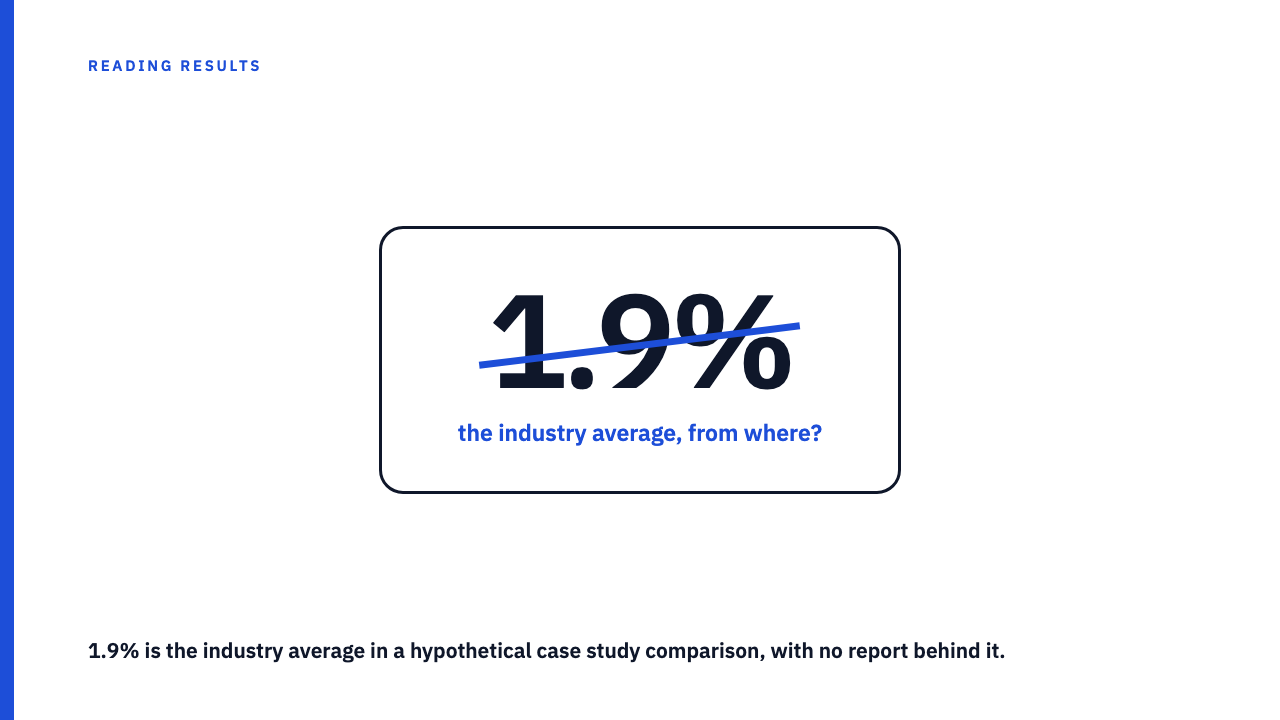
Take a hypothetical line, invented to show the pattern and drawn from no real report: an agency reports an engagement rate of 4.2%, more than double the industry average of 1.9%. The two numbers feel like one claim. They are not. The 4.2% measures a specific account over a specific period, something the agency could observe. The 1.9% refers to nothing you can point at. No report, no year, no platform, no definition of engagement.
Notice what it does anyway. On its own, 4.2% is a fact with no shape. Against 1.9% it becomes a multiple, and “more than double” is what you remember an hour later. That phrase is a claim about the 1.9%, so the persuasive weight has moved onto the unsourced number.
This is not dishonesty. Usually someone half remembers a figure from a webinar and nobody checks. That is why the pattern deserves a fixed rule, not a judgement about intent.
What “no source” actually means
Four situations hide under the word unsourced:
- Uncited. The number appears with nothing after it. No link, no report title, no footnote.
- Secondhand citation. It links to another marketing blog, which also cites no primary source. The chain sometimes runs three posts deep before it dead ends.
- Dead link. A real report was cited once and the URL now 404s. A fossil of a source.
- Vague plural attribution. “Industry studies show”, with no study named. The plural implies convergent evidence while committing to none of it.
These are not equally bad. A dead link at least names what was measured and by whom. But all four fail one test: can a reader independently locate the original measurement.
Why an untraceable number should be discounted entirely, not partially
The instinct most careful readers have is to split the difference: the number is probably in the right neighbourhood, so knock a bit off and move on. That feels moderate. It is not available.
Discounting requires knowing the direction and rough size of the error, and that comes from the sample, the method, and the period. A benchmark is useful only to the extent that its sample resembles the business compared against it. An untraceable figure hides sample, vintage, platform mix and metric definition, so nothing is left to partially credit.
A sourced benchmark is different. You can open the report, read who was measured and when, and judge. You may still reject the comparison, but on visible grounds. That second failure, solid source and wrong fit, is covered in someone else’s case study result is not your benchmark.
Two published social benchmark reports, and what tracing them actually looks like
A missing source is easier to spot once you have seen a present one. Sprout Social publishes a recurring report called the Sprout Social Index, at sproutsocial.com/insights/index/. Socialinsider publishes a social media benchmarks report at socialinsider.io/social-media-benchmarks. What matters is not their findings but that each page states its scope. Socialinsider’s page carries a labelled methodology section describing the sample of brands analysed and the dates covered. Sprout’s page states the populations surveyed. [EVIDENCE NEEDED: writer confirms current sample size, methodology and date range stated on each report page at time of writing, since these are refreshed periodically.]
Being sourced is not the end of it. Every study has scope limits: a finite set of accounts or respondents, a fixed window, a particular platform mix. Citing one properly means naming which report, which year, and which platform, since a later edition may not carry the older figure at all.
A three-question test before you let a benchmark into the comparison
Three questions, part of how to read a marketing case study without being misled:
- Can I find the named report this number came from? Not a blog citing a blog. A publication with a title, a publisher, and a page that opens.
- Does that report state a date and a sample? A measurement window and a description of what was measured.
- Does that sample resemble the business in front of me? Similar category, similar scale, similar platforms.
A no on either of the first two means the number is struck, not softened, along with any comparison built on it. A no on only the third is the separate fit problem.
What this does to the case study’s headline claim
Strike the uncited half of the hypothetical and read what survives: this account’s engagement rate was 4.2% over the reported period. Smaller, less quotable, and checkable: you can ask how engagement was defined and which dates counted. Those questions have answers, held to the standard in a case study number is only as good as what backs it up.
None of this makes the agency’s number false. Striking the benchmark does not touch the result, it removes a comparison that was never supportable. Whether 4.2% is impressive for an account like this is now your judgement, as is where the story starts, since the ‘before’ picture in a case study is also a choice.
Read a few real ones
Browse the case study library, each entry credited to the agency that produced it, or submit your own.
FAQ
Isn’t it safer to just discount the number a little rather than throw it out completely?
Discounting implies you know which way the error runs and roughly how large it is, and that comes from the sample and the method, which is exactly what an untraceable benchmark withholds. With nothing to adjust from, there is no moderate setting, only exclusion.
What if the case study cites “a 2025 industry report” without naming it?
Treat it as you would a number with no citation at all. A year is not a citation, it is a date stamp on an unnamed document you cannot open. That is vague plural attribution in a better suit, and it fails the first question the same way.
Does a sourced benchmark automatically make the comparison valid?
No, sourcing clears the first hurdle only. You still have to read who was in the sample, over what period and platforms, then decide whether that population resembles yours. A well sourced benchmark from the wrong category still misleads.
Sources
- Sprout Social Index, fetched 2026-09-07, HTTP 200.
- Socialinsider Social Media Benchmarks, fetched 2026-09-07, HTTP 200.