Earned media value is an estimate wearing a dollar sign
A dollar figure appears in the case study labelled earned media value. It sits beside impressions and follower growth, formatted like money, usually the largest number on the page. Nobody paid that amount. It is a small calculation, and one of its two inputs was chosen by whoever wrote the report.
What earned media value actually multiplies
Every EMV figure is the product of two numbers. The first is a count of what the campaign generated: impressions, reach, or mentions. The second is an ad-equivalent rate, a per-thousand or per-mention price standing in for what a comparable paid placement would have cost. Multiply them for the dollar sign.
The rate is where the trouble sits. It is a modelling assumption, not a price paid: nobody bought that inventory, nobody invoiced for it. The method predates social media. Macnamara’s definition, carried in Tom Watson’s history of the metric in Public Relations Review, describes advertising value equivalence as multiplying column centimetres of print coverage and seconds of broadcast publicity by the respective advertising rates, with the total valued as if it were advertising, irrespective of tone or content. EMV is that method with impressions in place of column centimetres, a cost never incurred rather than a return received, worth reading next to what backs up a self-reported number.
The same reach, two different price tags
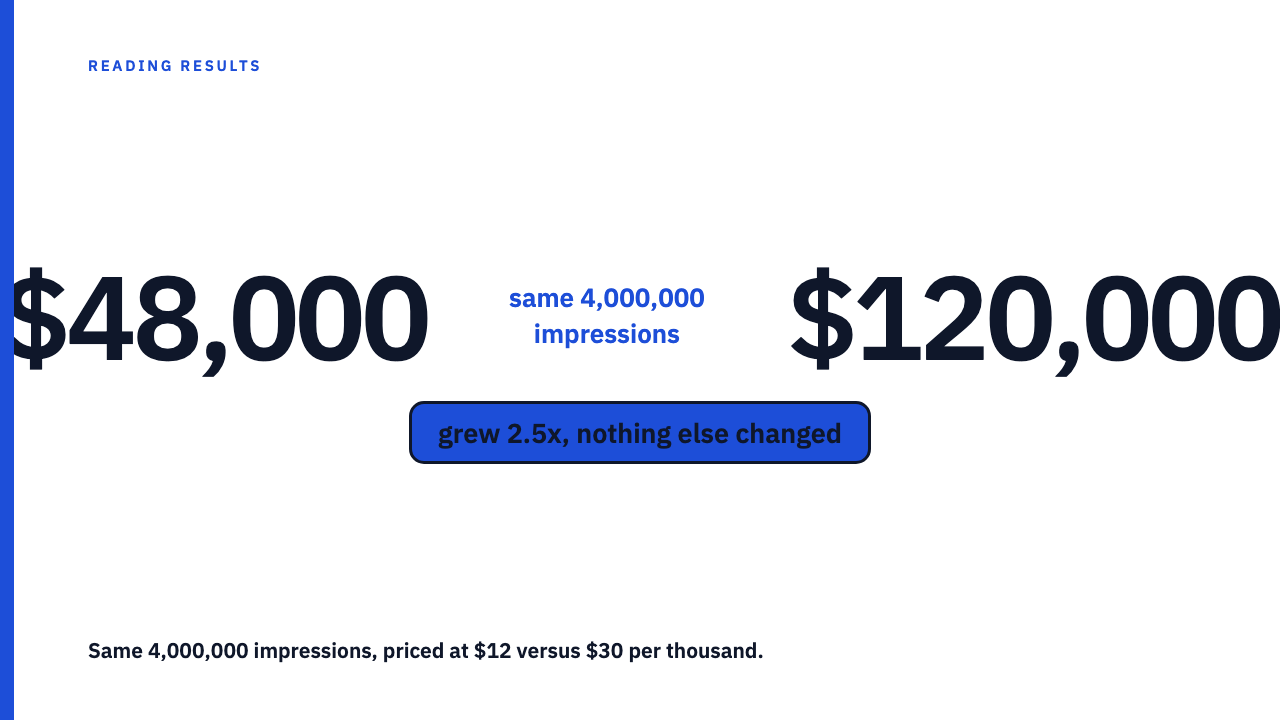
Take a hypothetical campaign, invented to show the mechanism and drawn from no real agency or client, generating 4,000,000 impressions in a quarter.
At an assumed ad-equivalent rate of $12 per thousand impressions, the EMV is $48,000. At $30 per thousand, plausible if the comparison is premium video rather than a feed buy, the same impressions become $120,000.
Nothing about the underlying activity changed. Only the assumed rate moved, and the headline grew two and a half times. If the report never prints the rate, you cannot tell which figure you hold.
Why the rate is a modelling choice, not a market price
Ad-equivalent rates usually come from published rate cards or comparable CPMs for a chosen channel, and that choice does quiet work. Video pre-roll gives a very different total than a remnant display buy, and the author picks the comparison. Whether the rate is then adjusted for engagement quality, placement, or audience overlap is a second decision by the same author.
For EMV itself, no published source documenting a standard ad-equivalent rate was located, the closest evidence being its predecessor. Watson’s paper reports AVE totals boosted by multipliers ranging from 2.5 to 8.0. Those are credibility multipliers layered on an already computed total, not ad-equivalent rates, and they are cited here only as evidence the field never settled on a fixed figure at any layer. AMEC, the field’s measurement body, has held since the Barcelona Principles that AVEs are not the value of communication and do not demonstrate the value of the work. Its Say No to AVEs campaign asks the industry to eradicate AVE and all of its derivatives. AMEC does not name EMV there, so read the lineage as inference rather than its ruling.
What to check before an EMV number gets filed as a financial figure
- What channel or ad product is the multiplier benchmarked against? A premium video rate and a feed display rate are not interchangeable, and the choice can double the total.
- Is the multiplier disclosed anywhere? Most print the total and not the rate, which makes the number unreproducible.
- Is the count reach, impressions, or mentions? Impressions typically exceed reach, so one rate gives very different totals for identical activity.
- Are negative and neutral mentions counted like positive ones? Usually they are, so critical coverage adds to the total exactly as praise does.
What EMV can and cannot tell a reader
One narrow use holds up. If a team tracks EMV over time within a single campaign, using one count type and one unchanged rate, the movement between periods is a relative indicator of coverage volume: the rate cancels out.
EMV cannot sit in the same column as money. Spend and revenue are transactions that happened, EMV is a cost that did not, so it should never be added to spend, divided by it, or compared with revenue or ROAS. Say a hypothetical case study prints $40,000 in spend and an EMV of $200,000 beside it, labels neither, and leaves the division to the reader, who comes away believing a five to one return. Nothing of the kind was measured, an instance of a headline number that hides more than it shows.
EMV next to the other numbers in the case study
| Figure | Where it comes from | Transaction behind it? |
|---|---|---|
| Earned media value | Modelled. A count multiplied by a rate the author selected. | No. Nothing was bought or sold at that rate. |
| Reach or impressions | Counted or platform-estimated. No currency conversion applied. | No, and none is claimed. |
| Ad spend or revenue | A financial transaction recorded in an account. | Yes. |
Those rows are three categories: assumed, counted, transacted. They cannot be summed or ratioed, however neatly a report lines them up. For the broader habits, start with how to read a case study without being misled.
Read a few side by side
The eye for a modelled figure comes from reading real ones. Browse the case study library, where every result stays credited to the agency that reported it, and if you have published work, submit your own.
FAQ
Is earned media value the same thing as ROI?
No. ROI and ROAS are ratios with a real cost on one side and a real return on the other. EMV estimates a media cost avoided rather than incurred, so it has no cost side to divide by. Presented as a return, it is a category error.
Why do two case studies report very different EMV totals for what looks like similar reach?
Usually because they applied different rates, benchmarked against different channels, or counted different things, impressions in one and reach in another. Most print the total and not the rate, so two EMV figures are rarely comparable.
Is there an industry standard EMV multiplier?
None was found documented for EMV. The nearest published record concerns its predecessor AVE, where Watson reports credibility multipliers of 2.5 to 8.0 layered on the computed total. Those are not ad-equivalent rates, but a spread that wide is no agreed figure either.
Sources
- Tom Watson, “Advertising value equivalence, PR’s orphan metric”, Public Relations Review. Fetched 6 September 2026.
- AMEC, “Barcelona Principles 3.0”. Fetched 6 September 2026.
- AMEC, “Say No to AVEs”. Fetched 6 September 2026.