A Case Study With Zero Numbers Is a Testimonial in Disguise
You get to the end of a case study and you believe it. Real problem, considered strategy, a confident outcome section. Then someone asks what the result actually was, and there is nothing to quote. Not a weak number, not a disputed one. No number.
The four-slot template that doesn’t require a number anywhere
Most published case studies fill four slots in the same order: client, challenge, strategy, outcome. Who the work was for, what was wrong, what the agency did, what happened next. That skeleton sits under nearly all the entries in this site’s own library.
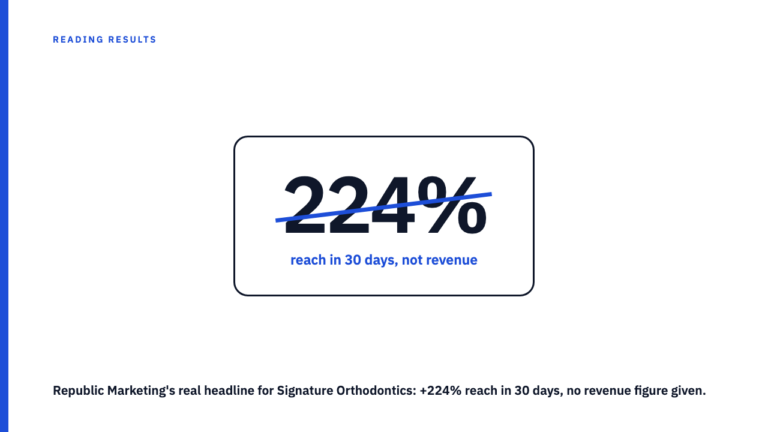
Three of those slots are openly descriptive. Nobody expects a figure beside a client name, a challenge, or a list of activities. The outcome slot is the one a reader assumes must hold a number, and the one that most easily gets away without one. “Engagement improved markedly across the account” sits where the proof goes and contains nothing checkable.
A well formatted case study and a well evidenced one are different claims: whether the document has the parts, and whether the parts hold anything checkable. Format tells you only which template was used. That check comes first in how to read a case study without being misled.
What actually counts as a verifiable figure
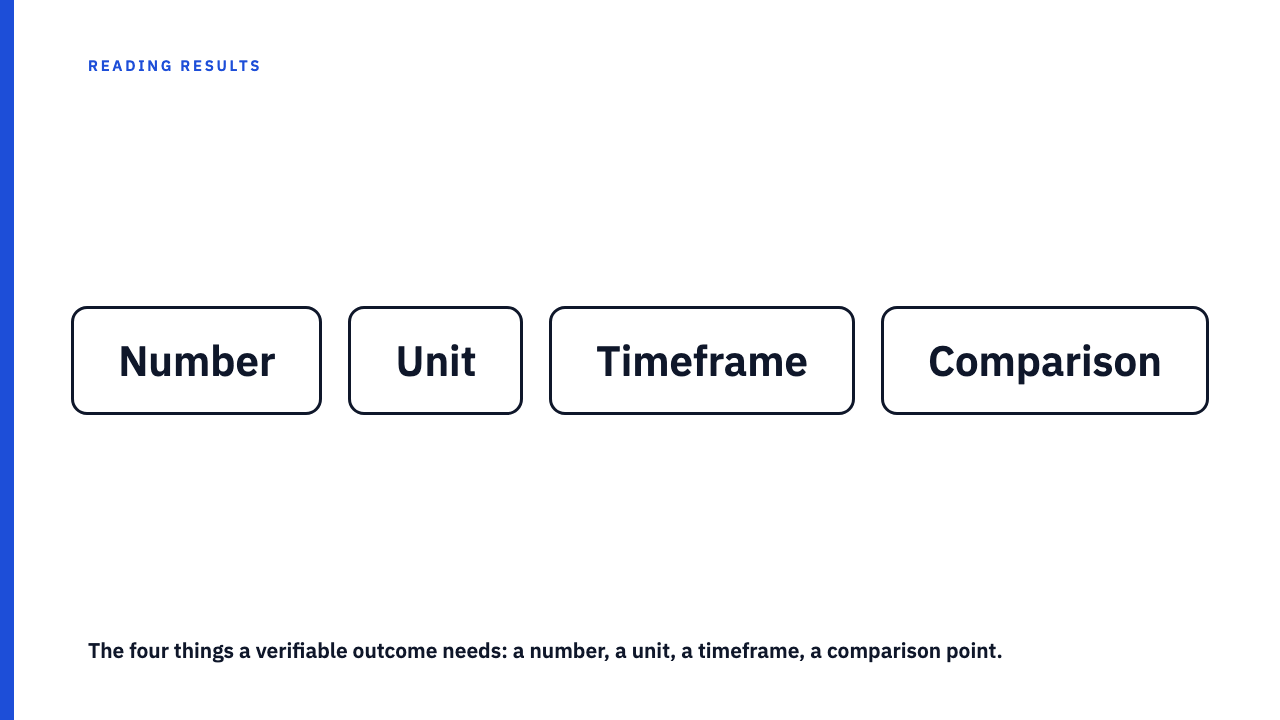
“More data” is not a useful demand. Here is a specific bar. A verifiable figure needs a number, a unit saying what is counted, a timeframe it was counted over, and a comparison point: a before, a baseline, or a control. Each fails the claim on its own. Every line below is hypothetical.
| Missing | Hypothetical outcome line | What you cannot establish |
|---|---|---|
| Nothing | 34 comments per post across the 12 weeks after launch, against 9 across the 12 before | Checkable as written. Whether it holds up is a further question |
| Number | Comments per post rose substantially after launch | Direction only. 9 to 11 and 9 to 400 both fit |
| Unit | Up 280 percent in the 12 weeks after launch, against the 12 before | 280 percent of what. Comments and revenue are not interchangeable |
| Timeframe | Comments per post rose from 9 to 34 | Whether that took a fortnight or four years |
| Comparison point | 34 comments per post across the 12 weeks after launch | Whether 34 is up, flat or down. It may have been 50 before |
The same outcome, written two ways
Picture a coffee subscription brand that ran a three month campaign. Both paragraphs below are hypothetical, written for this article, and neither is a real reported result.
Hypothetical version one. Following the campaign, engagement saw a significant and sustained increase across the brand’s channels, and the client reported strong momentum heading into the following quarter.
Hypothetical version two. Across the 12 weeks after launch, the account averaged 34 comments per post, against 9 comments per post over the 12 weeks before.
What changed is not tone or confidence. Version one is arguably the more assured writing. What changed is the presence of four things: a number, a unit, a window, and a comparison point.
Why a real result sometimes gets reported this way anyway
An adjective-only outcome does not mean the result was invented. A few explanations are worth holding loosely.
The numbers usually belong to the client, who may decline to let its figures appear under someone else’s byline. A real figure can be underwhelming, positive but small enough that an adjective flatters it. And almost nobody reads outcome sections closely, so a vague one may never have cost anything. All three are speculation, not documented practice, and not a claim about any particular write-up.
What can be said without speculating is that vagueness is a choice made somewhere. Somebody had the reporting in front of them and wrote “significant” instead. The reason is invisible to you. The effect is not.
The absence of a number is itself the finding
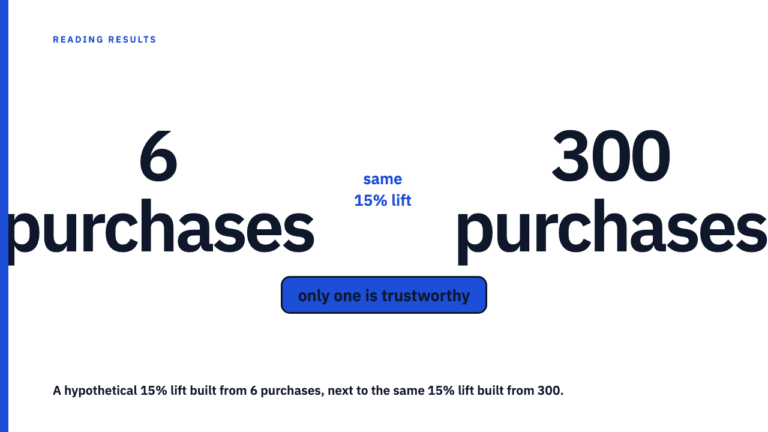
The instinct on finishing a case study is to ask whether the result was good. A prior question sits in front of it: is there a result to evaluate at all?
A testimonial and a case study are separated by whether that second question has an answer, not by title, length or design.
This is a more basic failure than the one most scrutiny targets. Once a case study does report a number, you can ask who measured it and against what baseline. Here there is nothing to audit, which is not an audit that failed.
Before you cite or share a case study, run this
- Find the outcome section. Ignore the client name, the dates, the challenge and the strategy paragraphs. The claim does not live in any of those.
- Read only that section and circle every hard figure: a number with a unit attached, not a count of tactics or channels.
- Check each circled figure against the four-part bar of number, unit, timeframe, comparison point.
- If you circled nothing, that is the finding, reached in under a minute. Treat the piece as a testimonial and do not cite it as evidence of what the strategy achieved.
- Say so when you pass it on. “Reads well, no figures in the outcome” beats a bare link.
See it in practice
Every entry links to the agency’s original write-up, so you can run the scan on published work. Browse the case study library, or submit your own. And every case study library is a selected sample, this one included.
FAQ
What’s the actual difference between a case study and a testimonial?
A testimonial asserts satisfaction or improvement in general terms. A case study, by format, claims to document a specific, checkable result. When the outcome section carries no figure, unit, timeframe or comparison point, the piece has the format of a case study and the content of a testimonial, whatever it is titled.
Is “significant growth” ever an acceptable way to report a result?
It works as colour alongside a figure, not as a replacement for one. Alone it gives a direction but no magnitude, no window and nothing to measure against, so it cannot be evaluated, only taken on trust.
If a case study does have a number in it, does that automatically make it trustworthy?
No, and that is a separate question this piece does not answer. A number only means there is something to check. Who reported it, over what window, against what baseline, is the next question, covered elsewhere on this site.
Sources
- Social Case Studies library index, fetched 6 September 2026, confirming the client, challenge, strategy, outcome shape used across its entries.