‘Best month ever’ is a fact about the calendar, not the campaign
A results summary says the client had its best month on record. Before reading that as the campaign working, check how easily a growing business produces that sentence unaided.
Why a proud ‘best month ever’ line proves less than it sounds
Picture a line like this, entirely hypothetical and attributed to no agency or client: “Our client’s best-performing month on record.” The instinct is to find a record remarkable. But it tells you only that the number is the highest it has been, not why. Growth in the business, the audience, the ad budget or the calendar would each produce the same headline. For a metric that trends upward, a new high is the expected outcome in most months.
That does not make it empty. The record may well be real credit to the campaign, and the job is to check. A record value is just the largest or smallest value in a sequence, and the habit worth borrowing is base-rate reasoning: weigh how often an outcome happens anyway.
Watch a record get set with no campaign at all
Here is a hypothetical business. The figures start at 10,000 sign-ups, grow 2% a month, and add a small hand-set wobble each month. No campaign effect is in them.
Hypothetical monthly sign-ups, 12 months. Constructed arithmetic, not a real account.
| Month | Sign-ups | New record? |
|---|---|---|
| 1 | 10,000 | Yes |
| 2 | 9,894 | No |
| 3 | 10,612 | Yes |
| 4 | 10,718 | Yes |
| 5 | 10,391 | No |
| 6 | 11,372 | Yes |
| 7 | 11,036 | No |
| 8 | 11,602 | Yes |
| 9 | 11,131 | No |
| 10 | 12,429 | Yes |
| 11 | 12,068 | No |
| 12 | 12,682 | Yes |
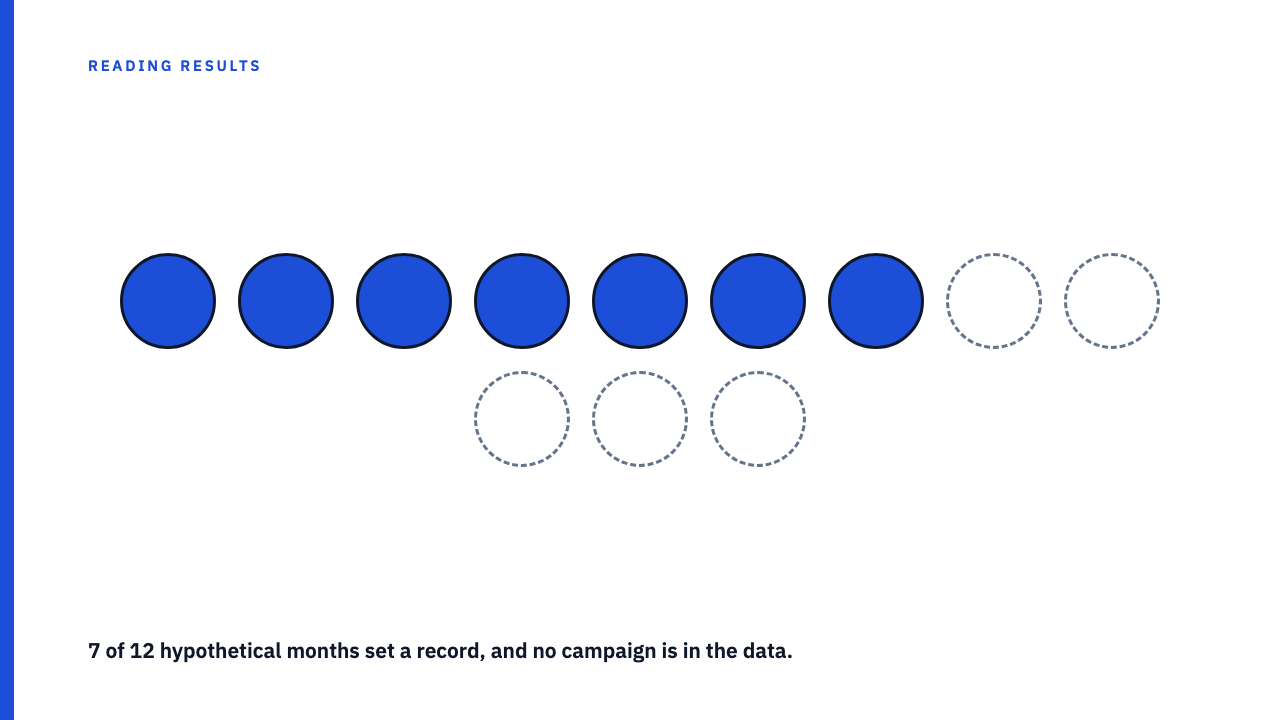
Seven of the twelve months set a record. In month 12 this business could truthfully write “best month on record,” with no campaign in the data. Month 1 counts only because nothing came before it.
The same wobble on a flat 10,000 baseline sets a record in 4 of the 12 months (months 1, 3, 6 and 10), against 7 for the growing one. Growth turns records from occasional into routine. This table is illustrative arithmetic, not a finding about any real business, agency or platform.
What a record is actually measured against
Every record hides a few choices. The first is the window. “Best month ever” means best since the history the writer chose to count, and a record over 8 months is a much lower bar than one over 8 years.
The second is plain chance. With no trend and months that behave like independent draws, the latest of n months has a 1 in n chance of being the highest so far, so records get rarer as history lengthens. Add 1 + 1/2 + 1/3 and so on to 1/12 and you get about 3.1: roughly three records in twelve trendless months, against 7 in the growing series.
The third is the calendar. A metric with a seasonal pattern can set a record in the same month every year, as covered in seasonal tailwinds. Comparing with the same month a year earlier is the usual way to take the calendar out.
The fourth is volume against rate. A total (followers, impressions, revenue) rises with size, so it is the easiest figure to break records on, and cumulative totals can rise while the rate falls. A rate, such as an engagement or conversion rate, does not rise just because the account is bigger, so a rate record asks more of the campaign. Rates can trend too, so this is a distinction, not a rule.
Four questions that separate an impressive record from an inevitable one
Run these in order. If the first has no answer, stop.
- How long is the history? A good answer gives a start date and a stretch long enough to include several flat or down months, so the record had competition.
- What was the trend before the campaign? A good answer shows the prior months, and the record sits clearly above where the earlier line was already heading, not just at the end of it.
- How far past the old best is it? A nudge past the previous high sits inside the metric’s normal noise. A good answer shows a margin that is large next to the ordinary month-to-month wobble in the same series.
- Is the metric a count that grows with the business, or a rate? A good answer is a rate, or a volume measure shown beside audience size or spend so you can see it kept pace.
What a record that means something looks like
In a second hypothetical account, 24 months of sign-ups stay between 9,500 and 10,400 with no upward drift. Then, after a change, the next three months come in at 11,800, 12,100 and 12,300.
The history is long and the trend was flat. The old best of 10,400 is beaten by 1,400, against about 900 points of ordinary wobble. The higher level holds for three months, not one. A record like that is a real signal that something changed.
Even here, it says something changed, not that the campaign caused it. Something else may have moved that month, so next check the category to see whether everyone rose together.
How to rewrite the headline so it says what it can support
The opening line, before and after. As printed: “Our client’s best-performing month on record.” Rewritten: “Highest of the 14 months since launch, 6% above the previous best, after a series that had been rising about 2% a month.” Both are hypothetical. The second gives the window, prior trend and margin, so you can judge the credit yourself. A record is a question to ask, not an answer to accept.
To practise, browse the case study library and run the four questions on each result, or submit your own.
FAQ
Does a ‘best month ever’ mean the campaign worked?
Not on its own. A metric that grows with the business sets records with or without a campaign, as the hypothetical 7 of 12 table shows. It becomes evidence when the history is long, the earlier trend was flat or shallow, and the margin is large next to normal monthly movement.
How often should a growing metric hit a record?
No industry rate is quoted here, and the numbers are illustrative. With no trend, about three records are expected in twelve months, thinning out as history grows. With steady growth they become routine, as in the hypothetical 2% a month series.
Sources
- Record value, Wikipedia (fetched 2026-09-21), definition only.
- Base rate fallacy, Wikipedia (fetched 2026-09-21), general principle only.
- Seasonality, Wikipedia (fetched 2026-09-21), definition of seasonal patterns.