A Great Cost Per Result Can Hide How Few Results There Were
You are three paragraphs into a case study and the agency has led with a single number: four dollars, cost per lead. It reads efficient. What it does not tell you, on its own, is whether that four dollars bought four leads or four thousand.
A ratio has no size until you know its denominator
Cost per lead is not a measurement of a campaign’s size. It is a fraction: total amount spent, divided by the number of leads that spend produced. A four dollar cost per lead can come from forty dollars spent against ten leads just as easily as it can come from four thousand dollars spent against a thousand leads. Those are two different campaigns that happen to divide to an identical result.
The same math applies wherever a report uses the word “per.” Cost per lead, cost per acquisition, cost per click, and what Meta and other ad platforms label cost per result are all built the same way: a dollar figure on top, a count of something on the bottom. None of them state their own denominator inside the ratio itself. That is also why a case study with no stated duration has no rate: a rate needs both halves of its fraction stated before it means anything.
Where the missing count usually hides
The volume figure is rarely hidden on purpose. It is more often simply left off the slide that carried the ratio. A few places to check:
- A headline stat block that states “a four dollar cost per lead” with no adjacent figure for total leads anywhere near it.
- A percentage improvement in cost per result over a prior period, for example “cost per lead down 40 percent,” with neither period’s total volume stated.
- A chart or graphic showing only the cost-per trend line over time, with the underlying count of results left out of the caption entirely.
A cost-per figure presented in any of these forms behaves a lot like a vanity metric used as the headline number: flattering standing alone, and unverifiable until something else is added back to it.
A hypothetical case study, told two ways
Picture two campaigns, both entirely hypothetical, neither a real reported result.
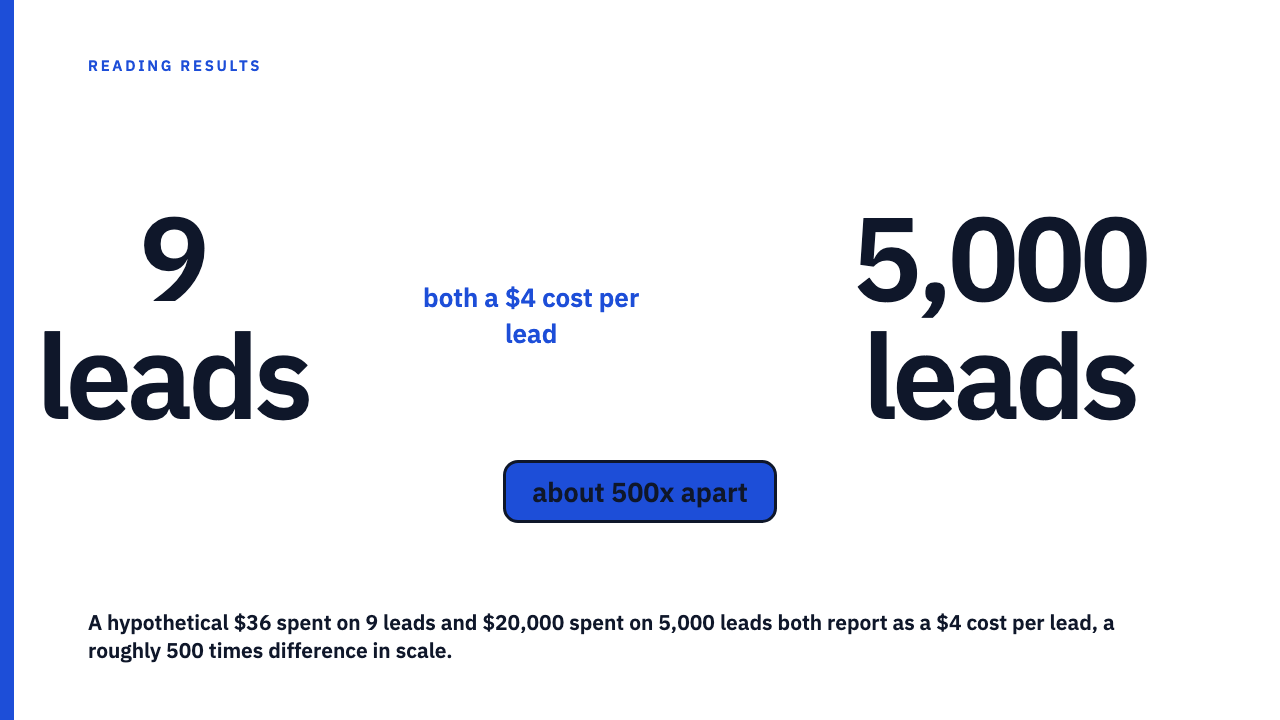
Hypothetical Campaign A ran for nine days. It spent a hypothetical 36 dollars and generated 9 hypothetical leads. Reported the way a lot of case studies report it, that becomes one line: a 4 dollar cost per lead.
Hypothetical Campaign B ran for 90 days. It spent a hypothetical 20,000 dollars and generated 5,000 hypothetical leads. Reported the same way, that also becomes: a 4 dollar cost per lead.
Both are hypothetical, neither is a real case study, and the numbers exist only to make one point: the identical headline figure describes a nine-day trial that produced a handful of leads and a three-month campaign that produced thousands, a difference in scale of roughly 500 times. “A 4 dollar cost per lead” cannot tell you, by itself, which of the two you are reading about.
Why a low cost-per can even be a symptom of low volume
There is a specific reason a low cost per lead from a small, early batch of results should not be mistaken for a number the campaign will hold onto as it grows. Ad delivery tends to spend against the easiest, cheapest to reach part of an audience first, the people already primed to respond, before it has any reason to widen out. As a campaign keeps spending and reaches further from that easy core, into colder segments, the cost of each additional result tends to rise. A cost-per figure taken from the first days of a test is not a smaller version of the eventual, steady-state number. It can be closer to a floor than a plateau.
This is a general mechanism common to paid media broadly, not a claim about any specific platform’s algorithm or any named campaign. It is the mirror image of a point already made on this site: cumulative totals can rise while the rate falls. A rate measured too early in a campaign’s life flatters it for the same reason a rate measured without a stated denominator does.
What to ask before you credit the number
A cost-per figure with no volume attached is not necessarily dishonest. It is incomplete, and incomplete claims can usually be completed by asking. Three questions do most of the work:
- What is the total count of results, leads, acquisitions, or clicks, that sits behind this cost-per figure?
- What is the time window and the total amount spent, so the count can be checked by dividing spend by the stated cost-per?
- Is this cost-per figure for the full campaign, or for a subset window that was chosen after the results were already known?
A true count attached to a cherry-picked nine days is still a different claim than the same count attached to the whole run, which is why the third question matters even after the first is answered.
This library’s own rule on the subject
Every number this library republishes belongs to the agency that reported it. A cost-per figure submitted here is credited to that agency as its own result, never smoothed into an industry benchmark and never restated as this site’s own measurement. The same principle behind the best metric on a dashboard is rarely the real story applies to what gets accepted here: a submission that reports a cost-per figure with no accompanying volume is exactly the kind of gap this site flags in the text, rather than quietly filling in.
See how other agencies report the number
If you want to see how agencies handle this reporting choice with their own numbers on the line, Browse the case study library. If you are holding a cost-per figure and want it read fairly, submit your own.
FAQ
Is a low cost per lead always a good sign?
No. On its own it says nothing about scale. A low cost per lead attached to a tiny total, a handful of leads from a brief or low-budget test, is a different claim than the same figure sustained across a large, ongoing volume. The number needs its count before it means anything.
How can I estimate the volume behind a cost-per figure if it is not stated?
If the case study states total spend along with the cost-per figure, divide spend by cost-per to back into an approximate count. If total spend is also missing, the figure cannot be checked and should be treated as unverifiable rather than assumed to be large.