What a ‘Revenue at 5.38x ROAS’ Headline Actually Tells You
You just read the Vulcan Strength entry in this library. The headline says $77,941 in revenue at 5.38x ROAS, and it is tempting to lift that number straight into a conversation about what good paid social results look like. Before you do, it is worth being precise about what that number actually confirms and what it only implies.
What the Vulcan Strength case study actually states
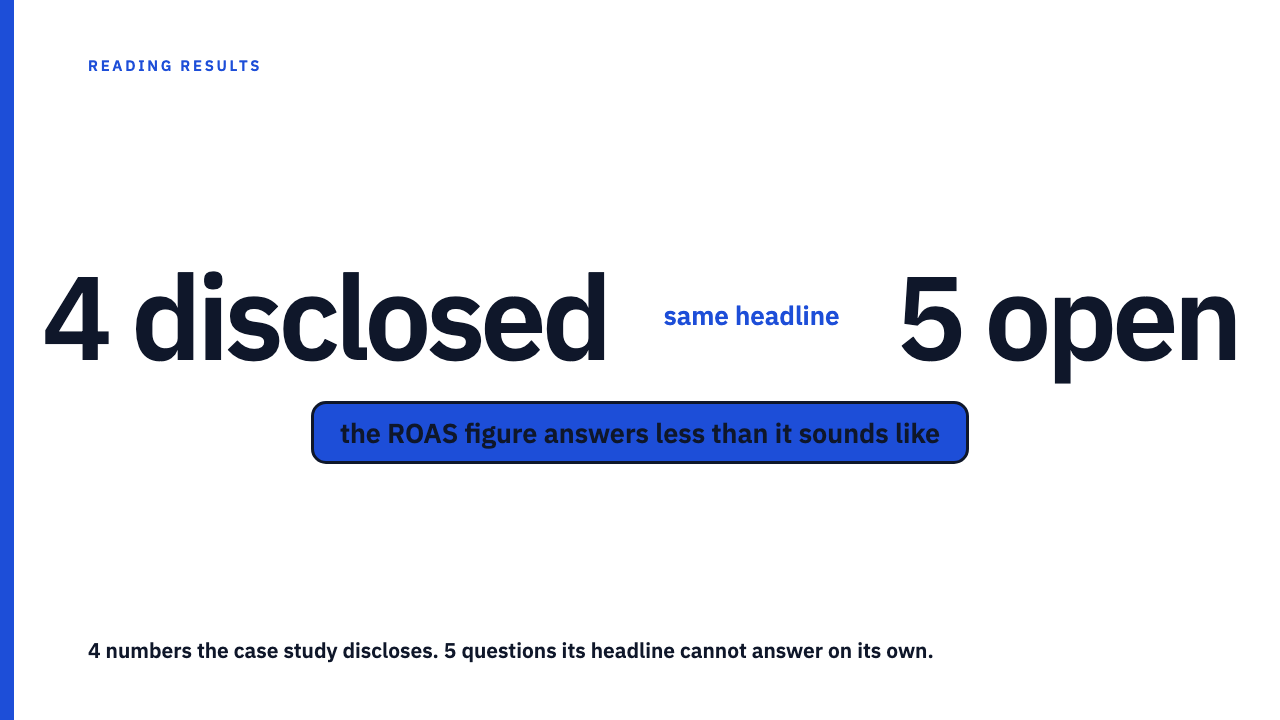
The summary on this site credits LYFE Marketing with four disclosed figures: 55,652 link clicks at $0.21 cost per click, 108 purchases, $77,941 in revenue, and 5.38x ROAS. LYFE Marketing’s own case study page, where this campaign was originally published, states the same four figures under a section it labels “Ad Results,” and adds one more that the shorter summary on this site does not carry: a $14,480 monthly ad budget for the campaign.
Both sets of numbers are the agency’s own reported figures. This site’s entry is a credited summary of a case study LYFE Marketing wrote and published about its own client work, not an independent audit of what happened to Vulcan Strength’s sales. That distinction matters, because the rest of this piece depends on it.
What 5.38x ROAS confirms, on its own terms
ROAS is a ratio of ad spend to attributed revenue, nothing more. A 5.38x figure says that for every tracked dollar of ad spend, $5.38 of tracked revenue followed. That is the whole claim the ratio makes. It says nothing yet about cost, profit, timeframe, or who the revenue came from.
Here is a hypothetical walk through the arithmetic, with no connection to Vulcan Strength’s actual budget. Picture a hypothetical campaign that spends a hypothetical $1,000 on ads and generates a hypothetical $5,380 in tracked revenue from those ads. Divide revenue by spend and you get 5.38, the same ratio reported in this case study. What varies from one case study to the next is everything the ratio leaves out.
One more number can be derived, though not one the agency states directly. Divide the disclosed $77,941 in revenue by the disclosed 108 purchases and you get an average order value of roughly $722. That figure is this writer’s arithmetic on two numbers LYFE Marketing reported, not a figure the agency published itself, and it should not be repeated as though it were.
Five things the headline does not tell you
- Campaign duration. Neither source states how long the campaign ran or over what period the $77,941 accumulated. The retargeting layer reaches site visitors from “the previous four months,” which defines the audience, not how long the campaign itself was active.
- Profit margin. $77,941 in revenue at 5.38x ROAS says nothing about what Vulcan Strength kept after cost of goods, shipping, and the $14,480 monthly spend itself. No margin figure appears on either page.
- Which layer produced the result. The case study names two distinct tactics: cold interest targeting on fitness audiences like CrossFit and kettlebell training, and a separate four month retargeting layer aimed at past site visitors. The results are reported as one combined total, so which layer actually drove the purchases is not visible.
- Attribution model. The case study reports “108 purchases” without naming an attribution window or model. Platform tracked and independently verified are different claims, and neither source says which one this is.
- New versus returning customers. The case study itself notes that Vulcan Strength “was already a well known and established brand” before this campaign began, which makes the missing new-versus-returning breakdown more consequential than it would be for a new advertiser. Neither source discloses that split.
Why this case study is still worth reading, caveats included
None of this makes the entry a bad case study by the standards this library applies. It names the agency, names the client, links to the original write-up, and specifies real tactics rather than vague competence: dynamic product ads, interest targeting on named fitness audiences, and a four month retargeting window. That is more disclosure than a bare headline number usually carries.
The honest bound is this. The page is complete enough to trust as a report of what LYFE Marketing did and what its own tracking recorded. It is incomplete enough that repeating “5.38x ROAS” as a claim about Vulcan Strength’s profitability, or as a benchmark for weightlifting equipment ecommerce generally, goes past what the page actually supports.
Read More Case Studies with This Lens
The gap between what a ROAS figure confirms and what it is often assumed to mean is not unique to this entry. ROAS and profit are different claims covers that gap in general terms. The question of how much weight a self-reported number can bear is covered in how to weigh a self-reported number, and the missing attribution model here is the kind of undisclosed choice discussed in the attribution window is a choice. You can also browse the case study library, or submit your own if you have a credited case study worth adding.
A five-question checklist for the next ROAS headline you read
The five gaps above generalize past this entry. Ask them of any revenue-at-ROAS case study you encounter next:
- How long did this campaign actually run, and over what period did the revenue accumulate?
- What is the margin? Does the revenue figure survive contact with cost of goods and the ad spend itself?
- Is this one campaign, or several distinct tactics reported as a single combined result?
- Is the purchase count platform tracked, or independently verified against a separate system?
- Is the audience new customers, existing customers, or an undisclosed mix of both?
Asking these five questions does not mean the headline number is false. It means the number answers a narrower question than the headline implies, and it is worth knowing exactly which question that is before you repeat it anywhere else.
FAQ
Is the $77,941 revenue figure in the Vulcan Strength case study verified by anyone outside the agency?
No independent verification is disclosed on either the summary on this site or LYFE Marketing’s own case study page. It is a self-reported figure from the agency that ran the campaign. That is disclosed rather than hidden, which is a different thing from being independently audited.
Does 5.38x ROAS mean Vulcan Strength made a profit?
No. ROAS measures revenue against ad spend before cost of goods, fulfilment, and other costs are subtracted, a distinction covered in general terms in ROAS and profit are different claims. For this specific case study, no margin figure is disclosed at all, so profitability cannot be assessed from the page.
Sources
- Vulcan Strength: $77,941 revenue at 5.38x ROAS, Social Case Studies, fetched 2026-09-09
- Vulcan Strength Social Media Advertising Case Study, LYFE Marketing, fetched 2026-09-09