Organic Reach Plus Paid Reach Is Not Total Reach
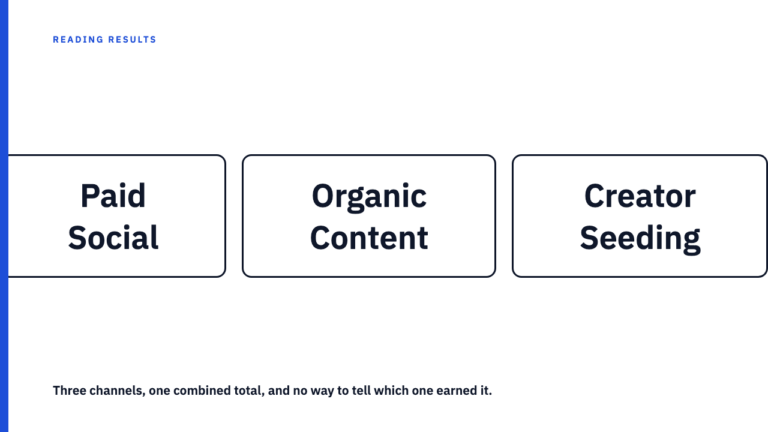
A case study reports two numbers: organic reach and paid reach. Adding them feels like the obvious next step. It is not. Each figure counts distinct people reached through that delivery method, not impressions, and not people who have never seen the brand any other way. Summing them assumes something the case study never states: that nobody in the organic audience also saw the paid version. For a brand running both at once, to the same broad audience, that assumption is almost never true.
The number that looks like arithmetic but isn’t
Reach metrics feel like they should stack cleanly because they are already counts of people, not counts of actions. Organic reach counts the distinct people who saw the brand’s unpaid posts. Paid reach counts the distinct people who saw the brand’s ads. Both can be honestly reported and both still leave out the one thing needed to add them: whether the two groups overlap, and by how much. A case study that lists them as two separate lines has not made a claim about that overlap. Adding them makes the claim silently, and the claim it makes is the one least likely to be true: zero overlap.
Why the same person ends up in both counts
A follower who already sees a brand’s organic posts is also a plausible target for its paid campaign, especially with retargeting, which reaches people already known to the brand, or a lookalike audience built from existing followers. Platforms build paid audiences from signals that already include organic engagers, so overlap is closer to expected than exceptional whenever both run to the same broad audience. That is a structural point about how targeting tools work, not a number any case study discloses.
A hypothetical case, worked in full
This example is entirely hypothetical. No real campaign, agency, or platform produced these figures; they exist only to show the arithmetic.
Picture a case study reporting an organic reach of 1,000,000 people and a paid reach of 800,000 people for the same period. Naively summed, that is 1,800,000. Now suppose, purely as a hypothetical assumption, that the overlap works out to roughly 28 percent of that summed total.
The overlap in people equals that rate applied to the summed total: 28 percent of 1,800,000 is approximately 500,000 people counted twice, once in the organic figure and again in the paid one. The deduplicated total is the sum minus that overlap, not the sum itself: 1,800,000 minus roughly 500,000 lands near 1,300,000 unique people, in this hypothetical.
The naive sum overstated unique people reached by roughly 500,000 in this hypothetical, close to 28 percent of the summed total, without any single figure being false. Every individual number could be accurate and the total still wrong, because the total was never measured. It was an assumption dressed as one.
What actually answers the unique-people question
One figure answers how many distinct people a campaign reached across both channels: a platform’s deduplicated or unique reach metric, sometimes reported as total campaign reach. It is calculated by the platform from its own user-level data, matching accounts or devices across the organic and paid paths, not by adding two channel totals. [EVIDENCE NEEDED: the exact current name for this metric on any specific platform’s reporting interface, confirmed against that platform’s own documentation.]
A reader outside the platform cannot deduplicate organic and paid reach alone, because the overlap rate is not observable from the outside. It depends on who saw the organic posts and who was served the ads, information that lives only in the platform’s own records. Without that combined figure, true unique reach sits at or below the naive sum, no more precise than that.
What to check before you trust a combined reach figure
- Whether the case study discloses a single deduplicated reach figure, or only two channel totals with no combined number.
- Whether a stated “total reach” is explicitly labelled platform deduplicated, or is silently the sum of the organic and paid numbers. The same phrase can describe either.
- Whether organic and paid ran to the same or an overlapping audience during the same window. A campaign aimed at people who do not already follow the brand carries far less overlap risk than one built from retargeting or a lookalike audience seeded by existing followers.
When adding the two numbers is closer to fine
The overlap problem shrinks toward zero when the paid audience is deliberately built to exclude existing followers or already engaged users, something some campaign objectives do on purpose, aiming at cold prospects rather than the brand’s own base.
Even then, the sum is an upper bound, not a measurement, unless the case study confirms the exclusion held. Targeting settings describe intent; they do not guarantee no one slipped through both paths. A case study stating the exclusion and confirming it held is more rigorous than one that reports two numbers and leaves the reader to assume the best.
Read the next one with this in mind
Related reading: how to read a marketing case study without being misled, read a results chart before you read the caption, and this problem’s mirror image, an organic result with paid spend behind it. You can also browse the case study library or submit your own.
FAQ
Is it ever correct to add organic reach and paid reach?
Only as a rough upper bound, never as a measurement of unique people reached. The sum equals unique reach only in the practical limit of zero overlap, uncommon when both run to the same brand’s existing audience. Without the platform’s own deduplicated figure, a reader cannot verify the overlap rate, so treat the sum as a ceiling, not an answer.
Why don’t case studies just report deduplicated reach instead of two separate numbers?
Channel level reach is what each platform’s reporting view surfaces most readily, and it makes each channel’s contribution visible. A single deduplicated total requires the platform to compute reach across both delivery methods at once, matching people rather than adding totals, and not every reporting view a case study draws from provides that figure.
What is a typical overlap rate between paid and organic reach?
There is no general figure to cite here. Nothing in this site’s first party data supports a typical or average overlap rate, and none should be implied. Overlap depends on how that campaign’s paid audience was built and how much it shares with the organic audience. Check what the specific case study in front of you discloses, rather than borrowing a rate from anywhere else.