A Case Study Written for an Award Judge Isn’t Written for You
You are part way through a published case study and its shape feels odd. A heading called Objective. Another called Insight. The results are one short block near the bottom, one number in bold, and nothing about how long it took. That page probably began life as an award submission, and the form is still doing the work.
The rubric writes the outline before the agency does
Entry forms for marketing and advertising awards are commonly built around a fixed set of fields. Wording varies, but the sequence is close to standard: objective, strategic insight, execution, then results. Each field usually carries a word or character limit, tight enough that context gets cut for space, not for editorial reason.
That form exists for a good reason, just not your reason. A judge reads many entries in one sitting, comparing entry seven with entry forty on the same axes.
The problem starts later. Republishing a finished entry costs almost nothing, so the headers get pasted across intact and the judge-facing shape lands in front of a reader who was never its audience.
What the reader loses when the audience is a judge
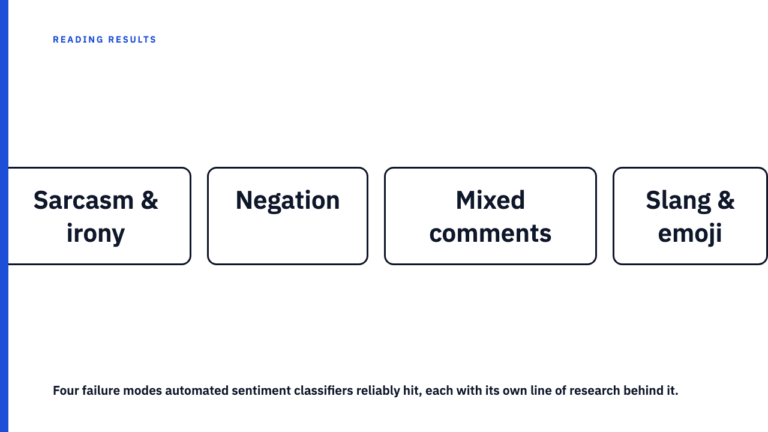
Two habits cause most of the trouble. The first is the headline metric. A results field with a hard character limit rewards the single most flattering number, because a skimming judge registers the outcome in about a second. Timeframe and base rate go first: both shrink the number and neither earns points.
The second is the objective field. It asks what the campaign set out to do, and is filled in after the campaign finished. A campaign that moved saves rather than sales can be entered with an objective about building consideration, and the result is coherent and unfalsifiable, a plan fulfilled because it was written backward from the fulfilment.
Scoring an entry against criteria and deciding whether an approach would hold up in your own situation are two different acts. The same paragraph can serve one well and the other badly, and nothing on the page tells you which you are holding.
A hypothetical, side by side: same result, two write-ups
What follows is HYPOTHETICAL. The numbers are invented, belong to no real campaign, and should not be quoted anywhere. Call the agency Agency A and the client a regional food retailer.
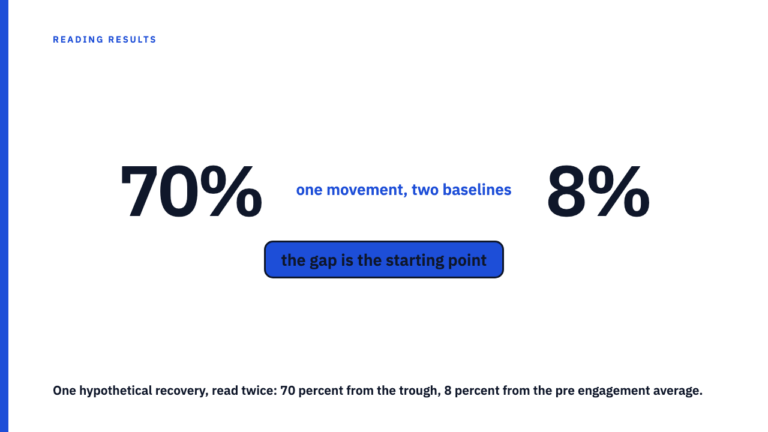
The plain version: Agency A ran a short video programme over fourteen weeks in one of four test markets. That market started at a 1.2 percent conversion rate on the retailer’s store and finished at 1.9 percent.
The entry version reads: a 58 percent conversion lift, and the most inventive use of short form video in the category that year. That is all of it, and the number does follow from 1.2 to 1.9. Gone are the fourteen weeks, the starting point, and the one market out of four. What arrives is a superlative and a category framing.
Both versions could be describing the same underlying result, which is the entire point. The format changed, not necessarily the outcome, but your ability to evaluate it certainly did.
Signs you are looking at an entry, not a report
All are visible on the page:
- A named award, show, or submission category in the body, the credits, or a badge near the title.
- Section headers that match rubric fields rather than a narrative: Objective, Insight, Idea, Execution, Results.
- Superlative and competitive language doing a number’s job: first, biggest, only, most, boldest.
- Short paragraphs with a trimmed feel, written to a character count rather than a natural length.
- No stated campaign duration and no starting baseline anywhere, because most entry forms require neither.
What this does not tell you
Whether the work was good creative work is a craft judgment, a different question from whether this page tells you what actually happened. Excellent work can be written up so a reader can check nothing.
An entry-shaped case study is also not automatically less honest. It was shaped for a different reader, and its omissions are structural more than deceptive. It is not exempt: the numbers need the same checks as any other case study, and the format makes them harder. The general method is in how to read a marketing case study, and every case study library is a selected sample before entries add another layer of selection.
Before you borrow the number, ask this
- What timeframe does the headline number cover? Entry forms rarely require one, so its absence says more about the form than the campaign.
- What did it start from? A baseline is optional on most entry forms and the first casualty of a character limit. A percentage with no starting value can describe almost any result.
- Was the objective set beforehand or written afterward? One that maps neatly onto the single metric reported reads better as a description of the outcome than a statement of intent.
- Did the category shape which metric got the headline? An entry competing on inventiveness of format leads with the number that supports inventiveness of format, not necessarily the one the client cared about. That is the trap in why the best metric on a dashboard is rarely the real story, and what backs up a case study number covers the sourcing question underneath.
Read a few and the pattern gets obvious
This site republishes case studies with full credit to the agency that produced them, 10 case studies so far alongside 22 blog posts. Read several in a row and the entry-shaped write-ups separate from the plainly reported ones. Browse the case study library, or submit your own and include the duration and baseline.
FAQ
Does a case study being written for an award mean the numbers are fake?
No. It means the emphasis and structure were chosen to fit a judging rubric, not that anything was fabricated. Check what you would check on any case study: timeframe, baseline, and scope. They deserve extra attention because the entry format makes them easiest to leave out.
Is this the same as saying the campaign did not deserve to win?
No. Whether the work deserved recognition is a craft judgment this site does not make. This piece is only about what the entry format does to the claims on the page.
Sources
- How to Read a Marketing Case Study Without Being Misled, fetched 2026-09-07.
- A case study number is only as good as what backs it up, fetched 2026-09-07.
- Every Case Study Library Is a Selected Sample, fetched 2026-09-07.
- Why the Best Metric on a Dashboard Is Rarely the Real Story, fetched 2026-09-07.