What We Ask Before a Case Study Goes Into This Library
An agency reads through this library, finds a case study format that matches its own recent work, and wonders whether that write-up would get published here. A reader who already trusts an entry wonders something adjacent: what did this site check before it went up. Both questions have the same answer, and it has almost nothing to do with how strong the result looks.
The bar is not persuasion, it is provenance
This library republishes work agencies have already published themselves, with credit back to the source. It does not commission case studies, and it does not independently audit the campaign data behind any of them. A result can be dramatic, well designed, and completely uncheckable, all at once.
There is a difference between a case study being impressive and a case study being traceable, and only the second is something an editorial standard can test. Impressive is a judgment about the number itself. Traceable is a judgment about whether the claim connects back to something the agency already put its own name on in public. This library can check that in an afternoon. It has no way to check whether the result is genuinely impressive, since that would require the underlying campaign data, and nobody submitting hands that over.
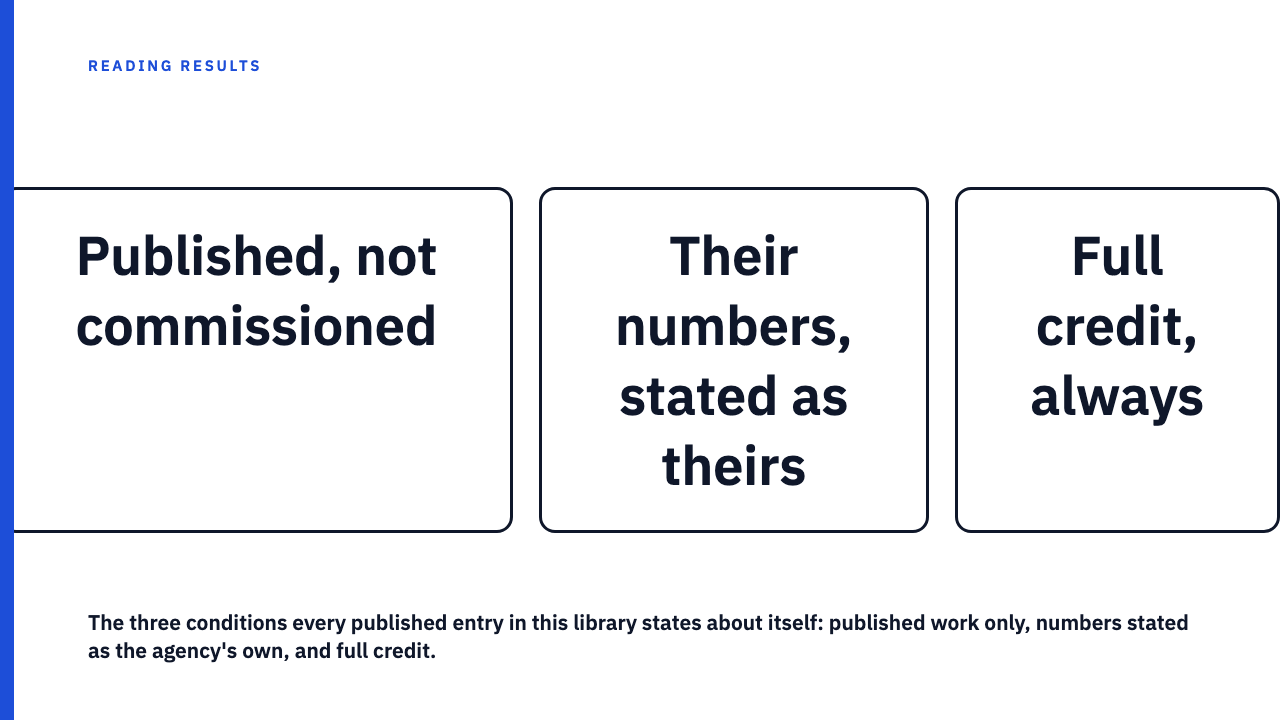
The three conditions this library states about itself
The homepage’s “How this library works” section states three conditions, each ruling something specific out.
- Published work only. The site’s own language: “Every entry comes from a case study the agency published themselves. We collect, we do not commission, and we never paraphrase private numbers.” This rules out a result relayed secondhand, a screenshot forwarded without context, or a strong number never written up anywhere the agency controls. No existing public document means nothing to republish, no matter how credible the person describing the result sounds.
- Their numbers, stated as theirs. The site’s own language: “The headline metric is the figure the agency reported. We summarise the work and attribute it, so you can weigh the claim yourself.” The number is always the agency’s reported figure, never restated as this library’s own finding and never generalised into an industry benchmark. That framing is what a reader needs to weigh the number correctly: a self-reported figure carries different weight than a verified, audited result, and blurring that distinction would make every entry read as more certain than it is.
- Full credit, always. The site’s own language: “Each entry names the agency and links to their original write-up. Ask us to amend or remove yours and we will, no questions asked.” Every entry has to trace to a named agency and a live link. A case study that cannot be credited, because the agency will not be named or does not want it linked, does not belong here regardless of the number. Credit is what lets a reader check the original, not a courtesy to the agency.
A submission that would not clear this, hypothetically
Picture a hypothetical submission: an agency, call it Meridian Social for the sake of the example and only for the sake of the example, sends in a write-up claiming a client’s engagement rate tripled over a quarter. The number is not implausible. Quarters like that happen. But when asked for the original public write-up, there is not one. The figure lives only in a slide deck used in new-business pitches.
That submission fails condition one, published work only, before condition two or three even matter. It does not matter that the number sounds reasonable or that the agency answers questions in good faith. Nothing about “Meridian Social” is a real agency and nothing about the tripled engagement rate is a real reported figure. The example exists only to show what published work only excludes: a claim with no independent public existence, no matter who is vouching for it.
Why the bar being narrow is the point
A library like this is only useful if every entry cleared the same gate before it went up. The moment one exception gets made, for an agency with an unusually good story and a thin paper trail, the reader loses the one thing this library offers: the knowledge that whatever they are looking at was published by the agency itself and can be checked against that original. A narrow, mechanical bar makes that guarantee possible, and it is worth looking through the case studies already in the library to see what that bar looks like once cleared.
Clearing this bar is not the same as the underlying number holding up. Passing the three conditions is an admission decision, not a verdict on whether the result survives the scrutiny the rest of this site teaches: baseline, window, sample size. An entry can clear provenance cleanly and still be one a careful reader should treat with skepticism once they read it closely. This piece is about getting in the door. A case study number is only as good as what backs it up is about what to do once you are looking at the number itself.
What this means if you are the one submitting
Three things follow directly from the conditions above.
- Have your own public write-up ready to link to. The case study has to already exist somewhere the agency controls, a blog post, a press release, a portfolio page, before it can be submitted. Writing it for the first time as part of the submission is what condition one rules out.
- Be ready to be credited by name, with a link back to that write-up. An anonymous submission, or one where the agency would rather not be named, does not fit condition three no matter how strong the result is.
- Expect the headline number to run as your reported figure, not as something this site vouches for independently. If the write-up frames the number as an industry benchmark, expect that framing corrected to match what you actually published.
Once a write-up meets those three conditions, submit your own through the site’s form.
FAQ
What kind of submission would not be accepted here?
One with no existing public write-up, no matter how strong the underlying number is. Published work only rules that out before the number or the credit question ever comes up.
Is a well-known agency name enough to get a case study in?
No. A recognisable name does not substitute for a traceable source. The same three conditions apply regardless of who submits, and reputation does not create a public write-up where none exists.
Sources
- Social Case Studies homepage, “How this library works” section, fetched 2026-09-09.