Average Watch Time Is Meaningless Without the Video’s Length
A case study opens with a line like this: average watch time up 40 percent after the new hook. Or simply: 45 second average watch time. Nothing in that number says whether 45 seconds was almost the whole video or a slice off the front of it. Until you know how long the video ran, you are not reading a result. You are reading a duration with a story attached.
The number that gets quoted, and the number that gets left out
The pattern is specific enough to spot at a glance. The headline stat is either a raw duration (“average watch time of 45 seconds”) or a percent change in a duration (“watch time up 40 percent”). Near it sits a causal claim about craft: the new hook, the faster cut, the reworked opening. And nowhere in the same paragraph, chart, or footnote does anyone say how long the video was.
That omission matters because watch time is not a self-contained metric. A view count stands on its own. Average watch time does not: it is a piece of something, and the size of the something is not printed on the piece.
Why the same 45 seconds can mean opposite things
What follows is a hypothetical, invented for illustration. The numbers belong to no agency, platform, or published case study.
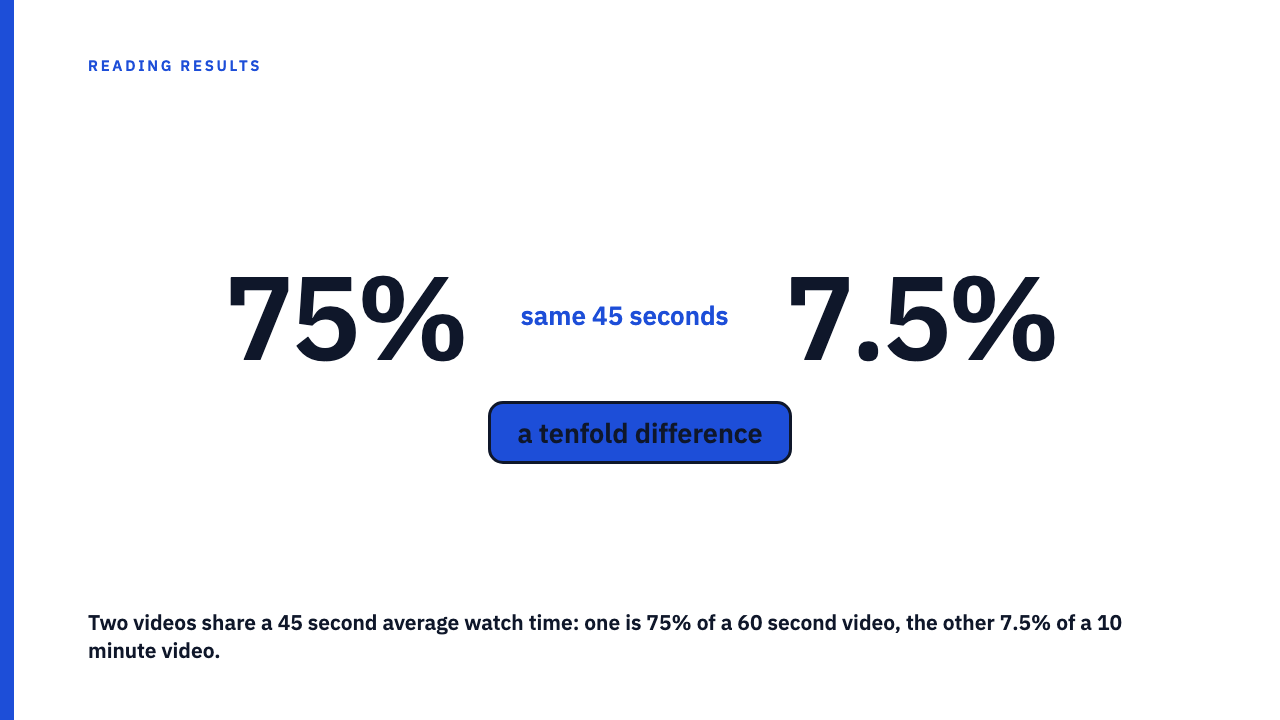
Picture two videos from a hypothetical furniture brand, both reporting an average watch time of 45 seconds. The first runs 60 seconds: 45 divided by 60 is 0.75, so the average viewer watched 75 percent of it and stayed nearly to the end. The second runs 10 minutes, which is 600 seconds: 45 divided by 600 is 0.075, so the average viewer watched 7.5 percent and left inside the first minute.
Identical headline figures. A tenfold difference in what happened on the screen. Report the 45 seconds without the runtime and the reader cannot tell which of the two they are being shown: a video that held attention, or one that lost it early and was long enough that the abandoned watching still added up to a respectable sounding number.
Completion rate is the number that actually locates the claim
Completion rate is average watch time divided by video length, expressed as a percentage. That ratio stays comparable when the format changes. Raw seconds do not, because they are measured against a denominator that moves from video to video while the reported figure pretends it does not. The same trap appears in an earlier piece on how a rate can move for reasons that have nothing to do with the total, applied here to one metric family.
Completion rate is not the end of the argument either. A 15 second clip watched in full and a 10 minute video watched to 75 percent are both high completion rates, and they describe different kinds of attention: seven and a half minutes of someone’s evening against fifteen seconds of a scroll. Neither is automatically better. Completion rate tells you what fraction was consumed, not that two very different formats belong in one column.
Questions to ask before crediting the edit or the hook
When you hit a watch time claim, four questions will usually tell you whether there is anything under it.
- How long was the video, in seconds or minutes? Not “short-form” and not “long-form”. A stated runtime. Those labels cover a range wide enough to swing a completion rate by an order of magnitude.
- Is the reported figure a duration or a percentage, and does the document keep them straight? Watch for a paragraph that opens with “average watch time of 45 seconds” and closes with “a 45 percent retention rate”, as though those were one measurement restated.
- Does the platform count replays or loops toward the reported average? Treat it as a question for whoever wrote the case study, not an assumption either way. If replays are counted, a figure at or above the runtime becomes possible, describing rewatching rather than first viewing.
- Are the videos being compared the same length? A before and after only reads as an improvement if the denominator held still. A shorter follow up will structurally show a higher completion rate with no change in editing at all.
A completion rate on its own is not proof of a good hook either
The failure mode after reading this far is to demand completion rate, get it, and then trust it the way the raw duration was trusted a paragraph ago. Completion rate moves for reasons that have nothing to do with editing. Cutting the runtime raises it mechanically. A different placement changes who arrives and how ready they are to stay. An account whose followers already know the format will hold them longer than a video shown mostly to strangers, and neither result is a verdict on the cut. This is the habit described in the note that the best metric on the dashboard is rarely the whole story.
None of this judges the edit. Whether the hook was well made and whether the pacing was earned are craft questions, and this piece is not answering them. The question here is narrower. Does the number on the page support the claim printed beside it, or does it need a second number that nobody supplied?
Read the next case study with the denominator in mind
Every entry in the library is credited to the agency that produced it, and its numbers are theirs. Reading a few with the runtime question in hand makes the habit stick. Browse the case study library, or submit your own. The wider skill this piece narrows down sits in the overview on how to read a marketing case study without being misled.
FAQ
What is the difference between average watch time and completion rate?
Average watch time is a raw duration: the seconds watched, on average, across viewers. Completion rate is that duration divided by the video’s total length, expressed as a percentage. The first means very little until the second sets it against the length of the thing being watched.
Why would a shorter video naturally show a higher completion rate?
Completion rate is watch time over length, so shrinking the length raises the ratio even when nothing about the content changed. A case study setting a new short video’s completion rate against an older, longer video’s is comparing two denominators and calling the gap an improvement. Ask for videos of comparable length first.